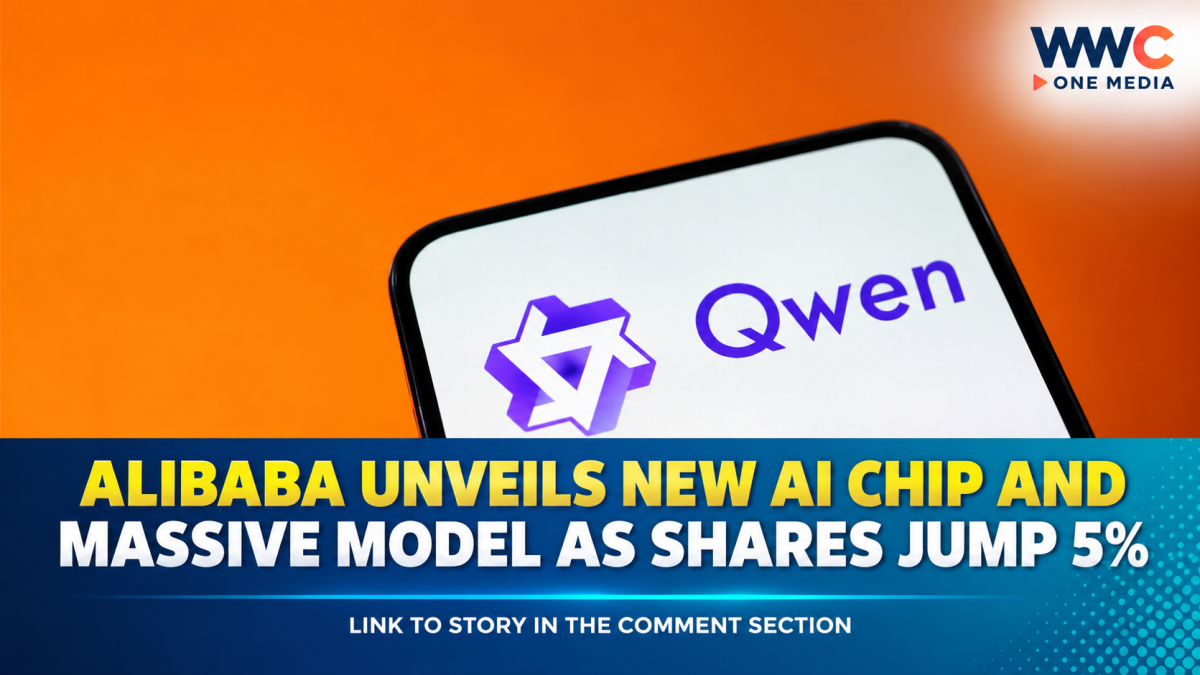
Alibaba is stepping up its artificial intelligence ambitions with a new homegrown AI processor and plans for a model that could reach as many as 10 trillion parameters, sending the Chinese technology giant’s Hong Kong-listed shares up more than 5% on Sept. 22.
The announcements were made at Alibaba Cloud’s annual Apsara Conference in Hangzhou, where the company outlined a strategy covering AI models, chips, data centres and AI agents. The move comes as Chinese technology companies accelerate efforts to develop domestic alternatives to advanced Nvidia processors amid tighter US restrictions on high-end chip exports to China.
Alibaba said its Qwen team is developing a new generation of models that could eventually scale to between 5 trillion and 10 trillion parameters. That would be up to four times the size of its current flagship Qwen 3.8 Max, which has about 2.4 trillion parameters.
The company said the larger models are intended to handle increasingly complex and longer-running tasks as Alibaba pursues what it describes as artificial superintelligence. Its next-generation Qwen 4 is already being trained, with future versions expected to scale further.
At the same time, Alibaba unveiled the Zhenwu V900, a new AI chip developed by its T-Head semiconductor division. Alibaba says the processor delivers three times the performance of its predecessor and can be linked into clusters containing as many as 500,000 chips for training and running large AI models.
Mass production and commercial release are expected in the first quarter of 2027, meaning the chip’s actual market impact will depend on manufacturing and deployment over the coming months.
Alibaba is also expanding the computing infrastructure needed to support its AI ambitions. Chief executive Eddie Wu said Alibaba Cloud aims to push its global data-centre capacity beyond 20 gigawatts by 2032, while the company expects strong demand for AI computing from customers.
Wu said supply constraints are currently limiting how quickly Alibaba Cloud can expand, with the company preparing to bring AI supernodes into commercial operation at scale.
Investors responded quickly to the announcements. Alibaba’s Hong Kong-listed shares rose 5.1% to their highest level in about a month, while its US-listed shares also moved higher in premarket trading.
The developments also arrive at a sensitive moment for the global technology industry. Chinese companies are attempting to strengthen their domestic AI supply chains while US export controls continue to restrict access to some advanced semiconductor technologies.
For Alibaba, the strategy represents a push beyond simply building AI applications. The company is attempting to control more of the underlying technology stack — from the chips that provide computing power, to the models that process information, to the cloud infrastructure used to deploy them.
The scale of Alibaba’s planned models and the performance claimed for the V900 are significant, but the longer-term impact will depend on whether the company can turn those announcements into commercially available hardware, large-scale computing capacity and AI systems capable of delivering results in real-world applications.