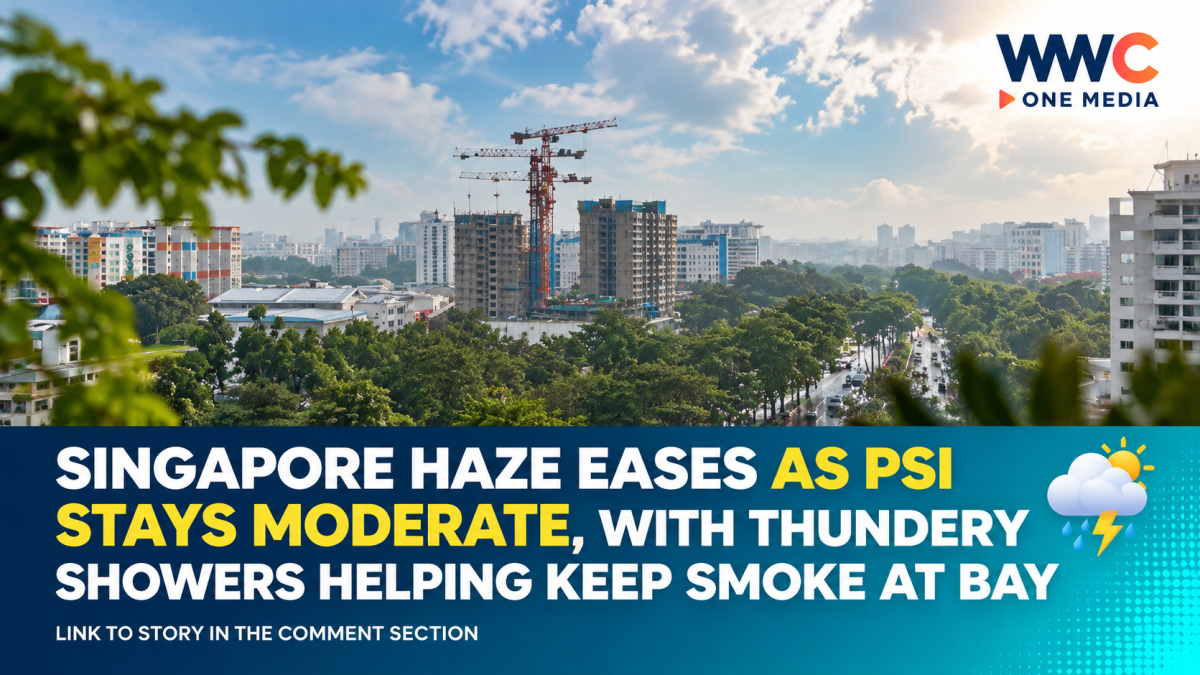
Singapore’s air quality remained in the moderate range on Sept. 22 as afternoon thundery showers helped limit the impact of smoke haze drifting from fires in parts of Indonesia.
At 6pm, the 24-hour Pollutant Standards Index (PSI) across Singapore’s five regions ranged from 59 to 77, with the central region recording the highest reading at 77. All five regions remained within the moderate range.
The one-hour PM2.5 readings were also in the normal Band 1 range across the island, measuring between 11 and 21 micrograms per cubic metre at 6pm. The National Environment Agency (NEA) advises residents to use the one-hour PM2.5 reading when deciding on immediate outdoor activities, while the 24-hour PSI is more useful for planning activities for the following day.
The improvement follows a spell of more unsettled weather. Moderate to heavy thundery showers affected various parts of Singapore during the afternoon, while showers were also recorded over northern and central Sumatra.
Despite the improvement, haze remains a regional concern. Dry conditions continued over parts of Kalimantan and southern Sumatra, where moderate to dense smoke plumes from fires were observed.
Singapore had experienced a more serious deterioration in air quality earlier in September. Several regions entered the unhealthy range during the month, with the central region reaching particularly high PSI readings as smoke from fires in Sumatra and Kalimantan drifted towards the island.
The latest forecast, however, points to continued moderate conditions. More showers are expected over Singapore and surrounding areas on Sept. 23, which could further reduce the risk of smoke haze affecting the island. The NEA forecasts the 24-hour PSI to remain in the moderate range.
Under Singapore’s health guidance, normal activities are generally appropriate when the 24-hour PSI is moderate. If the PSI reaches the unhealthy range, people are advised to reduce prolonged or strenuous outdoor physical activity.
For now, the combination of rain and shifting regional weather conditions is giving Singapore some relief from the haze — but ongoing fires and dry conditions in parts of Indonesia mean air quality can still change quickly.