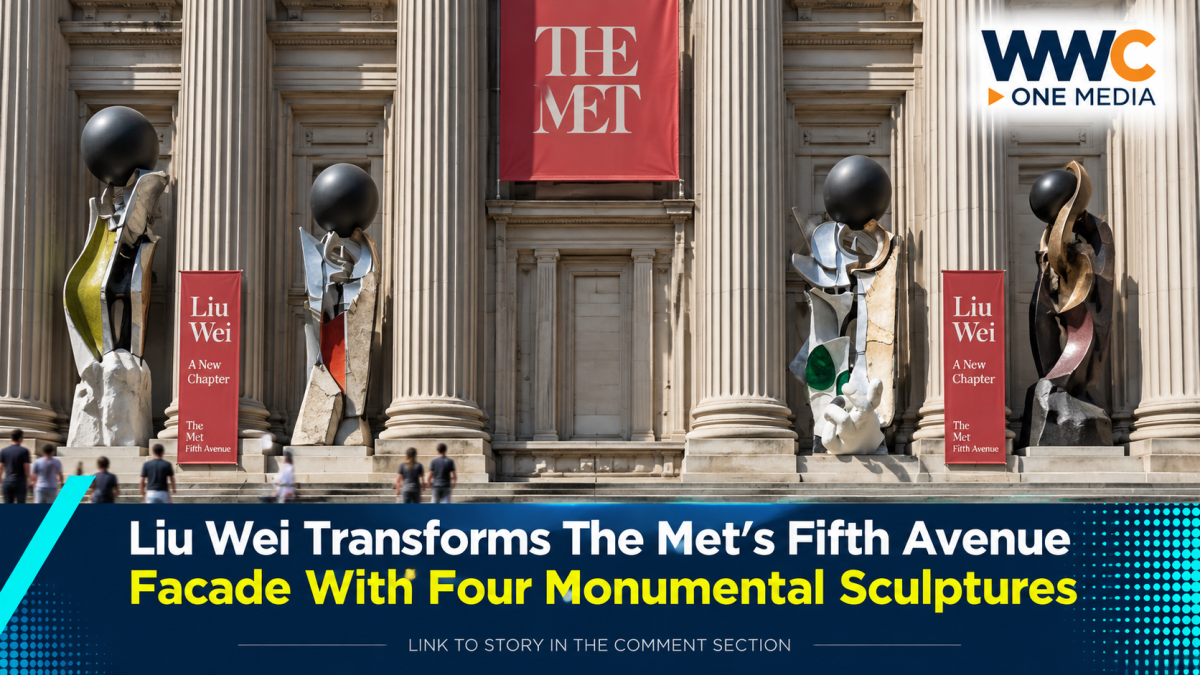
NEW YORK — The iconic Fifth Avenue facade of The Metropolitan Museum of Art has been dramatically transformed as Beijing-based contemporary artist Liu Wei unveils four monumental sculptures for the museum’s 2026 Genesis Facade Commission.
Titled “The Genesis Facade Commission: Liu Wei, Speculation,” the installation opened Sept. 17 and will remain on view through June 8, 2027. The project marks Liu Wei’s first major presentation at a U.S. institution and the seventh commission in The Met’s ongoing facade series.
Presented in partnership with Korean luxury automaker Genesis, the project places contemporary sculpture directly against the museum’s Beaux-Arts architecture, creating a striking visual contrast between New York’s historic cultural landmark and Liu’s fragmented, futuristic forms.
Four Giant Sculptures Take Over The Met’s Facade
The installation consists of four works:
- “Speculation / Λ”
- “Speculation / G”
- “Speculation / c”
- “Speculation / h”
The sculptures occupy the large niches along The Met’s Fifth Avenue exterior.
The two central works are especially imposing, while the outer sculptures are comparatively more delicate. Together, they combine organic shapes, geometric structures and references to architecture, monuments and the human body.
One recurring element throughout the series is the human hand, which Liu uses as a visual link between familiar human forms and more abstract, fantastical structures.
The result is deliberately difficult to categorize: part architectural fragment, part bodily form and part imagined object.
Liu Wei Turns “Rupture and Repair” Into Sculpture
The exhibition’s title, “Speculation,” reflects Liu’s interest in uncertainty, transformation and the way societies continually rebuild themselves.
The Met describes the project as an exploration of fragmentation, transformation and renewal, with the sculptures reflecting cycles of rupture and repair experienced by individuals, cities and societies.
Liu’s approach also draws on his experience of living through rapid modernization and social change in China.
Rather than creating sculptures that simply imitate historical forms, he takes recognizable fragments and reconfigures them into unexpected combinations.
That process is central to the artist’s practice and gives the facade installation its unusual appearance.
A Mix of Industrial and Organic Materials
The sculptures combine a wide range of materials, including fiberglass composite, steel, aluminum alloy, polyurethane paint and bovine rawhide, with some works incorporating additional materials such as bronze, rope and other elements.
The mixture reinforces Liu’s interest in bringing apparently unrelated objects and textures together.
The New York Times described the installation as an array of visual references ranging from Cubist and Expressionist forms to futuristic, digitally inspired shapes, emphasizing the contrast between the sculptures and the classical architecture behind them.
Why The Met’s Facade Matters
The project is part of The Met’s annual facade commission, which began in 2019 and invites contemporary artists to create works specifically for the museum’s Fifth Avenue exterior.
The commission is designed to establish a dialogue between contemporary art, The Met’s historic architecture, its vast collection and the millions of people who encounter the building from Fifth Avenue.
Previous artists have included Lee Bul and Jeffrey Gibson, whose commissions similarly introduced contemporary perspectives into the museum’s historic exterior.
Liu’s project is the third commission presented through the multiyear partnership between The Met and Genesis, following the earlier presentations under the program.
Liu Wei Makes U.S. Museum Debut
Born in Beijing in 1972, Liu Wei has worked across photography, painting, video, sculpture and installation since the late 1990s.
His work has appeared in major exhibitions and institutions in China and internationally, including presentations in Beijing, Shanghai, Seoul and Cleveland.
The Met commission represents his first major institutional project in the United States.
The museum also describes Liu as an important figure among a generation of Chinese artists who sought to develop their own approaches to conceptual art while responding to contemporary social and cultural realities.
Genesis Expands Its Art Partnership With The Met
For Genesis, the Liu Wei project is part of a broader cultural strategy connecting the automotive brand with major artists and international cultural institutions.
The Genesis Facade Commission was established in 2024 as a multiyear partnership with The Met.
The initiative gives artists an unusually visible platform: instead of being displayed inside galleries, their works occupy one of New York’s most recognizable museum facades.
Genesis said its wider Genesis Art Initiatives include cultural programs with institutions such as the Los Angeles County Museum of Art and South Korea’s National Museum of Modern and Contemporary Art.
A New Conversation Between Ancient History and Contemporary Art
The striking aspect of Liu Wei’s installation is not simply its scale.
It is the collision between old and new.
The Met’s Fifth Avenue building evokes centuries of artistic and architectural traditions, while Liu’s sculptures deliberately break apart familiar visual references and rebuild them into something unfamiliar.
That tension is at the heart of “Speculation.”
The sculptures ask viewers to consider how familiar structures—whether architectural, social or cultural—can be dismantled, transformed and reconstructed.
And because the works face one of the busiest avenues in New York, that conversation is happening not only inside the museum but directly in the public space outside it.
The Exhibition Runs Into 2027
“The Genesis Facade Commission: Liu Wei, Speculation” is now on view at The Met Fifth Avenue and is scheduled to remain on the exterior facade until June 8, 2027.
The installation gives New Yorkers and visitors an opportunity to encounter Liu Wei’s work without needing to enter a conventional gallery setting.
For The Met, it is another example of how its historic facade can become a living canvas for contemporary art.
For Liu Wei, it represents a major U.S. institutional debut—and an opportunity to place his ideas about fragmentation, transformation and renewal directly in front of one of the world’s most recognizable museums.