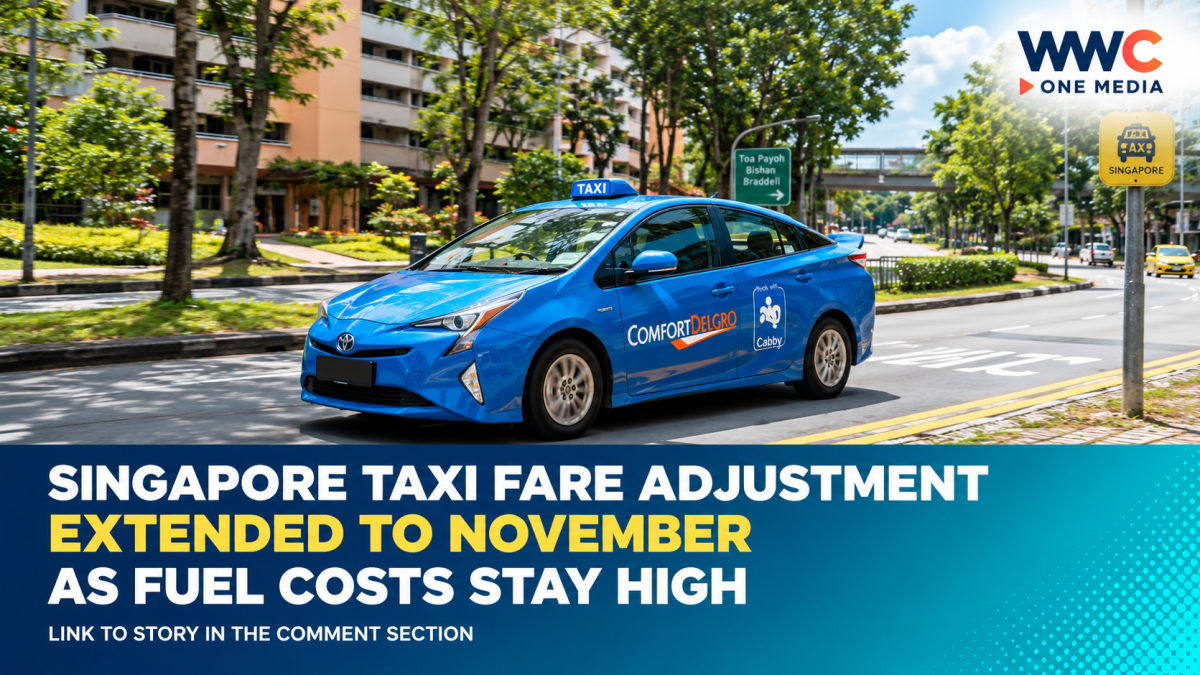
Singapore taxi passengers will continue paying temporarily higher metered fares until Nov. 30, after ComfortDelGro and Strides Premier extended their fare adjustments for another two months.
The measures were originally introduced in March to help taxi drivers cope with rising fuel and operating costs. They were initially scheduled to end on May 31, but were subsequently extended to July 31 and then Sept. 30.
Under the extended arrangement, the distance-and-time rate remains one cent higher than the usual rate.
For ComfortDelGro, the rate is S$0.27 for every 400m travelled up to 10km, every 350m after 10km, or every 45 seconds of waiting for regular and larger taxis. Limousine taxis are charged S$0.39 at the corresponding intervals.
ComfortDelGro will also continue its temporary driver fee for eligible fixed-fare bookings. The fee is S$0.50 for fares below S$15 and S$0.80 for fares of S$15 or more. The company said the full amount collected goes directly to drivers to help offset fuel expenses.
Strides Premier is also extending its one-cent increase. Its affected taxis will continue to charge S$0.27 for every 400m up to 10km, every 350m beyond 10km and every 45 seconds of waiting. The operator said the additional amount will likewise be passed directly to its driver-partners.
The extension comes after another sharp increase in Singapore fuel prices. The price of commonly used 95-octane petrol rose from about S$3.36 per litre on Sept. 13 to as much as S$3.49 by Sept. 20, adding further pressure to drivers whose earnings are closely tied to fuel and vehicle operating costs.
The latest extension means commuters will continue to see the temporary adjustment for two more months, even though the increase per distance or waiting interval is relatively small.
For longer journeys or trips affected by traffic, however, the additional one-cent charges can accumulate across multiple billing intervals. App-booked fixed-fare journeys may also carry the separate driver fee where applicable.
The operators have framed the measures as temporary support for drivers rather than permanent changes to their underlying fare structures. With fuel prices remaining volatile, the duration of the adjustments will continue to depend on operating-cost conditions.