Taiwan has become one of the most sensitive issues in China’s foreign policy, touching on questions of sovereignty, national identity, military strategy and the wider balance of power between Beijing and Washington.
For Beijing, Taiwan is not viewed simply as a separate political entity across the Taiwan Strait. China considers the island part of its territory and says reunification is a national objective, while maintaining that it prefers peaceful reunification but has not ruled out the use of force. Taiwan, which has its own democratically elected government, rejects Beijing’s sovereignty claim.
The roots of the dispute go back to the Chinese civil war. After the Communist victory in 1949, the defeated Republic of China government relocated to Taiwan, while Mao Zedong established the People’s Republic of China on the mainland.
Since then, Taiwan and mainland China have developed separate political systems. Beijing regards the separation as unfinished business from the civil war, while Taiwan has evolved into a self-governing democracy with its own government, military and institutions.
For China’s Communist Party leadership, the Taiwan issue is also closely connected to the country’s concept of national rejuvenation and territorial integrity. Beijing regularly objects to foreign governments treating Taiwan as a separate country or expanding official contacts with Taipei.
That is why Taiwan can become a particularly sensitive issue whenever China deals with the United States.
Washington does not maintain formal diplomatic relations with Taiwan, but US law requires the United States to make defensive weapons available to Taiwan. Beijing strongly opposes those arms sales and argues that they interfere in what it regards as an internal Chinese matter.
The issue is especially prominent this week because Chinese President Xi Jinping is expected to raise Taiwan with US President Donald Trump during their upcoming Washington summit. China is expected to press Washington over American arms sales to Taiwan, while US officials continue to debate future security assistance.
Taiwan’s strategic importance also extends beyond politics.
The island sits along major sea and air routes in the western Pacific, making its location important to regional security. Any serious military confrontation around Taiwan could affect neighbouring countries, commercial shipping, financial markets and supply chains across Asia.
Taiwan is also central to the global semiconductor industry. Its technology companies and manufacturing ecosystem play an important role in producing advanced chips used in smartphones, computers, artificial-intelligence systems and other technologies. That gives developments around the Taiwan Strait consequences far beyond East Asia.
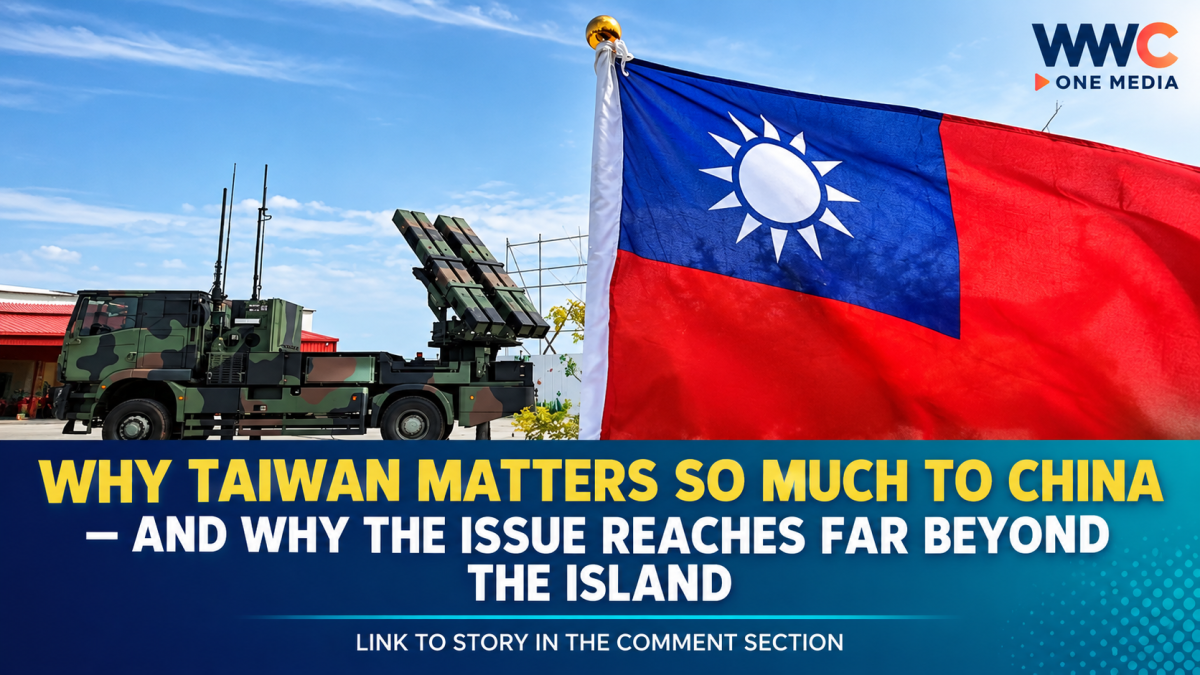
Military activity has also become a regular feature of the dispute. Taiwan has reported Chinese military aircraft and naval vessels operating around the island, including aircraft crossing the Taiwan Strait’s median line. Taiwan’s defence ministry reported four Chinese military aircraft, seven naval vessels and four official ships operating around the island during the 24-hour period ending Sept. 21.
Taiwan has simultaneously been strengthening its military capabilities. On Sept. 18, its forces conducted exercises combining attack drones with conventional weapons, alongside anti-aircraft, anti-ship and anti-landing missile systems.
The diplomatic dimension is equally important. On Sept. 21, the foreign ministers of the United States, Japan and South Korea issued a joint statement stressing the importance of peace and stability across the Taiwan Strait and opposing unilateral changes to the status quo.
For China, however, outside involvement is precisely what makes the issue particularly sensitive. Beijing argues that Taiwan is an internal Chinese matter and opposes what it considers foreign interference. Taiwan and its partners, meanwhile, focus on maintaining the island’s ability to govern itself and preserving peace across the Strait.
That combination of history, sovereignty claims, military planning, technology, trade and US-China rivalry explains why Taiwan occupies such an unusually important place in China’s strategic calculations.
It also explains why relatively small developments — an arms sale, military exercise, diplomatic meeting or statement about Taiwan’s political status — can quickly become part of a much larger dispute between Beijing, Taipei and Washington.