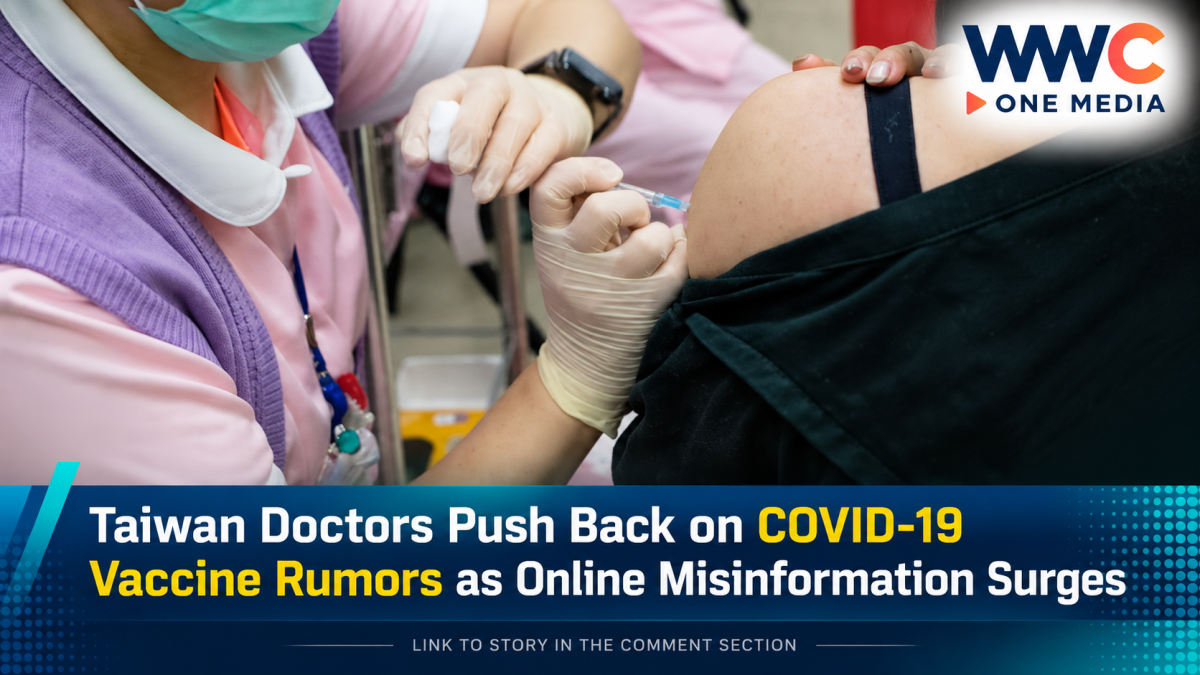
TAIPEI — Taiwanese doctors are pushing back against renewed online claims that mRNA COVID-19 vaccines alter human DNA or cause cancer, saying there is no scientific evidence supporting those claims.
The warnings come as COVID-19 vaccine discussions continue to generate significant attention on Taiwanese social media ahead of the country’s next publicly funded vaccination campaign in October.
A Taiwan-based social-media analysis found that vaccine side effects and long-term effects were the most discussed COVID-19-related topic, followed by vaccine effectiveness and alleged links between COVID-19 vaccines and cancer. Health experts say the high volume of online discussion also makes the subject vulnerable to misinformation.
Doctors Reject Claims That mRNA Vaccines Change DNA
Huang Li-min, a distinguished professor at National Taiwan University College of Medicine, said the claim that mRNA vaccines can alter a person’s DNA is scientifically unfounded.
He explained that vaccine mRNA operates in the cytoplasm, where ribosomes use the genetic instructions to produce a protein that stimulates an immune response. The mRNA does not enter the cell nucleus to modify a person’s DNA.
Huang also said there is no evidence that mRNA COVID-19 vaccination causes cancer.
The explanation is consistent with previous independent fact-checking and scientific assessments, which have found no reliable evidence that COVID-19 vaccines alter human genetic code or cause cancer.
Taiwan Preparing for Another COVID-19 Vaccination Season
The discussion comes shortly before Taiwan’s next publicly funded COVID-19 vaccination program begins.
Taiwan’s Centers for Disease Control says the 2026–27 COVID-19 vaccination program is scheduled to begin Oct. 1, using an XFG-targeted vaccine under recommendations from the country’s Advisory Committee on Immunization Practices.
The agency says COVID-19 remains in circulation and that immunity from previous infection or vaccination can decline over time as the virus continues to evolve.
Taiwan CDC’s latest safety information also says reported adverse-event rates for currently used COVID-19 vaccines have declined. From October 2025 through June 2026, reported adverse events for the Moderna LP.8.1 and Novavax JN.1 vaccines were approximately 2.6 and 2.9 reports per 100,000 doses, respectively, which the agency said was comparable with influenza vaccines.
COVID-19 Still Poses a Greater Concern for Older and High-Risk Groups
While vaccine misinformation remains a major focus, doctors are also warning people not to overlook the continuing health risks posed by COVID-19 itself.
Taiwan CDC reported that from October 2025 through Sept. 14, 2026, Taiwan recorded 675 locally acquired severe COVID-19 cases, including 124 deaths.
People aged 65 and older accounted for 73.3% of severe cases, while 82.8% had chronic medical conditions. The agency also reported that 83.6% of the severe cases had not received the current-season COVID-19 vaccine.
Doctors say COVID-19 can involve more than the respiratory system, with severe infection potentially affecting organs and systems including the heart, kidneys, brain and blood vessels.
Experts Warn Social-Media Attention Can Amplify Misinformation
The online discussion itself has become part of the public-health challenge.
Taiwan’s recent analysis found that vaccine side effects and after-effects generated 13,647 online mentions, making it the most-discussed COVID-19 vaccine topic in the survey.
Experts stressed that high social-media engagement does not establish whether a medical claim is true. Instead, they urged people to check vaccine information against current scientific evidence and official health guidance.
That distinction is particularly important as Taiwan enters another respiratory-virus season and prepares to offer updated COVID-19 vaccines.
The Bottom Line
Current evidence cited by Taiwanese physicians and health authorities does not support claims that mRNA COVID-19 vaccines modify human DNA or cause cancer.
At the same time, Taiwan continues to monitor vaccine safety and COVID-19 disease trends, meaning both vaccine benefits and potential adverse events remain subjects of ongoing medical surveillance rather than issues that should be settled by social-media claims alone.