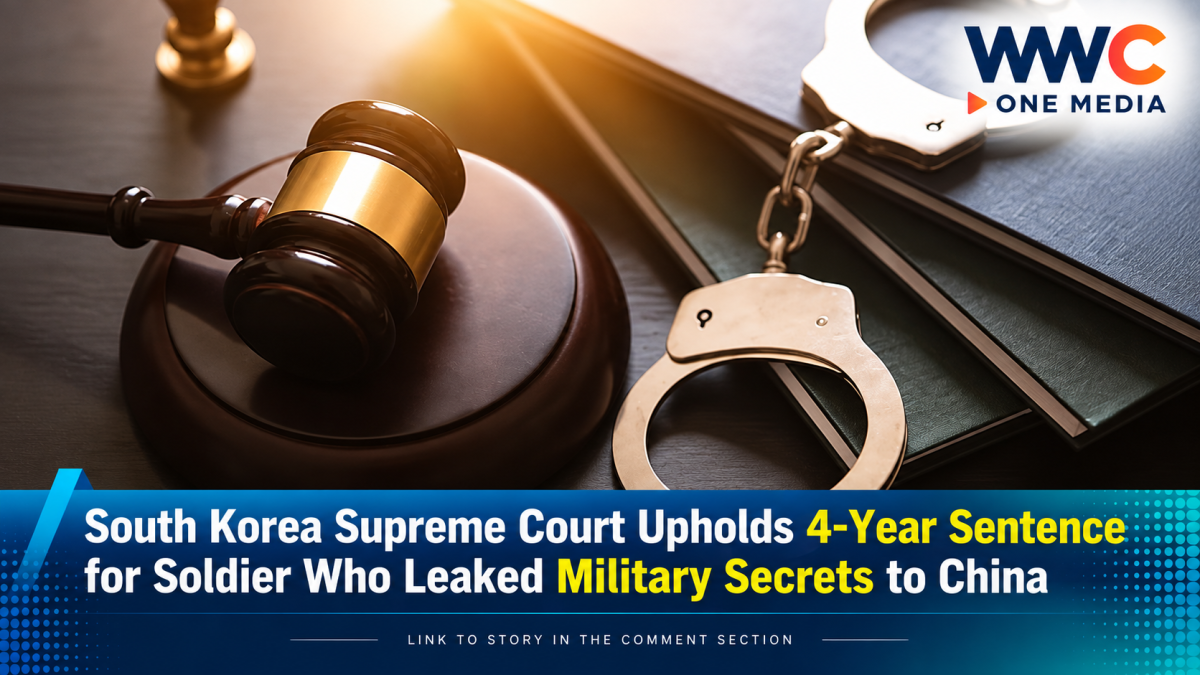
SEOUL — South Korea’s Supreme Court has finalized a four-year prison sentence for a former Army soldier convicted of leaking classified military information, including materials connected to South Korea-U.S. military exercises, to a Chinese intelligence organization in exchange for money.
The Supreme Court’s Second Division upheld the lower court’s ruling, which also imposed a 20 million won (about US$14,500) fine and ordered the forfeiture of 19.07 million won. The ruling, reported on September 18, brings the case to a final conclusion.
Soldier Met Chinese Contact Through Social Media
According to court records cited by Yonhap and Korean media, the soldier was serving as an Army sergeant when he met a Chinese national in Beijing in August 2024.
The Chinese contact, whom the soldier had first encountered through social media, presented himself as an official connected to a Chinese intelligence organization and asked for classified South Korean military information.
Investigators found that the soldier accepted the proposal and subsequently provided military secrets on seven occasions between August 2024 and February 2025.
The information included materials concerning South Korea-U.S. joint exercises, United Nations Command-related information and South Korean military training, according to Yonhap. Other Korean reports said the leaked material also included information concerning military personnel and manuals associated with the Combined Forces Command.
Payment Reached About 17.26 Million Won
The former soldier received approximately 17.26 million won in exchange for the information, according to Yonhap.
Investigators also determined that he received a wristwatch-style camera, which he used to photograph classified military material after reportedly encountering difficulty photographing documents with a smartphone.
The case therefore involved more than a single disclosure: prosecutors established that classified information was transferred repeatedly over several months.
First Sentence Was Five Years
The soldier was initially sentenced by a military court to five years in prison.
The Seoul High Court later reduced the prison term to four years while adding a 20 million-won fine and ordering the forfeiture of 19.07 million won.
The defendant argued that he had not intended to aid an adversary by providing the information. The appellate court rejected that argument.
The appellate court also noted an important evidentiary distinction: there was no direct evidence proving that the Chinese individual who recruited the soldier was himself a member of a Chinese intelligence organization. Nevertheless, the court concluded that the evidence established that the military information was ultimately passed to a Chinese intelligence organization.
Supreme Court Rejects Final Appeal
The Supreme Court found no legal or procedural error significant enough to overturn the appellate ruling and therefore upheld the sentence.
The final judgment includes convictions involving aiding the enemy, disclosure of military secrets, accepting benefits after improper conduct and violations of South Korea’s information and communications network law, according to Korean court reporting.
The Supreme Court’s decision comes as South Korea continues strengthening its response to foreign espionage and information leaks.
Case Highlights Growing Security Concerns
The case comes against a broader backdrop of concern in South Korea over the unauthorized transfer of sensitive information to foreign entities.
The Financial Times recently reported that South Korea has strengthened its espionage framework to cover sensitive economic and technological information involving foreign entities, amid concerns about technology leaks, particularly involving China. The revised framework represents a broader approach to protecting strategically important information beyond traditional military secrets.
However, the latest case itself concerns military secrets and an Army serviceman, rather than industrial technology.
The Supreme Court ruling now makes the four-year prison term final, closing a case that began with a soldier’s contact with a foreign national through social media and ended with the country’s highest court confirming his criminal liability.