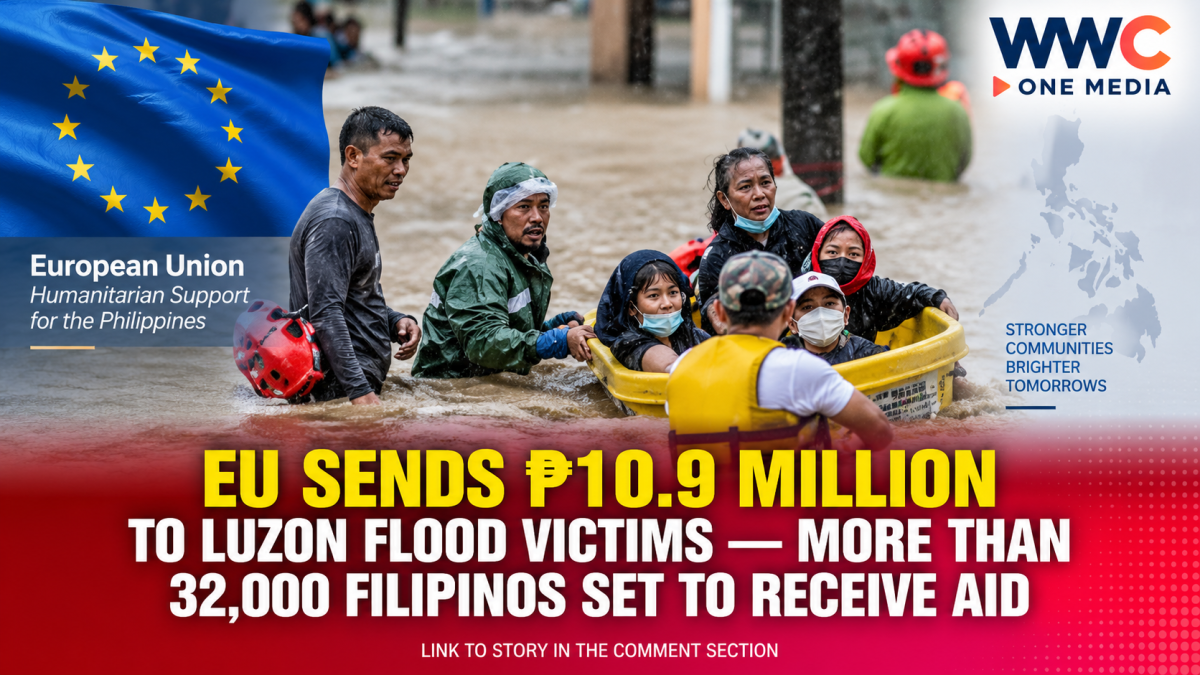
The European Union is stepping up humanitarian assistance for communities hit by severe monsoon flooding across Luzon, releasing €150,000, or approximately ₱10.9 million, to support more than 32,000 people in some of the hardest-hit areas.
The assistance, announced on September 18, will be delivered through the Philippine Red Cross (PRC) and will focus on immediate food, water, household, health and sanitation needs in the Ilocos Region, Central Luzon and Metro Manila.
The figure is important: the assistance is ₱10.9 million—not ₱109 million, as some versions of the headline may suggest.
What the EU’s ₱10.9-million assistance will provide
According to the EU Delegation to the Philippines, the funding will allow the Philippine Red Cross to distribute essential household supplies to affected families.
These include:
- Sleeping kits
- Water containers
- Hygiene supplies
- Hot meals
- Safe drinking water
The response will also deploy mobile health teams to provide medical consultations, medicines, health information and mental-health support.
Hygiene promotion and disease monitoring will likewise be carried out to reduce the risk of water-borne and vector-borne diseases, which can increase following major flooding.
More than 32,000 people are expected to benefit
The EU said the new funding is intended to support more than 32,000 people in some of Luzon’s most severely affected areas.
The targeted areas include the Ilocos Region, Central Luzon and Metro Manila, where prolonged southwest monsoon rains caused widespread flooding and, in some locations, landslides.
The Philippine News Agency likewise reported that the assistance will prioritize communities affected by the recent monsoon floods, with the Philippine Red Cross handling the delivery of relief and health services.
The scale of the flooding is much larger
The EU’s announcement comes as the country continues to deal with the effects of prolonged southwest monsoon, or Habagat, activity that began intensifying in early August.
According to the EU, the monsoon was strengthened by several tropical cyclones and other weather systems, resulting in prolonged rainfall across Luzon.
As of September 14, more than 10.5 million people across 11 regions had been affected.
More than 120,100 people had been displaced and were staying in more than 500 evacuation centers.
The EU also reported that more than 4,500 homes had been damaged and 188 cities had been placed under a state of calamity.
The flooding damaged not only homes but also roads, bridges, agricultural land, water systems and power infrastructure, highlighting the broader impact of the prolonged rains.
The Philippine Red Cross will lead the frontline response
The new funding will be implemented through the Philippine Red Cross, allowing relief efforts to combine immediate assistance with health and disease-prevention measures.
This means the funding is not simply a cash distribution program.
Instead, it is designed to provide concrete emergency services—including food, drinking water, household supplies and medical assistance—to communities affected by the flooding.
Mobile health teams are particularly important after major floods because stagnant and contaminated water can increase exposure to water-borne illnesses, while mosquitoes and other disease vectors can proliferate in affected communities.
The money comes through the international Red Cross emergency fund
The €150,000 allocation forms part of the EU’s contribution to the Disaster Response Emergency Fund (DREF) of the International Federation of Red Cross and Red Crescent Societies (IFRC).
The DREF is designed to provide rapid financing to National Red Cross and Red Crescent societies when disasters strike, allowing emergency assistance to begin before larger-scale humanitarian funding can be mobilized.
The EU said the new funding comes on top of more than €2 million already allocated to humanitarian partners in the Philippines at the beginning of 2026.
EU humanitarian assistance to the Philippines goes beyond the latest floods
The latest flood response is part of a much longer record of EU humanitarian assistance in the Philippines.
EU humanitarian aid data says the bloc has provided around €176 million in humanitarian assistance to the Philippines since 1996, supporting communities affected by disasters and other humanitarian emergencies.
For 2026, the EU’s initial humanitarian allocation for the Philippines was more than €2 million, before additional emergency assistance was provided.
The assistance has included support for food, water and sanitation, health care, disaster preparedness and other emergency needs.
Why the latest assistance matters
The immediate challenge for flood-affected communities is recovery from displacement and the loss of access to basic necessities.
For families staying in evacuation centers, access to clean water, food, hygiene supplies and medical care can become an urgent concern.
The EU-backed response therefore combines relief and disease prevention, rather than focusing exclusively on food distribution.
The assistance also arrives while many affected communities are still dealing with damaged homes, infrastructure and livelihoods following weeks of heavy rainfall.
More help may still be needed
The ₱10.9-million package is significant humanitarian support, but its scale should be viewed against the size of the disaster.
With more than 10.5 million people reported affected across 11 regions as of September 14, the latest EU funding is targeted specifically at more than 32,000 people in some of the hardest-hit areas rather than representing assistance for every person affected nationwide.
For the communities receiving the assistance, however, the combination of food, clean water, household supplies and medical services can provide immediate relief while recovery efforts continue.
The bigger challenge now is what happens after the floodwaters recede—how quickly damaged homes, livelihoods, roads and essential services can be restored, and whether further humanitarian assistance will be needed as affected communities begin rebuilding.