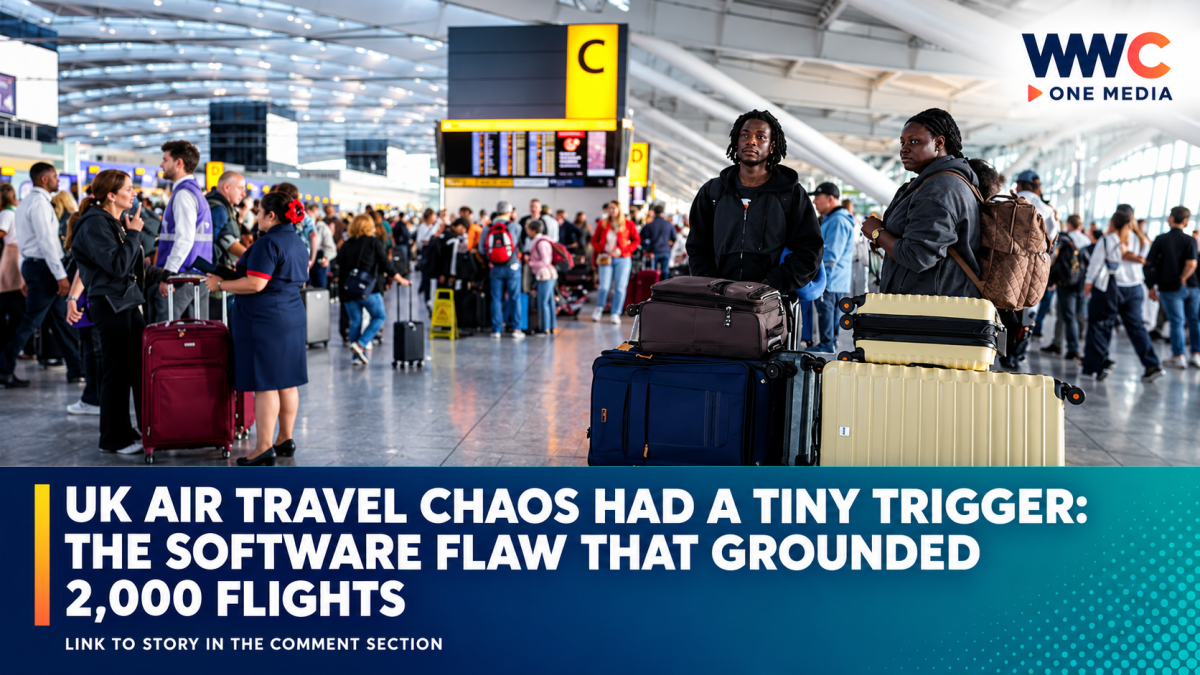
LONDON — A software defect buried inside Britain’s air traffic control system has been identified as the cause of the disruption that cancelled around 2,000 flights and affected hundreds of thousands of passengers earlier this month, according to a preliminary investigation by the UK’s air traffic control provider, NATS.
The failure occurred on September 8, when a problem in part of NATS’ National Airspace System disrupted the processing of flight information. The resulting restrictions spread across the aviation network, hitting major airports including Heathrow, Gatwick, Manchester and Stansted and triggering widespread delays and cancellations.
NATS chief executive Martin Rolfe said the problem was traced to a small section of software code in the system responsible for processing aircraft identification information.
The defect was exposed when a request to allocate an aircraft identification, commonly known as a squawk code, was interrupted by a higher-priority request. According to the preliminary report, the timing difference occurred within milliseconds and caused the system to produce corrupted information, forcing restrictions to be imposed while the system was recovered.
How a tiny software fault caused a major aviation disruption
Squawk codes are used by air traffic control systems to identify aircraft on radar and link them to their flight information.
The NATS report said the incident was triggered by a legitimate manual request. The operator said there was no evidence that an incorrect action by either civil or military personnel caused the failure.
NATS also said the latest outage was not connected to the major air traffic control failure in August 2023, which caused extensive disruption across Britain.
The company additionally rejected speculation that military activity was responsible for the September incident. Earlier reports had raised questions about whether a military flight plan was involved, but NATS said the latest findings did not support that explanation.
The preliminary findings also have not identified evidence that the disruption was caused by a cyberattack.
Safety was not compromised, NATS says
Despite the scale of the disruption, NATS said aircraft safety was not compromised.
The system’s restrictions were introduced as a safety measure after the software problem affected the processing of flight information. Sky News reported that the issue was confined initially to the London Area Control Centre, but restrictions had to be applied more broadly while the National Airspace System was restarted and recovered.
NATS said a mitigation measure has already been put in place while engineers test and deploy a permanent software fix.
The company is expected to publish a more detailed report later.
Airlines demand answers after another major disruption
The technical explanation has not ended criticism of Britain’s air traffic control infrastructure.
The September 8 disruption caused more than 1,000 cancellations on the day itself, with the knock-on effects continuing as airlines attempted to reposition aircraft and crews. NATS later estimated the overall impact at around 2,000 cancelled flights.
Ryanair chief executive Michael O’Leary publicly challenged NATS’ handling of the incident and renewed calls for chief executive Martin Rolfe to leave his position. Other airlines have also raised concerns about the financial consequences of the disruption and the resilience of Britain’s air traffic control system.
The Financial Times reported that UK airlines were seeking compensation and pressing for stronger measures to address the resilience of the system following the disruption.
UK government orders independent review
The British government has separately ordered an independent review by the Civil Aviation Authority (CAA).
Transport Secretary Heidi Alexander described the disruption as unacceptable and said the review would examine why the software defect was not identified and fixed before it caused widespread disruption.
The CAA had already said that NATS would be required to provide a technical report and that an independent review would examine what happened and whether NATS has sufficient resilience to provide reliable services in the future.
For passengers, the CAA said airlines remain responsible for providing appropriate care during disruption. However, because the outage is likely to fall under the category of “extraordinary circumstances”, passengers may not automatically qualify for compensation for delays or cancellations directly caused by the NATS failure.
The bigger question is now resilience
The immediate technical problem may have been identified, but the investigation leaves a broader question for Britain’s aviation system: how could a previously unknown software defect in a critical air traffic control system trigger such extensive disruption?
That question is particularly significant because the latest incident follows other technical problems affecting NATS in recent years, including the major 2023 outage and a separate technical incident in 2025.
NATS has said the September incident was different from those earlier failures and that work is already under way on a permanent fix.
The independent CAA review will now provide another layer of scrutiny, including examination of NATS’ resilience and investment plans.
For passengers and airlines, the software defect may explain what went wrong on September 8. The next stage of the investigation is expected to focus on why the defect remained undetected — and whether Britain’s air traffic control system is sufficiently protected against another failure.