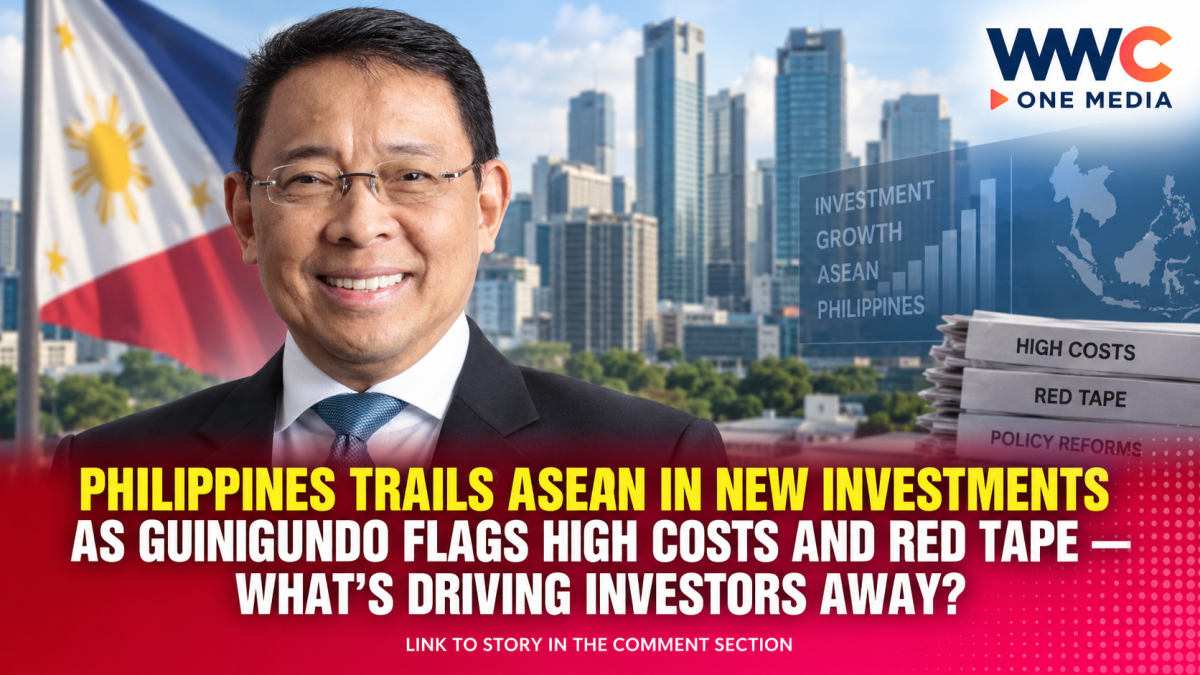
The Philippines is facing renewed questions over its ability to attract large, long-term investments as neighboring Southeast Asian economies capture a growing share of global capital.
Former Bangko Sentral ng Pilipinas deputy governor Diwa Guinigundo has repeatedly pointed to high business costs, regulatory uncertainty, infrastructure gaps and weak investor confidence as structural obstacles that continue to make the Philippines less competitive.
His latest assessment comes as ASEAN as a whole continues to attract substantial foreign direct investment, with capital increasingly flowing toward semiconductors, electronics, renewable energy, digital infrastructure, advanced manufacturing and electric-vehicle supply chains.
ASEAN is attracting record investment—but the Philippines is taking a smaller share
The scale of the regional competition is significant.
According to the ASEAN Investment Report based on UNCTAD’s 2026 World Investment Report, ASEAN attracted approximately US$243.9 billion in foreign direct investment in 2025, up 9.7% from the previous year.
Singapore accounted for about US$150.9 billion, while Indonesia and other major ASEAN economies continued to attract significant amounts of capital.
The Philippines, by comparison, captured roughly US$9 billion in FDI in 2025, placing it sixth among Southeast Asian economies, according to reporting based on the UNCTAD data.
That gap has become increasingly important because the competition is no longer simply about attracting any foreign capital. ASEAN countries are competing for factories, technology projects, semiconductor investments, renewable-energy facilities, logistics hubs and higher-value manufacturing.
Guinigundo: The cost of doing business remains a major obstacle
Guinigundo has argued that investors look beyond tax incentives and ownership rules when deciding where to place factories and other long-term projects.
Among the problems he has identified are high operating costs, regulatory uncertainty, slow permitting, infrastructure deficiencies, high logistics expenses and delays in the judicial system.
He has also argued that governance matters because uncertainty over regulations, contracts and enforcement can increase the risks associated with committing capital for years or decades.
In an earlier assessment, Guinigundo said the high cost of doing business—partly linked to regulatory inefficiencies—remains a structural constraint on investment. He also called for stronger transparency, accountability and rule-of-law institutions.
Electricity, logistics and permits add to the challenge
The concerns are not limited to government paperwork.
The OECD’s 2026 Economic Survey of the Philippines found that logistics costs amount to about 27% of wholesale prices, higher than the shares reported for Vietnam and Thailand in the cited comparison.
The OECD also said that lengthy procedures and overlapping mandates across agencies can create uncertainty and raise transaction costs for investors. It identified regulatory fragmentation at the local-government level as another complication, because businesses may encounter different requirements for permits, construction approvals, local taxes and other processes.
The U.S. Department of Commerce similarly identifies government red tape, regulatory uncertainty, slow judicial processes, inconsistent application of rules by local governments and infrastructure limitations among challenges cited by investors in the Philippines.
Vietnam, Malaysia, Indonesia and Thailand are competing for the same capital
The Philippines is not competing in isolation.
Vietnam has emerged as a major manufacturing destination, particularly for electronics and export-oriented industries. Indonesia is attracting investment connected to critical minerals, electric vehicles and manufacturing, while Malaysia and Thailand continue to secure projects in electronics, communications and other higher-value industries.
The South China Morning Post, citing UNCTAD’s 2026 World Investment Report, reported that Singapore remained Southeast Asia’s largest FDI destination in 2025, followed by Indonesia, while the Philippines ranked sixth.
This matters because multinational companies typically compare locations across several variables—including energy prices, labor availability, logistics, market access, regulatory predictability and supply-chain connectivity—before committing billions of dollars to a project.
Philippine FDI has also weakened in 2026
The investment picture has become more concerning this year.
Philstar reported that preliminary BSP data showed net FDI fell 33.4% to US$2.18 billion from January to May 2026, compared with US$3.27 billion during the same period in 2025.
May alone recorded FDI of about US$210 million, down 64.7% from US$595 million a year earlier.
The figures are particularly significant because FDI is different from short-term portfolio flows. Foreign direct investment generally represents longer-term commitments to businesses, facilities and productive capacity.
In other words, a sustained decline in FDI can matter for the country’s ability to build factories, expand production and generate jobs tied to new investment.
But the Philippines is not standing still
There is another side to the story.
The government has introduced reforms intended to reduce the time required to approve strategic investments.
Under Executive Order No. 18, investment “green lanes” were established to speed up approvals for high-impact projects.
The Philippine Information Agency reported that, as of the end of August 2026, enterprises based in the Philippines accounted for ₱4.46 trillion of the ₱6.36 trillion in capital projects approved for expedited processing under the program.
The same report said average permit turnaround times had fallen from a prescribed 19.12 days to about 7.67 days for projects covered by the mechanism.
These figures indicate that efforts to reduce regulatory friction are producing measurable changes for projects covered by the green-lane system.
The challenge is whether those improvements can be expanded beyond strategic projects and translate into broader improvements in the country’s investment environment.
Liberalization alone may not be enough
The Philippines has also opened several sectors to greater foreign participation.
The 2022 Public Service Act reforms, for example, removed foreign-ownership restrictions in several sectors including telecommunications, air transport, airports, maritime transport and railways, subject to applicable safeguards.
However, the OECD noted that significant foreign-equity restrictions remain in areas classified as public utilities, while administrative barriers can still affect sectors that are formally open to foreign investment.
This creates a distinction between legal openness and the practical cost of establishing and operating a business.
An investor may technically be permitted to enter a market but still face expensive electricity, logistics constraints, multiple permits, infrastructure limitations or uncertainty over how regulations will be applied.
Investment is also being held back by weaker growth
The investment issue comes as Philippine economic growth has slowed.
Philstar reported that the Philippine economy expanded by 2.3% year-on-year in the second quarter of 2026, following 2.8% growth in the first quarter. First-half growth averaged 2.6%.
Guinigundo and economist John Manalac have separately argued that restoring investor confidence, improving the permitting environment, strengthening human capital, addressing energy and food vulnerabilities and developing a clearer industrial policy are important to achieving investment-led growth.
Investment itself was a major drag on second-quarter growth, with gross capital formation contracting by 9.2%, according to their assessment reported by Philstar.
The bigger question: Can the Philippines turn reforms into investment?
The Philippines still has major advantages: a large domestic market, a young workforce, English-language capability, an established business-process outsourcing industry and strategic access to the wider Asian market.
But the competition is intensifying.
ASEAN’s record 2025 FDI performance shows that global companies are willing to place large amounts of capital in Southeast Asia. The question for the Philippines is how much of that capital it can capture—and whether it can move beyond services and consumption toward more manufacturing, technology, infrastructure and high-value industries.
Guinigundo’s warning therefore goes beyond simply cutting paperwork.
The broader issue is whether the Philippines can make power, logistics, permitting, regulation, infrastructure and governance predictable enough for investors to commit capital for the long term.
The country has already begun implementing measures to reduce red tape. The next test is whether those reforms can materially narrow the investment gap with ASEAN neighbors—and whether the Philippines can convert its economic potential into factories, technology projects, productive capacity and jobs before more investment flows elsewhere.