
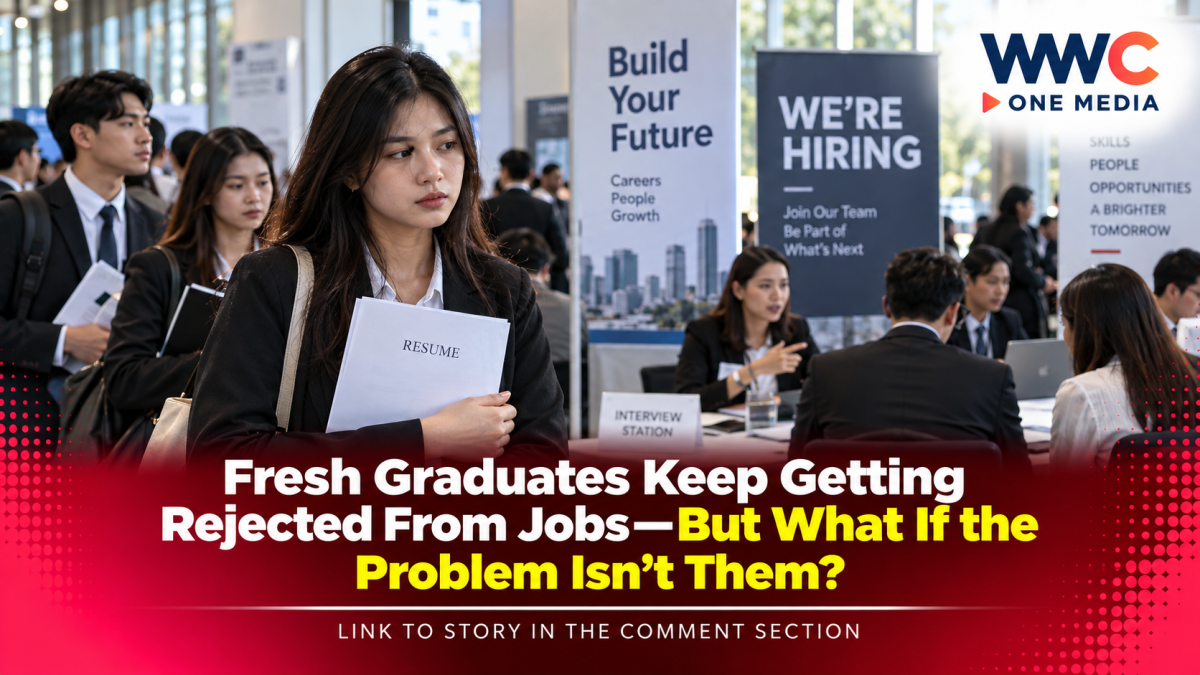
Rejection is one of the hardest parts of starting a career—but a growing debate in Singapore is challenging fresh graduates to ask an uncomfortable question: Could some of the problem be in the way they are approaching the job search?
A recent Straits Times commentary argues that while graduates face genuine challenges in today’s labor market, candidates also need to examine what they can change rather than assuming every rejection is caused by employers or the economy. The writer draws on personal experiences with internship, scholarship and job applications and argues that taking responsibility for weaknesses can create opportunities to improve.
But the wider employment data suggests the story is more complicated.
Fresh graduates really are facing a tougher hiring environment
Singapore’s 2025 Graduate Employment Survey found that 83.4% of recent graduates who were seeking employment were working within six months of their final examinations, down from 87.1% in 2024.
The proportion who had secured employment under the survey’s newer measurement was 88.9%, compared with 91.2% a year earlier. Meanwhile, 11.1% had not secured employment, including 8.5% who had applied for jobs but had not received a full-time permanent offer.
Universities attributed part of the change to a moderation in job vacancies from the post-pandemic peak and more cautious hiring amid economic uncertainty.
So rejection isn’t necessarily evidence that a graduate has failed to prepare adequately.
But employers are also looking beyond qualifications
There is another factor increasingly affecting entry-level applicants: experience.
Singapore’s Ministry of Manpower said graduates who remain unemployed or underemployed can face several different challenges, including limited work experience in their target sector, weaker interview skills and slower hiring in particular industries.
The Business Times also reported that employers adopting AI are increasingly looking for candidates who can demonstrate the ability to apply AI in real business settings, while recruiters have observed stronger demand for experienced talent in some technology roles.
That creates a difficult situation for new graduates: employers may want practical experience, while graduates need their first job to obtain that experience.
Thousands of entry-level jobs still exist
The situation isn’t simply that companies have stopped hiring young workers.
MOM data cited by CNA showed 32,800 entry-level PMET vacancies in March 2026, representing 43.6% of all PMET openings at the time.
Yet individual graduates can still struggle to land a position because the available jobs may not match their degree, preferred industry, location, salary expectations or existing skills.
That mismatch helps explain why the overall number of available positions can look healthy while some graduates send dozens—or even hundreds—of applications without success.
So, what can graduates actually learn from rejection?
The lesson from the debate isn’t that every rejected applicant should simply “work harder.”
Instead, rejection can be used as information.
If applications consistently produce no interviews, the candidate may need to reconsider how their résumé communicates relevant skills or whether they are applying for roles that match their background.
If interviews are happening but offers aren’t following, interview performance, communication or preparation could be areas worth reviewing.
And if a candidate is repeatedly applying for positions requiring experience they don’t yet have, internships, traineeships, project work or other forms of relevant experience may provide a bridge into the industry.
But those individual changes should not obscure the broader labor-market reality.
Singapore is expanding support for graduates
The Singapore government has acknowledged the challenge and expanded support aimed at helping young graduates transition into employment.
MOM said that close to half of trainees who have completed the Graduate Industry Traineeships Programme have secured employment, with more expected to do so over the following months. The ministry also said graduate employment outcomes generally improve beyond the six-month mark as more graduates find work.
That means an early period of unemployment does not necessarily determine someone’s eventual career trajectory.
The bigger question isn’t simply “Who’s to blame?”
The debate surrounding fresh-graduate rejection risks becoming too simplistic if it turns into graduates versus employers.
The reality can involve both individual and structural factors.
Candidates can improve their résumés, interview skills, portfolios, professional knowledge and understanding of what employers actually require.
At the same time, companies determine how much entry-level talent they hire, how much experience they require and whether they are willing to train people at the beginning of their careers.
For graduates, perhaps the most useful question isn’t “Whose fault is this?”
It’s “What can I change, and what is outside my control?”
That distinction can turn rejection from a final verdict into feedback—while recognizing that sometimes the job market itself is part of the problem.
WWC ONE MEDIA G,A




Leave a Reply