
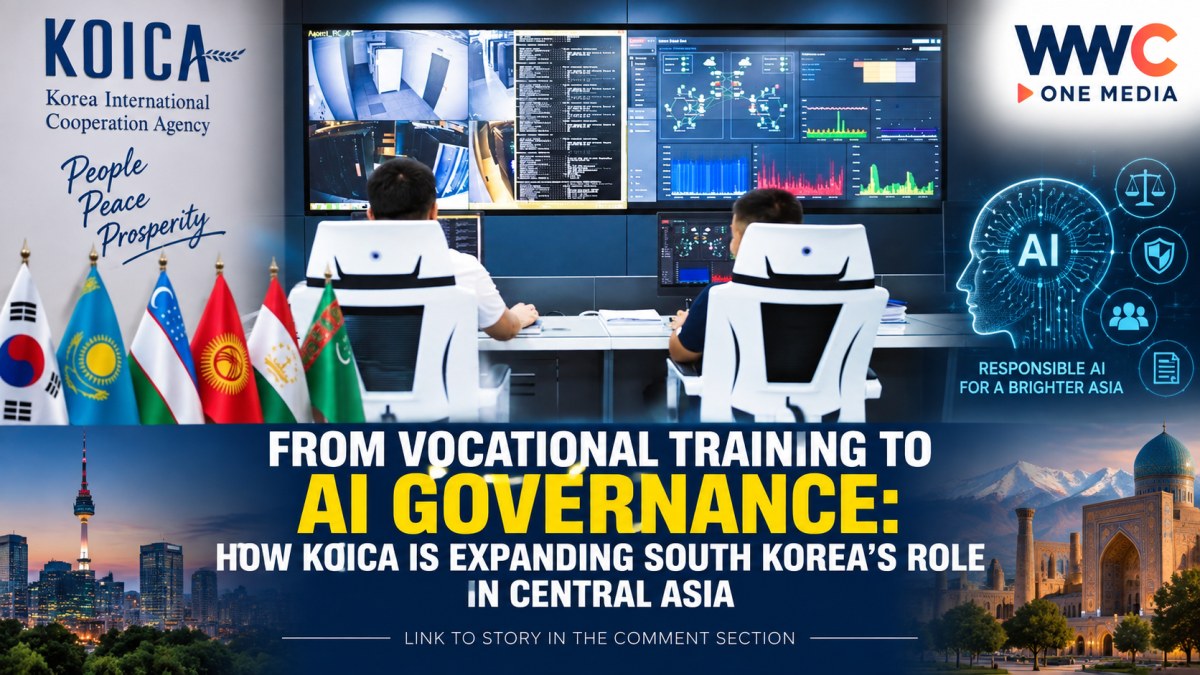
KOICA’s Central Asia Strategy Moves From Vocational Training to AI and Digital Governance
South Korea’s development cooperation in Central Asia is entering a new phase.
The Korea International Cooperation Agency, or KOICA, has spent decades supporting vocational education, healthcare, rural development and public-sector capacity building across the region. But its recent portfolio shows a growing emphasis on artificial intelligence, digital government and technology-driven public administration.
The shift comes as Central Asian governments accelerate their own digital-transformation programs and as Seoul seeks deeper economic and strategic ties with Kazakhstan, Kyrgyzstan, Tajikistan, Turkmenistan and Uzbekistan.
From Skills Training to Digital Transformation
Between 1992 and 2025, KOICA provided roughly $440 million in official development assistance to the five Central Asian countries, according to a Korea Times report based on KOICA data.
Education accounted for about 30.2% of the agency’s regional assistance, while public administration represented 24.9%. Technology, environment and energy made up another 18.8%.
Earlier projects focused heavily on practical development needs, including vocational training centers, healthcare, rural infrastructure and energy-sector capacity building.
That model is now being supplemented by projects designed to help governments build and operate digital systems.
11 AI and Digital Governance Projects Underway
As of 2026, 11 public-sector AI and digital-governance projects were either underway or being prepared across Central Asia.
Uzbekistan accounts for eight of those projects, making it the most active partner in KOICA’s current regional digital portfolio. Three of the Uzbek projects specifically involve AI-powered e-government services.
The projects cover areas far beyond conventional IT training.
They include digital parliamentary systems, legal services, disaster management, public administration, cultural-heritage management and education.
In Uzbekistan, cooperation also includes an intellectual-property management project expected to run through 2029 and a legal-services development project extending through 2030.
Uzbekistan Emerges as a Major Korean Technology Partner
One of the most prominent examples is IT Park Uzbekistan, a state-backed technology hub established in 2019.
KOICA supported the development of IT Park’s operating model, staff capabilities, network infrastructure and technology-training programs. It also helped connect Korean and Uzbek companies through business-process outsourcing opportunities.
According to KOICA figures cited by The Korea Times, the combined revenue of companies operating at the technology hub increased from about 2.5 trillion Uzbek som to 19 trillion som after the support program concluded in 2025.
That represents a reported 7.6-fold increase, although the figures describe the performance of companies within the IT Park ecosystem rather than a direct measure of KOICA’s financial return.
Kyrgyzstan Takes a Different Digital Path
KOICA’s work is not limited to Uzbekistan.
In Kyrgyzstan, Korean development assistance helped establish the country’s G-Cloud digital infrastructure, supporting the modernization of government information systems.
KOICA has also worked with Kyrgyz institutions on electronic parliamentary processes and broadcasting systems, with projects scheduled for completion by 2027. Similar digital-government assistance is being provided in Tajikistan.
The approach reflects a broader principle in KOICA’s regional work: projects are adapted to each country’s existing infrastructure, institutional capacity and policy priorities rather than simply copying South Korean systems wholesale.
Why AI Is Becoming Central to the Partnership
Central Asian governments are increasingly looking to digital technology to modernize public services, manage government data and improve administrative processes.
That makes AI cooperation potentially more consequential than traditional technology-transfer projects.
KOICA officials say digital projects can also help landlocked Central Asian economies overcome some geographic limitations while supporting industrial transformation. At the same time, the projects create opportunities for Korean technology companies to establish relationships in emerging Central Asian markets.
The development-assistance relationship is therefore becoming intertwined with broader economic cooperation.
The Timing Matters for Seoul
KOICA’s technological pivot comes as South Korea is also stepping up high-level engagement with Central Asia.
President Lee Jae Myung is hosting the leaders of Kazakhstan, Kyrgyzstan, Tajikistan, Turkmenistan and Uzbekistan in Seoul for the first South Korea-Central Asia summit at the leaders’ level.
The summit agenda includes trade, investment, energy, critical minerals and supply chains, reflecting Seoul’s broader interest in strengthening economic and strategic ties with the resource-rich region.
Against that backdrop, KOICA’s digital projects give South Korea another channel for long-term engagement—one that works directly with government institutions, universities, technology hubs and public-sector professionals.
From Aid Projects to Long-Term Partnerships
The evolution of KOICA’s role illustrates how development cooperation is changing.
What began with vocational training and basic development infrastructure is increasingly moving toward digital capacity, AI applications and public-sector modernization.
For Central Asian governments, the projects offer access to Korean experience and technology as they attempt to build digital institutions.
For South Korea, they create deeper institutional relationships in a region that is becoming increasingly important for trade, technology, energy and critical-mineral supply chains.
The next question is whether these AI and digital-government projects can move beyond pilot programs and become sustainable systems operated independently by Central Asian institutions.
KOICA’s Central Asian story may no longer be simply about teaching people new skills—it is increasingly about helping governments build the digital systems that will shape how those skills, services and economies work in the future.




Leave a Reply