
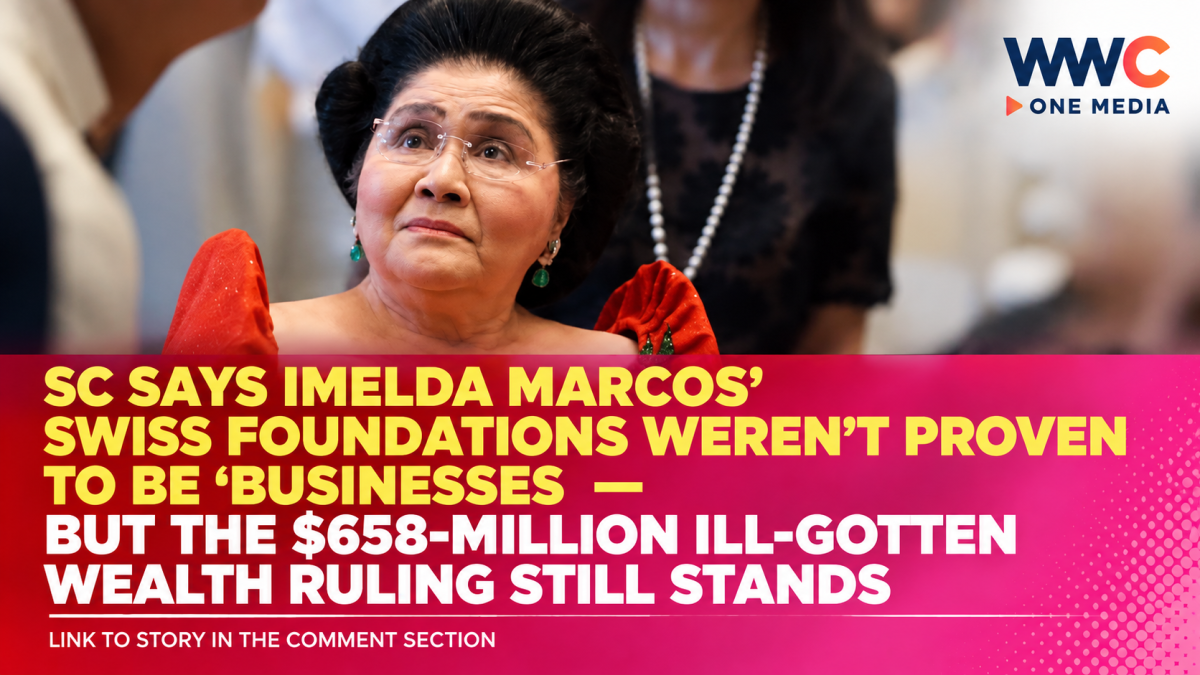
MANILA, Philippines — The Supreme Court is drawing a sharp legal line around its controversial acquittal of former First Lady Imelda Marcos, stressing that the Swiss foundations at the center of her graft cases were not sufficiently proven to be “businesses” under the specific anti-graft provision used against her.
That distinction matters because the Court’s ruling does not mean the foundations were declared legitimate, charitable or unrelated to assets previously forfeited to the Philippine government.
Instead, the case turned on a much narrower criminal-law question: Did prosecutors prove every required element of the graft offense beyond reasonable doubt?
The Supreme Court concluded they did not.
The clarification follows the Court’s June 10 decision — made public on September 9 — overturning the Sandiganbayan’s 2018 conviction of Marcos on seven counts of graft involving foundations and entities linked to Swiss bank accounts.
And that has created an apparent contradiction now dominating public discussion:
How could Marcos be acquitted of graft involving Swiss foundations when the Supreme Court had already ruled decades ago that hundreds of millions of dollars held through related foundations were ill-gotten wealth?
The answer lies in the difference between a criminal graft prosecution and a civil forfeiture case.
What the Supreme Court Actually Ruled
Marcos was prosecuted under Section 3(h) of Republic Act No. 3019, the Anti-Graft and Corrupt Practices Act.
That provision prohibits a public officer from directly or indirectly having a financial or pecuniary interest in a business, contract or transaction in which the official intervenes in an official capacity or is otherwise legally prohibited from having an interest.
For prosecutors to secure a criminal conviction under that theory, they therefore had to prove, among other things, that the entities in which Marcos allegedly maintained financial interests qualified as the type of “business” contemplated by the law.
The Sandiganbayan believed they did.
In its 2018 ruling, the anti-graft court said the foundations engaged in activities such as maintaining bank accounts, moving money and earning investment income for the benefit of the Marcos family.
The Supreme Court disagreed that those facts, standing alone, were sufficient to establish that the foundations were commercial businesses.
It said opening bank accounts, transferring money and earning interest or investment returns do not automatically transform an entity into a commercial enterprise. The prosecution failed to show that the foundations regularly offered goods or services primarily for profit.
That is the narrow legal point behind the latest clarification.
‘Not Proven to Be a Business’ Does Not Mean ‘No Financial Interest’
This distinction is easy to lose in headlines.
The Court did not simply rule that Marcos had no connection to the foundations.
Nor did it make a blanket finding that she never had a financial or beneficial interest in assets associated with them.
Its ruling was that the prosecution failed to establish that the entities themselves met the meaning of businesses required for conviction under Section 3(h).
That difference is crucial.
A person can hold money through a foundation, trust or investment vehicle without that entity necessarily operating as a commercial business selling goods or services.
The Supreme Court said criminal statutes must be strictly interpreted against the government when there is doubt about whether particular conduct falls within the wording of the offense.
So the acquittal rests partly on how narrowly the word “business” must be construed in a criminal prosecution.
The Swiss Documents Were Another Major Problem
Even if prosecutors had cleared the “business” hurdle, they faced another evidentiary weakness.
The Supreme Court found that crucial Swiss documents relied upon by the prosecution were not properly authenticated.
The government presented witnesses including former Solicitor General Francisco Chavez, former Philippine ambassador to Switzerland Luis Ascalon and a Presidential Commission on Good Government records officer.
But the Court said those witnesses could explain how documents entered Philippine government custody without necessarily having personal knowledge sufficient to authenticate their original execution or contents.
Without proper authentication, the Court found that critical portions of the documentary evidence were inadmissible or lacked sufficient probative value.
That matters enormously in a criminal case.
A court may strongly suspect that something occurred, but suspicion cannot substitute for admissible evidence proving every element of an offense beyond reasonable doubt.
A Third Problem: Marcos Was Convicted Under a Different Official Capacity
The Supreme Court identified another defect in four of the seven cases.
For cases involving the Maler, Trinidad, Rayby and Palmy foundations, the criminal informations accused Marcos based on her position as a member of the Interim Batasang Pambansa.
But the Sandiganbayan relied on a constitutional restriction applicable to Cabinet members when it convicted her.
The Supreme Court held that this difference was not merely technical.
An accused person has the constitutional right to know the exact nature and basis of the accusation being defended against.
The Court ruled that Marcos could not be convicted using an official capacity materially different from the one alleged in the information.
Taken together, the ruling rested on three central problems:
the foundations were not proven to be businesses covered by the charged offense; key Swiss records were not properly authenticated; and four cases involved a mismatch between the charge and the legal basis used for conviction.
What Happened to the 2018 Conviction?
In November 2018, the Sandiganbayan Fifth Division found Marcos guilty on seven graft counts involving:
Maler Establishment, Trinidad Foundation, Rayby Foundation, Palmy Foundation, Vibur Foundation, Aguamina Foundation and Avertina Foundation.
She was sentenced to imprisonment of roughly six years and one month to 11 years for each count and permanently disqualified from public office.
Marcos appealed.
The Supreme Court’s First Division ultimately reversed that conviction in its June 10, 2026 decision, concluding that the prosecution failed to establish her guilt beyond reasonable doubt.
She had previously been acquitted of three other charges from the original batch of 10 cases.
But What About the $658 Million in Swiss Deposits?
This is where the legal story becomes far more complicated.
The graft acquittal does not overturn the Supreme Court’s earlier final ruling involving the Marcos Swiss deposits.
In a separate civil forfeiture case, the Supreme Court ordered approximately $658.2 million in Swiss deposits, including accumulated interest, forfeited to the Philippine government as ill-gotten wealth.
The deposits had originally totaled about $356 million and were held through groups of foreign foundations associated with Swiss accounts.
The Supreme Court’s records identify foundation groups including Azio-Verso-Vibur, Trinidad-Rayby-Palmy, Rosalys-Aguamina, Avertina-linked entities and Maler among the structures associated with the deposits.
The earlier forfeiture case examined whether those assets were disproportionate to the lawful income of Ferdinand and Imelda Marcos.
The Court found that the Marcoses’ documented lawful income was vastly smaller than the value of the Swiss deposits and ordered the funds forfeited to the Republic. The judgment became final in 2003.
That decision remains separate from the 2026 criminal acquittal.
So How Can Both Decisions Be True?
Because they answer different legal questions and apply different standards.
The civil forfeiture proceedings concerned whether particular assets constituted ill-gotten wealth subject to recovery by the government.
The 2026 criminal proceeding asked whether Imelda Marcos personally committed the specific crime defined by Section 3(h) of RA 3019, with every element proven beyond reasonable doubt.
Civil and criminal cases also operate under different evidentiary burdens.
An asset can therefore have been finally forfeited to the State in a civil proceeding without automatically establishing an individual’s criminal guilt under a separately defined offense.
The Supreme Court itself emphasized that its latest ruling deals with criminal liability and does not resolve whether the assets associated with the foundations were ill-gotten. That issue belongs to the separate forfeiture cases.
The Case Has Been Running for Decades
The graft charges date back to 1991, making the dispute one of the longest-running criminal cases connected to the Marcos family’s foreign assets.
Imelda Marcos had held several government positions during her husband Ferdinand Marcos Sr.’s presidency, including Minister of Human Settlements, Metro Manila governor and membership in the Interim Batasang Pambansa.
The original criminal allegations centered on whether she unlawfully maintained financial interests and participated in the management of foreign foundations while holding public office.
More than three decades later, the case ultimately collapsed at the Supreme Court because the evidence and legal theory did not satisfy the requirements for a criminal conviction.
President Marcos Says He Is ‘Happy’ With the Decision
President Ferdinand Marcos Jr., Imelda Marcos’ son, publicly welcomed the decision.
Speaking on September 13, he said the cases had hung over the family for decades and that he was pleased his mother no longer had to worry about the conviction.
The administration has separately said it respects the Supreme Court as the final arbiter of legal disputes.
Those political reactions do not change the Court’s legal reasoning or the status of the earlier forfeiture ruling.
Why This Case Matters Beyond Imelda Marcos
The decision highlights a recurring weakness in long-running corruption prosecutions: evidence can exist historically yet still fail in court if it is not authenticated, presented through competent witnesses or connected precisely to every element of the offense charged.
Philstar noted that evidentiary problems involving photocopies, authentication and hearsay have also affected other decades-old cases connected with Marcos-era assets.
That makes the latest decision significant not merely because of who was acquitted.
It underscores the difference between establishing a historical or civil claim over assets and proving an individual criminal offense beyond reasonable doubt.
The Supreme Court’s ruling therefore should not be summarized as:
“The Court ruled the Marcos Swiss wealth was legal.”
It did not.
Nor is the most accurate summary simply:
“The Court found Imelda had no financial interest.”
It did not make that broad finding either.
The narrower conclusion is this:
Prosecutors did not successfully prove that the foundations were “businesses” covered by the particular anti-graft provision, failed to properly authenticate critical Swiss documents, and encountered constitutional defects in four of the charges.
That was enough to require an acquittal.
The separate ruling forfeiting hundreds of millions of dollars in Swiss deposits as ill-gotten wealth remains a different — and final — chapter in the same much larger historical dispute.



Leave a Reply