
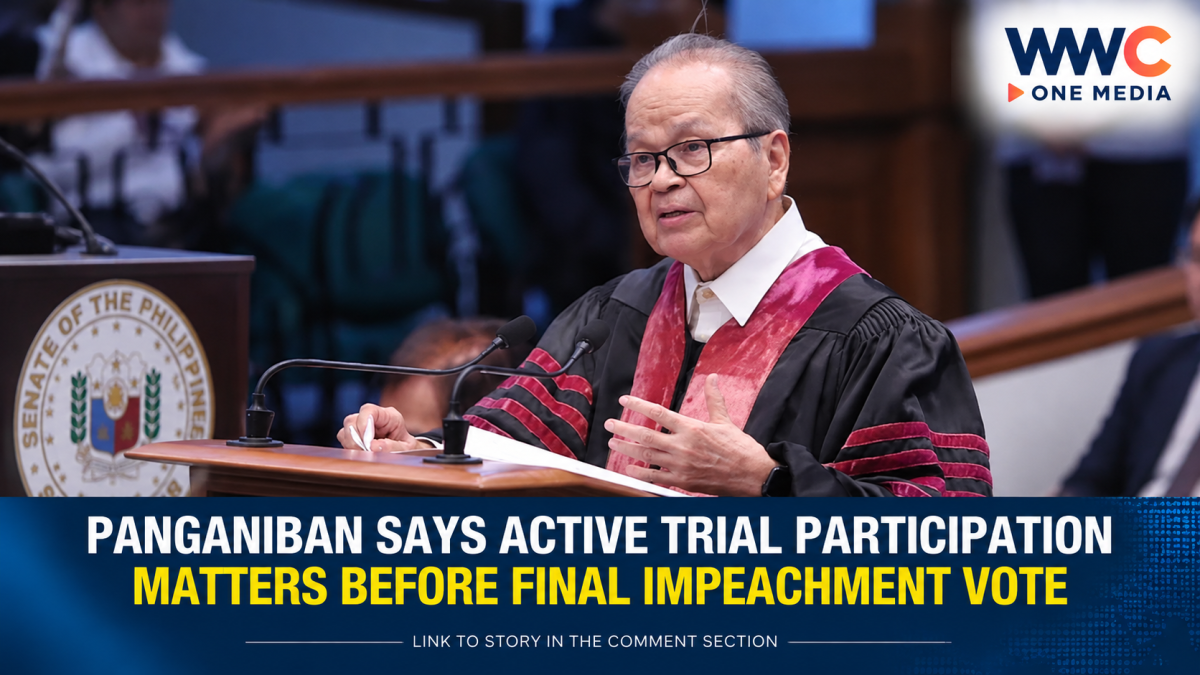
MANILA — Retired Supreme Court Chief Justice Artemio Panganiban has told the Senate impeachment court that senator-judges should personally participate in the trial proceedings before exercising their power to decide the final verdict.
Panganiban is among four retired Supreme Court justices invited by the impeachment court as amici curiae, or “friends of the court,” to provide legal views on a dispute that could affect the eventual vote in the impeachment case against Vice President Sara Duterte.
His position comes as the Senate weighs a key procedural question: How should the required two-thirds vote for conviction be calculated if some senator-judges do not participate in the trial?
Panganiban: Trial Participation Should Come Before Judgment
Panganiban said senator-judges should personally engage with the evidence and proceedings before taking part in the final decision.
The former chief justice’s argument centers on the nature of impeachment proceedings: senators serving as impeachment judges are expected to hear the case before exercising their constitutional authority to determine whether an impeachable official should be convicted.
The Philippine News Agency reported that Panganiban emphasized the importance of personal participation in the trial before voting on the merits of the case.
The issue has become particularly significant because not all members of the Senate have participated in the proceedings.
Why the Voting Threshold Is Now Under Scrutiny
Under the 1987 Constitution, conviction in an impeachment trial requires the concurrence of at least two-thirds of all the Members of the Senate.
With a 24-member Senate, that translates to 16 votes if all 24 senators are counted.
The legal dispute is whether the phrase “all the Members of the Senate” should continue to mean all 24 senators even when some senator-judges have not participated in the trial, or whether nonparticipating members should be treated differently when calculating the threshold.
That distinction could have major procedural consequences for the eventual vote.
Four Retired Justices Asked to Advise the Senate
The impeachment court has sought views from four former Supreme Court justices: Artemio Panganiban, Reynato Puno, Hilario Davide Jr. and Adolfo Azcuna.
They were invited as amici curiae to help the Senate resolve the constitutional and procedural questions surrounding the conviction threshold.
The Senate is not required to adopt every opinion presented by an amicus curiae. Their role is to provide legal analysis that can assist the impeachment court as it considers the disputed issue.
A separate legal paper from San Beda University College of Law dean Fr. Ranhilio Aquino has also been incorporated into the Senate’s review of the threshold question, showing how closely the court is examining the constitutional language before the final vote.
The Debate Comes as the Trial Continues
The question over the voting requirement comes while the impeachment trial itself continues to develop.
Recent proceedings have included disputes over evidence, witnesses and the prosecution’s presentation of its case. The House prosecution team has also withdrawn several planned witnesses, changing the direction of the proceedings.
Meanwhile, the Senate impeachment court continues to consider how the final decision should be reached under the Constitution and its own rules.
The threshold debate therefore concerns procedure rather than the merits of the allegations against Duterte. Whether the Vice President should ultimately be convicted or acquitted remains a matter for the senator-judges after the trial process.
Why Panganiban’s View Matters
Panganiban’s intervention puts the spotlight on a basic question of impeachment judging: Can a senator who has not meaningfully participated in hearing the evidence still take part in the final judgment?
His view adds another dimension to the Senate’s ongoing examination of the two-thirds requirement.
Other retired justices and legal experts have been asked to address the same constitutional question, and their interpretations may differ. The Senate impeachment court will ultimately determine how the relevant constitutional provision applies to the proceedings before it.
For now, the Senate faces two separate questions: how the trial should proceed under its rules, and how the Constitution’s two-thirds requirement should be applied when the final vote arrives.
And with the final decision still ahead, the legal debate over who counts in that final vote — and how many votes will actually be required — remains one of the most closely watched issues in the impeachment proceedings.




Leave a Reply