
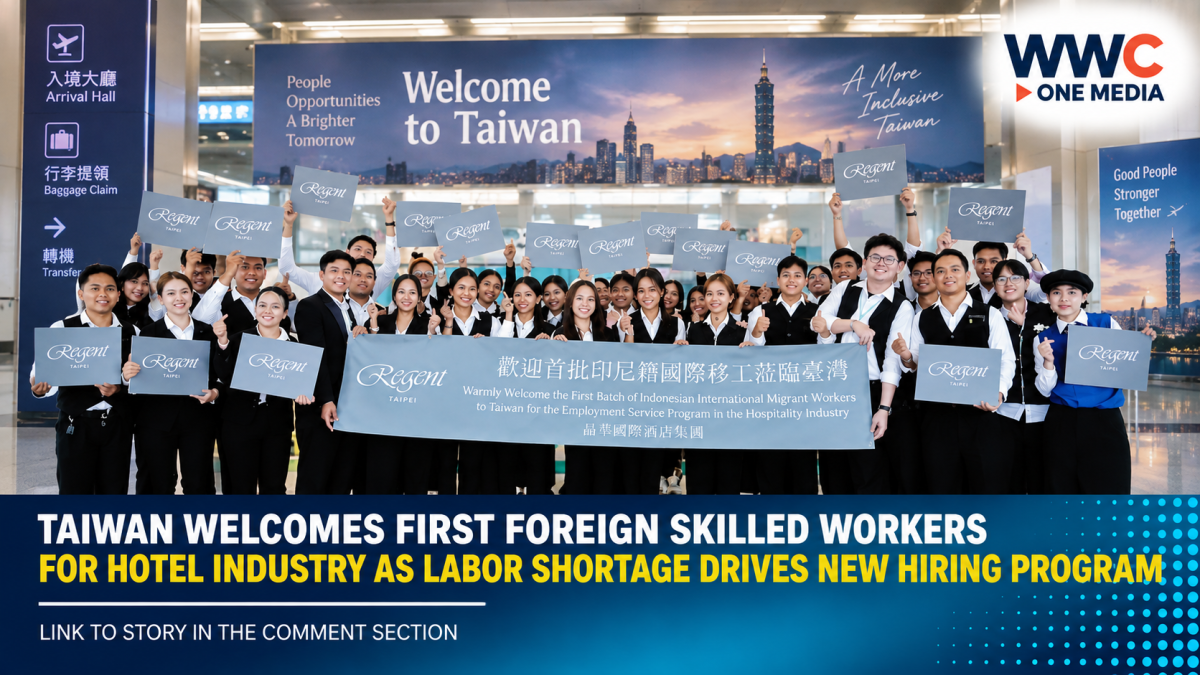
TAIPEI — Taiwan has welcomed its first group of foreign skilled workers recruited specifically for the hospitality industry, marking a major step in the government’s effort to tackle persistent labor shortages in hotels and tourism.
A group of 35 Indonesian workers arrived in Taiwan on September 14, becoming the first foreign skilled workers to enter the country under the government’s new Multinational Skilled Worker Enhancement Program for the hospitality sector. The workers were recruited by Regent Taipei.
The arrival follows Regent Taipei’s approval to recruit Indonesian workers under a new system launched by Taiwan’s Ministry of Labor in January 2026.
Why Taiwan is opening hotel jobs to foreign skilled workers
Taiwan’s hospitality industry has been struggling with a persistent shortage of workers, a problem intensified by the country’s declining birth rate and rapidly aging population.
The Ministry of Labor said the hospitality sector faces an annual labor shortage of approximately 6,000 workers, making recruitment a growing challenge for hotels and other tourism businesses.
The new program is designed to supplement Taiwan’s domestic workforce while also improving employment conditions for local workers.
Under the program, participating hotels can hire foreign skilled workers at a 1-to-1 ratio if they raise the wages of their lowest-paid full-time local entry-level workers by at least NT$2,000.
That requirement is intended to ensure foreign recruitment does not simply become a substitute for improving wages for Taiwanese workers.
Who are the first workers?
The first arrivals are Indonesian workers who already have experience with Taiwan’s hospitality industry.
According to Taiwan’s Ministry of Labor, the workers had previously undergone training and internships at Regent Taipei. That experience means they are already familiar with hotel operations, Taiwan’s workplace environment and local working culture.
Their duties can include areas such as housekeeping, cleaning, reservations and guest reception, depending on their roles. Some also have Mandarin or English-language skills.
The workers are classified as foreign skilled workers rather than general migrant workers, reflecting the government’s emphasis on prior experience, technical ability and language skills.
They will also be required to reach at least A2-level Mandarin speaking or listening proficiency within three years of beginning employment in Taiwan.
Regent Taipei became the industry’s first
Regent Taipei was the first hospitality business to receive approval under the new system.
Taiwan’s labor authorities initially announced in August that the hotel had obtained employment permits for 37 Indonesian workers, making it the first hotel to use the expanded foreign-skilled-worker framework.
The subsequent arrival of 35 workers represents the first actual entry of foreign skilled workers under the new hospitality recruitment mechanism.
Interest from other hotels is already growing
Regent Taipei is unlikely to remain the only hotel using the program.
By the end of August, more than 60 hospitality businesses had applied to participate in overseas recruitment, with requests covering more than 600 workers, according to Taiwan’s Ministry of Labor.
That suggests the program could expand significantly if hotels continue to face difficulty filling positions.
The Indonesian Economic and Trade Office in Taipei also said it had already received several job orders from other Taiwanese hotels and was working to verify them.
A new chapter for Taiwan’s tourism industry
The policy represents a significant change for Taiwan’s hospitality sector.
For years, hotels have relied heavily on local workers and international students participating in internship programs to help fill staffing gaps. The new framework creates a formal pathway for qualified foreign workers to move into skilled hospitality positions.
It also comes amid broader efforts to make Taiwan’s tourism industry more competitive as international travel continues to recover.
However, Taiwan has previously faced concerns over the treatment and protection of foreign hospitality interns. A June investigation by Taiwan’s Control Yuan highlighted issues surrounding insurance and other labor protections for foreign students participating in hotel internships.
The new skilled-worker system therefore places greater emphasis on formal employment arrangements and recruitment rules.
More than just filling empty positions
Taiwan’s government is presenting the initiative as more than a solution to worker shortages.
By requiring participating employers to raise the wages of qualifying local workers before gaining access to foreign-skilled labor, officials are attempting to create a system in which foreign recruitment supplements rather than simply replaces the domestic workforce.
If the program succeeds, Taiwan could have a new model for dealing with labor shortages in an aging society: attract experienced workers from abroad while simultaneously improving conditions for workers already employed locally.
For the country’s hotels, the first arrival of Indonesian workers could be just the beginning.
With more than 60 businesses already showing interest, the bigger question now is how quickly Taiwan’s foreign-skilled hospitality workforce will grow — and how much it could reshape the country’s tourism industry.




Leave a Reply