
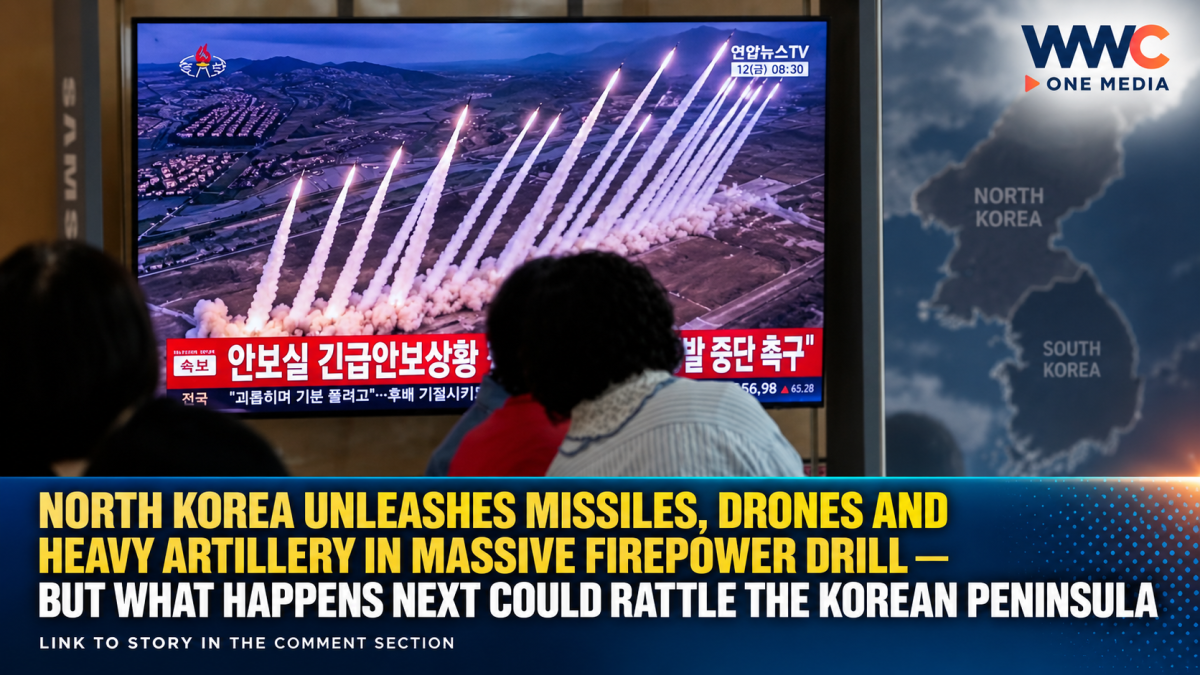
SEOUL — North Korea has staged a major live-fire exercise involving missiles, long-range artillery and attack drones, declaring that the coordinated operation demonstrated what it described as the country’s “huge destructive power” amid renewed military tensions on the Korean Peninsula.
The exercise was conducted on September 12 and involved selected units from five North Korean artillery and missile formations, according to the country’s state-run Korean Central News Agency (KCNA). The report was released two days later.
The drill came shortly after the United States, South Korea and Japan concluded their five-day Freedom Edge military exercise, a trilateral operation that Pyongyang has repeatedly condemned as a provocation.
Missiles, drones and rocket launchers used in coordinated drill
According to KCNA, the exercise brought together several weapons systems, including attack drones, tactical cruise missiles, tactical ballistic missiles and large-caliber multiple rocket launchers.
North Korea said the exercise was designed to improve its ability to coordinate different weapons under an integrated fire-control system and to strengthen the readiness of its forces for rapid military action.
North Korean officials also claimed that the weapons used in the exercise successfully hit their targets with 100 percent accuracy.
That claim, however, cannot be independently verified.
South Korea’s military separately confirmed that North Korea launched multiple short-range ballistic missiles from the Wonsan area on its eastern coast on September 12. The missiles traveled approximately 250 kilometers (155 miles) toward the East Sea, according to South Korea’s Joint Chiefs of Staff.
Why the timing matters
The timing of the launches has drawn particular attention.
The North Korean firing drill came just after the United States, South Korea and Japan completed Freedom Edge, a trilateral military exercise conducted in international waters.
Pyongyang has long viewed joint military exercises involving Washington and Seoul as preparation for a potential attack, while the participating countries describe such exercises as defensive and designed to strengthen deterrence and coordination.
The latest launches therefore appear to serve two purposes: demonstrating military capabilities while sending a political message to Washington, Seoul and Tokyo.
Reuters reported that the September 12 launches represented North Korea’s 13th ballistic missile launch of 2026, according to South Korean assessments.
Kim Jong Un was notably absent
One of the more significant details surrounding the exercise is that North Korean leader Kim Jong Un did not personally attend.
Instead, the drill was observed by Pak Jong Chon, vice chairman of North Korea’s Central Military Commission, according to KCNA and Yonhap.
That absence has prompted analysts to view the exercise somewhat differently from high-profile weapons demonstrations personally overseen by Kim.
South Korean media have noted that Pyongyang also disclosed the exercise after a delay, while the announcement appeared through KCNA rather than the country’s main domestic party newspaper. That may indicate an effort to signal military capability internationally while keeping the messaging somewhat more controlled.
A warning after US military exercises?
The drill also comes against the backdrop of Washington’s recent efforts to reduce the scale of some joint military exercises with South Korea.
US President Donald Trump previously ordered a substantial reduction in a major bilateral military exercise with Seoul, describing his relationship with Kim Jong Un positively and signaling an interest in diplomacy.
North Korea, however, rejected the gesture, arguing that reducing the exercise did not change what Pyongyang regarded as its hostile character.
That leaves the region facing an increasingly complicated situation: Washington has signaled an interest in diplomacy, while Pyongyang continues to demonstrate and expand its conventional and nuclear-capable military capabilities.
Why the weapons display matters
The significance of the latest exercise goes beyond the number of missiles fired.
The combination of ballistic missiles, cruise missiles, drones and large-caliber rocket systems demonstrates North Korea’s continued focus on integrating different weapons into a coordinated battlefield response.
Analysts cited by international media say such exercises can provide Pyongyang with an opportunity to test command-and-control procedures and gather operational information while simultaneously sending a deterrence message.
AP reported that the coordinated firing could be aimed at improving North Korea’s ability to overwhelm South Korean and US defenses through concentrated firepower.
At the same time, North Korea’s claims about the effectiveness and accuracy of its weapons remain difficult to independently verify.
The bigger question for the Korean Peninsula
For South Korea, the immediate concern is not simply how many missiles North Korea fires, but how quickly Pyongyang can combine different weapons systems in a potential conflict.
The latest exercise demonstrates that North Korea continues to develop a military strategy built around simultaneous and coordinated strikes, even as diplomatic signals between Pyongyang and Washington remain mixed.
The timing is also significant because the exercise followed a major trilateral military operation involving the United States, South Korea and Japan.
For now, there is no indication from the available reports that the latest drill represents the beginning of an imminent conflict. But it does underline how quickly military tensions can rise whenever North Korea, South Korea, the United States and Japan conduct competing demonstrations of military strength.
And with North Korea continuing its missile development while maintaining its nuclear arsenal, the question now is not simply what Pyongyang has demonstrated — but what it could test next.




Leave a Reply