
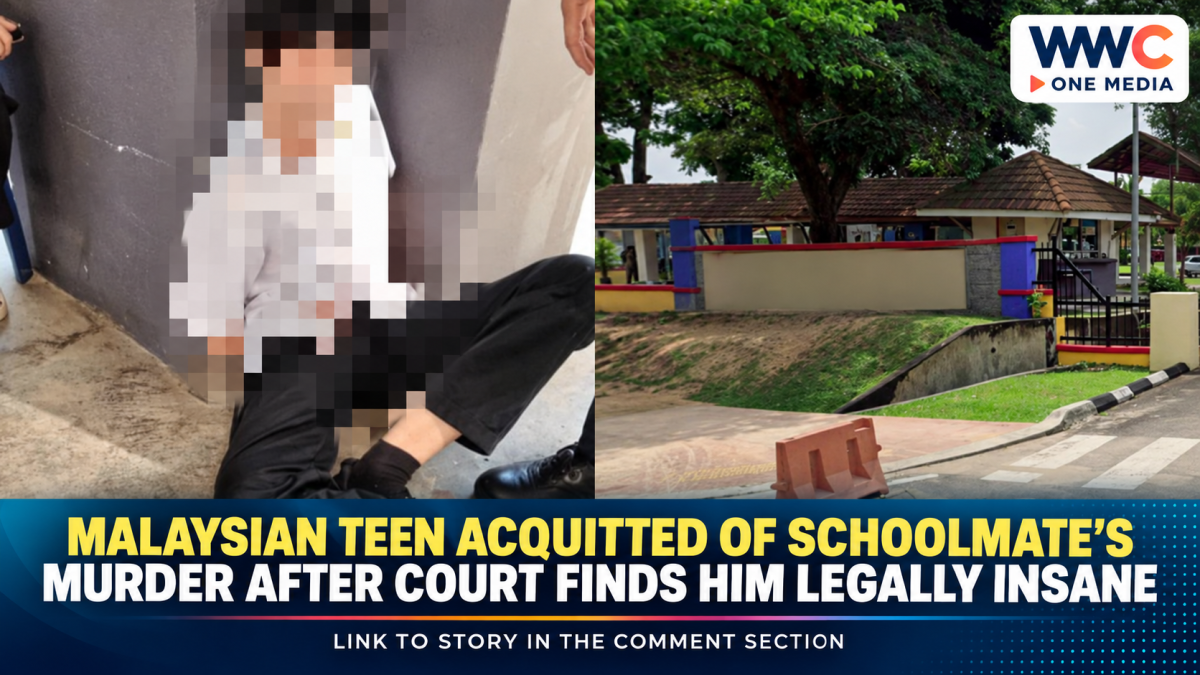
A 15-year-old Malaysian boy has been acquitted of murdering his 16-year-old schoolmate after the High Court in Shah Alam found that he was of unsound mind at the time of the fatal stabbing.
The teenager was accused of killing the girl inside a female students’ toilet at a secondary school in Bandar Utama, Petaling Jaya, on Oct 14, 2025.
Instead of being released, however, the boy was ordered to undergo psychiatric treatment at Hospital Bahagia Ulu Kinta in Perak. The period of his detention will be determined with the approval of the Sultan of Selangor.
Court accepts insanity defence
Judge Adlin Abdul Majid ruled that the defence had successfully established that the teenager was legally insane when the killing occurred.
His lawyer, Kitson Foong, said the court accepted the defence’s reliance on Section 84 of Malaysia’s Penal Code, which provides an exception to criminal responsibility when a person is incapable of understanding the nature of an act or that it is wrong because of a mental disorder.
The court accepted evidence from consultant forensic psychiatrist Dr Ian Lloyd Anthony, who diagnosed the teenager with severe and aggressive schizophrenia.
According to the defence, the condition caused the boy to lose his sense of identity. He believed he was a god and reported hearing voices giving him instructions.
The prosecution did not dispute the psychiatrist’s evidence.
Fatal school stabbing shocked Malaysia
The incident occurred on the morning of Oct 14, 2025, at a secondary school in Bandar Utama.
The teenager was accused of stabbing his female schoolmate, who was a Form 4 student, inside a girls’ toilet between about 9.20am and 9.35am.
The victim, Yap Shing Xuen, was 16 at the time of her death.
The case drew widespread attention across Malaysia because it involved a fatal attack between students inside a school and prompted broader discussions about youth violence, mental health and the safety of children in schools.
The teenager, who was around 14 when the incident occurred, was subsequently arrested and charged with murder.
Because he is a minor, Malaysian law prohibits the publication of his identity and photographs.
Teen had been ruled fit to stand trial
The case went through several stages of psychiatric assessment.
In January, the teenager was reported to have been found fit to stand trial and capable of mounting a defence after undergoing assessment at Hospital Bahagia Ulu Kinta.
He later pleaded not guilty to the murder charge.
The trial began in August, with prosecutors calling 11 witnesses, including medical and forensic witnesses as well as people involved in the investigation.
The defence called two witnesses, including the teenager himself.
The court subsequently ruled that there was a case for the teenager to answer and required him to enter his defence.
Murder charge carried severe penalties
The teenager had been charged under Section 302 of the Penal Code.
For an adult, a murder conviction under the provision can result in the death penalty or a prison sentence of between 30 and 40 years, together with whipping in circumstances where the death penalty is not imposed.
However, the boy was under 18 when the offence allegedly occurred.
Malaysia’s Child Act 2001 prohibits the death penalty for offenders below 18. If convicted of an offence punishable by death, a child may instead be detained for a period determined under the law and subject to the relevant royal authority.
The insanity ruling meant the teenager was acquitted rather than convicted.
Acquittal does not mean immediate freedom
The court’s decision does not mean the teenager simply walks out of custody.
Following the acquittal, the court ordered him to be placed at Hospital Bahagia Ulu Kinta for treatment and supervision.
The arrangement is intended to address the psychiatric condition that the court found affected his mental state when the killing occurred.
His lawyer said treatment would begin immediately and that recovery would take time.
The judge also reminded the teenager to recognise that his actions had resulted in the loss of a life and urged him to appreciate the second chance he had been given.
Proceedings were held behind closed doors
Because the accused is a minor, the proceedings were conducted in camera.
His identity cannot be disclosed, and members of the public were not allowed to attend the proceedings.
The victim’s family was present at court for the decision.
The ruling brings a major legal chapter in the case to a close, but the teenager’s psychiatric treatment and detention will continue under the court’s order.
A case that raises difficult questions
The verdict highlights the difficult intersection between criminal responsibility, childhood and severe mental illness.
The court did not dispute that a fatal stabbing occurred. Instead, the central legal issue was whether the teenager possessed the mental capacity required for criminal responsibility at the time.
The finding of legal insanity means the court accepted that his psychiatric condition fundamentally affected his ability to understand his actions.
For the victim’s family, however, the ruling comes after the loss of a 16-year-old girl in a case that shocked the country.
For Malaysia, the case is also likely to keep attention focused on how the justice system should respond when children accused of serious violence are themselves suffering from severe psychiatric disorders.
For now, the teenager remains under psychiatric care rather than returning to the community, with his future dependent on his treatment and the legal orders governing his detention.




Leave a Reply