
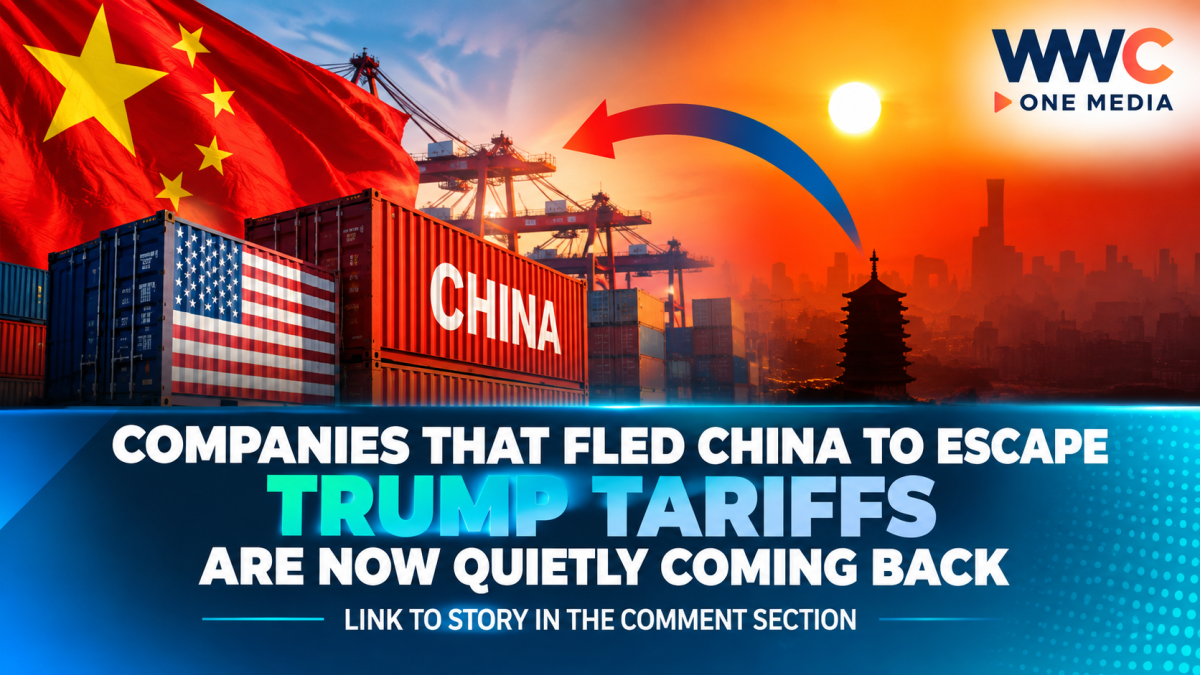
Companies that shifted production out of China to avoid US tariffs are beginning to rethink that strategy, with some bringing orders back to Chinese factories after discovering that cheaper alternatives can come with much higher hidden costs.
The reversal highlights a surprising consequence of the US-China trade war: tariffs were intended to reduce American companies’ dependence on Chinese manufacturing, but the difficulty of rebuilding China’s vast industrial ecosystem elsewhere is making some businesses reconsider how far they should move.
For years, companies adopted a “China plus one” strategy, shifting part of their manufacturing to countries such as Vietnam, India and Thailand while keeping some production in China.
Now, for some manufacturers, the equation is changing.
Leaving China proved harder than expected
Moving production to another country can look attractive when tariffs are calculated on a spreadsheet.
But companies have discovered that manufacturing is not simply about the cost of assembling a product.
China has built an enormous network of specialised suppliers, skilled workers, machinery manufacturers, logistics companies and supporting industries that can work together within a relatively small geographic area.
Replicating that ecosystem elsewhere can take years.
Businesses that moved production to Southeast Asia or South Asia have encountered difficulties finding suitable suppliers, training workers, securing equipment and maintaining consistent production quality.
The result is that some of the tariff savings have been offset by higher operating and logistics costs.
Some companies are sending orders back
Several businesses that previously shifted production away from China are now returning some orders to Chinese suppliers.
Metal manufacturer Dawang Metals, for example, moved some production overseas in response to tariffs but later found that China’s established manufacturing network remained difficult to replicate.
US retailer Target has also shifted some orders back to Chinese suppliers as the economics of manufacturing in alternative locations have changed.
Other companies have decided that maintaining a larger manufacturing base in China makes more sense than continuing to expand overseas facilities.
The trend does not mean companies are abandoning diversification altogether.
Instead, many are becoming more selective about where individual products are made.
Vietnam and India are not automatically cheaper
Vietnam and India have been among the biggest beneficiaries of the global push to diversify away from China.
Both countries have attracted factories and investment from companies seeking lower labour costs and reduced exposure to US tariffs on Chinese goods.
But lower wages do not automatically translate into lower overall manufacturing costs.
Companies must also consider electricity, infrastructure, transportation, supplier availability, worker productivity, production scale and the cost of importing components.
A factory may be cheaper to operate on paper while still being more expensive once the entire supply chain is taken into account.
That is particularly important for products requiring hundreds of components from specialised suppliers.
China’s biggest advantage is its manufacturing ecosystem
China’s manufacturing strength goes far beyond cheap labour.
The country has spent decades developing industrial clusters where suppliers, factories and logistics companies operate close to one another.
A manufacturer can often source components, packaging, machinery and specialised services within the same region.
Factories can also scale production rapidly because supporting suppliers already exist.
That makes China particularly difficult to replace for complex products.
Companies moving production to countries with less-developed supplier networks may have to import components from China anyway, reducing some of the advantages of relocating.
Tariff differences have also changed
Another factor is that the tariff advantage of moving production out of China has narrowed in some cases.
Companies initially faced strong incentives to move because Chinese products were hit with substantially higher US tariffs than goods from countries such as Vietnam or Thailand.
But as US trade policy has evolved, the gap has become less straightforward.
Businesses are therefore reassessing whether the additional costs and risks of relocating production are justified by the remaining tariff savings.
For some products, the answer is increasingly no.
The “China plus one” strategy is changing
The global supply-chain strategy that emerged during the first US-China trade war was often described as “China plus one”.
Instead of completely abandoning China, companies would maintain Chinese production while establishing an additional manufacturing base elsewhere.
The approach became even more popular after the pandemic, when factory shutdowns and shipping disruptions exposed the risks of relying heavily on a single country.
But the latest developments suggest some companies are moving toward an even more flexible model.
Rather than deciding that China or another country must become their primary manufacturing base, businesses are increasingly choosing production locations product by product.
A company might manufacture labour-intensive products in Vietnam, maintain sophisticated production in China and assemble certain goods closer to US customers.
Geopolitical risks remain
The return of some production to China does not mean geopolitical concerns have disappeared.
US-China tensions remain a major risk for multinational companies.
Future tariffs, export controls, sanctions and restrictions on sensitive technologies could once again change the economics of manufacturing in China.
Companies also remain concerned about potential disruptions caused by worsening relations between Beijing and Washington.
That means many businesses are reluctant to completely reverse their diversification plans.
Instead, they are trying to maintain multiple options.
China remains difficult to replace
The broader lesson from the latest supply-chain shifts is that tariffs can change where companies manufacture, but they cannot easily recreate the industrial infrastructure that has developed in China over several decades.
China continues to have enormous advantages in supplier density, manufacturing scale, skilled labour, infrastructure and logistics.
Those advantages can outweigh tariff savings when companies attempt to move complex production elsewhere.
At the same time, Southeast Asia and India are still attracting substantial investment, meaning the diversification trend has not disappeared.
Instead, the global manufacturing map is becoming more complicated.
The trade war has created an unexpected outcome
The return of some production to China illustrates the limits of using tariffs as a tool to reshape global supply chains.
The original goal was to make China less attractive as a manufacturing base and encourage companies to establish production elsewhere.
That strategy has worked in some industries.
But in others, companies are discovering that leaving China comes with costs that are difficult to see in the headline tariff rate.
For manufacturers, the lesson is increasingly clear: avoiding tariffs is only one part of the calculation.
When the cost of rebuilding an entire supply chain becomes greater than the tariff itself, China can once again become the more economical choice.
And that could make the next phase of the global trade war less about companies abandoning China altogether and more about businesses deciding exactly how much of China they can realistically afford to leave behind.




Leave a Reply