
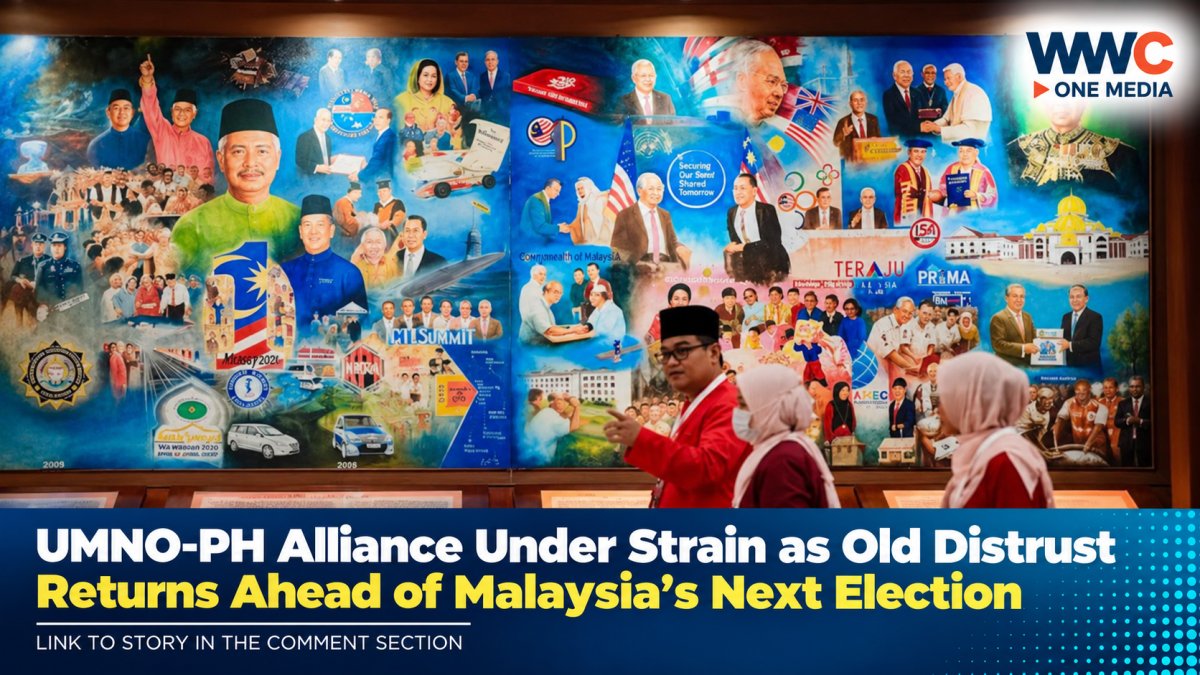
KUALA LUMPUR, Malaysia — Nearly four years of governing together have failed to erase decades of political rivalry between UMNO and Pakatan Harapan (PH), with tensions inside Malaysia’s unity government becoming increasingly difficult to ignore.
The unlikely partnership was forged after the 2022 general election produced a hung parliament. Former political rivals were brought together under Prime Minister Anwar Ibrahim to create a government capable of commanding a parliamentary majority.
But as Malaysia moves closer to its next general election, old political wounds are resurfacing—and UMNO’s distrust of key PH allies, particularly the Democratic Action Party (DAP), remains a major fault line.
An alliance born from political necessity
The UMNO-PH partnership was never a conventional political marriage.
UMNO and its Barisan Nasional coalition had dominated Malaysian politics for decades before losing federal power in 2018. PH, meanwhile, had campaigned as an opposition force promising political and institutional reform.
The 2022 election changed the equation.
Neither PH nor the opposing Perikatan Nasional (PN) coalition secured enough seats to govern alone. The resulting political deadlock eventually produced the unity government led by Anwar, bringing former rivals into the same administration.
The arrangement ended a period of intense political instability—but it did not erase the ideological differences separating the parties.
UMNO’s latest assembly exposes the old fault lines
Those differences were particularly visible during UMNO’s annual general assembly on September 12.
According to The Straits Times, UMNO delegates openly criticised DAP, with Penang delegate Zaidi Said accusing the party of undermining UMNO’s mission to champion Malay interests.
The tone was significant because UMNO president Ahmad Zahid Hamidi was reported to have smiled and nodded during the speech.
Another symbolic development was the absence of PH leaders from this year’s UMNO assembly. Unlike in 2023, when Anwar was invited to address the gathering, PH’s coalition partners were not invited to the 2026 event.
Instead, representatives of opposition PAS were given prominent seating, highlighting the shifting political calculations inside UMNO.
The Najib issue adds another layer of tension
The relationship has also been tested by the continuing political fallout surrounding former prime minister Najib Razak, an influential UMNO figure who remains imprisoned over corruption convictions linked to the 1MDB scandal.
Najib has sought a new royal pardon, while PH has stressed that people convicted in major corruption cases should serve their court-ordered sentences.
UMNO leaders have pushed back against PH’s position, with party secretary-general Asyraf Wajdi Dusuki questioning whether the government was applying consistent standards.
Malaysia’s King Sultan Ibrahim subsequently deferred a decision on Najib’s latest clemency request at a pardons board meeting on September 11.
The issue demonstrates how easily legal questions can become politically sensitive when they involve a former prime minister and one of the most powerful parties in the governing coalition.
The next election is changing the calculation
For years, cooperation has been sustained by the practical need to keep the unity government functioning.
But elections change incentives.
As parties prepare for the next national contest, they must simultaneously defend their own political identities and maintain enough cooperation to prevent the government from collapsing.
For UMNO, that means remaining relevant to Malay voters while governing alongside PH parties that have historically represented a very different political constituency.
For PH, particularly DAP, the challenge is maintaining its reform-oriented identity while working with a party that was once its principal political adversary.
That balancing act becomes harder as campaigning approaches.
Four years together—but trust remains fragile
The unity government has demonstrated that former rivals can cooperate when political circumstances require it.
But cooperation should not be confused with reconciliation.
The latest UMNO assembly showed that decades of political distrust cannot simply disappear because two parties share cabinet tables.
The question now is whether UMNO and PH can keep their differences contained long enough to complete the government’s mandate—or whether electoral pressures will eventually push the partners in opposite directions.
Malaysia’s next election may therefore become more than a contest between political coalitions.
It could also become the moment when voters discover whether the country’s unlikely political marriage was strong enough to survive the return of old rivalries.



Leave a Reply