
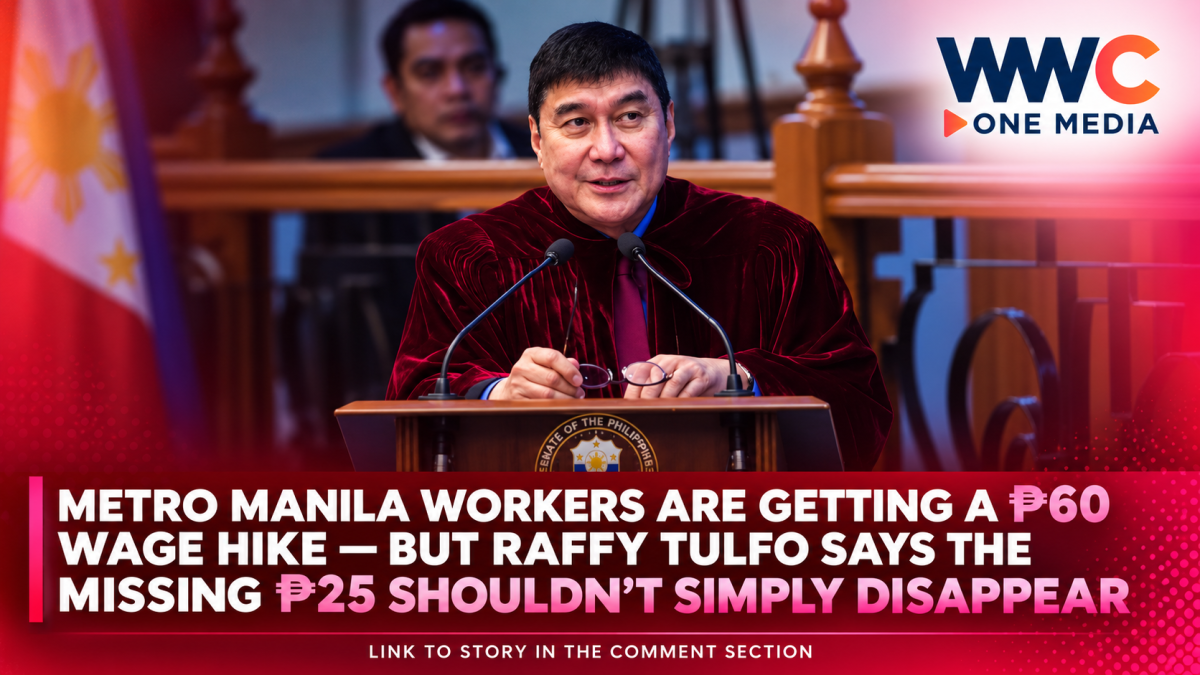
MANILA, Philippines — Metro Manila’s minimum-wage workers are finally set to receive a new ₱60 daily pay increase beginning September 26, but Sen. Raffy Tulfo says the government should not treat that increase as the end of a much bigger wage battle.
Tulfo is urging the Department of Labor and Employment to continue defending the earlier ₱85 daily wage increase under Wage Order NCR-27, which remains caught in a court dispute months after it was approved.
For the senator, the issue comes down to a simple question: If workers were already granted ₱85, what happens to the other ₱25 now that the government has issued a separate ₱60 wage order?
Tulfo, vice chairperson of the Senate Committee on Labor and Employment, acknowledged the newly issued ₱60 increase but stressed that it is still lower than what Metro Manila workers were originally supposed to receive.
He urged DOLE not to abandon the legal fight surrounding the older wage order, arguing that workers continue to face rising prices and need every peso of the previously approved adjustment.
A new ₱60 wage order takes effect September 26
DOLE announced on September 11 that Wage Order NCR-28 will raise Metro Manila’s daily minimum wage by ₱60 effective September 26, 2026.
For non-agricultural workers, the daily minimum wage will rise from ₱695 to ₱755.
Workers in agriculture and other establishments covered by the lower minimum-wage category will also receive a ₱60 increase.
DOLE said the order went through the established tripartite wage-setting process and promised to monitor employers’ compliance once it takes effect.
For hundreds of thousands of workers struggling with food, transport, rent and utility costs, the increase provides immediate relief.
But the new order has also opened a fresh controversy.
That is because Metro Manila workers had already been granted an even larger increase just months earlier.
What happened to the original ₱85 increase?
Under Wage Order NCR-27, Metro Manila’s regional wage board approved a total ₱85 daily increase to be implemented in two stages.
The first ₱60 tranche was scheduled to take effect on July 25, while another ₱25 was due on January 20, 2027.
Full implementation would have raised the non-agricultural minimum wage from ₱695 to ₱780 per day.
But two construction companies — Readycon Trading and Construction Corp. and R-II Builders Inc. — challenged the wage order in court.
The Pasig City Regional Trial Court initially issued an order stopping its implementation and later granted a preliminary injunction while the companies’ challenge was being litigated.
The court said temporarily freezing the wage order would allow the rights and interests of both employers and workers to be considered while the dispute was resolved.
Labor organizations fiercely opposed the ruling, arguing that wage-setting disputes should be handled through the mechanisms provided under labor law rather than halted by lower courts.
The National Wages and Productivity Commission has also publicly defended the validity of Wage Order NCR-27 and said it would pursue appropriate legal remedies.
The wage battle has reached the Supreme Court
The dispute is no longer confined to the Pasig court.
Labor organizations and worker representatives have gone to the Supreme Court, asking the tribunal to overturn orders blocking the ₱85 increase.
On August 26, the Supreme Court directed Readycon, R-II Builders and another respondent to comment on a petition challenging court actions involving Wage Order NCR-27.
The petition also asks the high court to stop further proceedings in the lower-court cases.
Importantly, the Supreme Court’s action requiring comments was not yet a final ruling on whether the injunction was valid or whether the ₱85 increase must immediately be implemented.
That legal question therefore remains unresolved.
DOLE, for its part, has already sought reconsideration of the injunction before the Pasig RTC. Labor Secretary Francis Tolentino personally joined the filing of the government’s motion in August.
Tulfo: Don’t forget the other ₱25
That unresolved case is exactly why Tulfo says DOLE must keep fighting.
The senator said that while the ₱60 wage increase should be properly implemented, the government should not simply disregard Wage Order NCR-27.
Tulfo has portrayed the difference between the two wage orders as effectively depriving workers of ₱25 that had previously been approved.
Technically, the new order does not cut today’s ₱695 minimum wage. It increases it by ₱60.
But Tulfo’s argument is that compared with the ₱85 total increase already approved under the earlier order, workers would end up ₱25 short if Wage Order NCR-27 is ultimately abandoned.
That distinction is important.
Calling the ₱60 order an outright wage “decrease” could be misleading because wages are still rising from their current statutory base. It is a smaller increase than the previously approved ₱85 package, rather than a ₱25 cut from workers’ existing salaries.
Labor groups are asking the same question
Tulfo is not alone.
The Trade Union Congress of the Philippines and other labor organizations have questioned why a new ₱60 order was necessary while the original ₱85 order remains the subject of litigation.
Some labor groups fear Wage Order NCR-28 could weaken the push to preserve the additional ₱25 contained in the previous order.
Others have welcomed the immediate relief while insisting the legal fight over NCR-27 must continue.
The Federation of Free Workers has argued that the new wage order does not automatically make its challenge over Wage Order NCR-27 irrelevant.
That means workers could potentially receive the ₱60 increase under NCR-28 while litigation over the remaining benefits associated with NCR-27 continues — although exactly how the two orders interact could ultimately depend on court and wage-board decisions.
Employers had challenged the wage-setting process
The companies that went to court have challenged the validity of Wage Order NCR-27, including whether employers’ capacity to pay was adequately considered.
The Pasig RTC’s August 13 order called for a ₱10-billion injunction bond in connection with the preliminary injunction. Labor groups later questioned the status of that bond and argued that the suspension should not continue if the required conditions were not met.
The dispute exposes the difficult balance at the center of Philippine wage policy.
Workers argue that minimum pay has struggled to keep pace with basic living costs.
Businesses, especially smaller companies and labor-intensive industries, argue that sharp increases can raise operating costs and threaten jobs if employers cannot absorb them.
Regional wage boards are legally tasked with weighing those competing interests.
DOLE itself has said the wage-setting process considers workers’ needs, socioeconomic conditions and employers’ ability to pay.
Tulfo wants courts stopped from freezing future wage orders
Tulfo is also seeking a longer-term legislative solution.
He has backed a bill that would make it clearer that lower courts cannot halt the implementation of wage orders through temporary restraining orders or preliminary injunctions.
The senator has argued that wage orders already undergo public hearings, economic studies and tripartite consultations among government, employers and labor representatives.
Allowing lengthy litigation to repeatedly delay increases, he argues, can defeat the purpose of granting workers timely relief.
The controversy has also highlighted Article 126 of the Labor Code, which labor advocates have cited in arguing that courts should not interfere with wage-board proceedings.
The courts, employers, labor groups and government agencies have nevertheless advanced competing interpretations of how that provision applies to challenges against completed wage orders — one reason the pending Supreme Court cases could have consequences far beyond the current ₱85 dispute.
Workers now face two dates — and one unresolved question
For now, one date is clear.
September 26, 2026: Wage Order NCR-28 takes effect, raising the non-agricultural Metro Manila minimum wage to ₱755 per day.
What remains unclear is whether workers will eventually secure the additional ₱25 originally promised under Wage Order NCR-27.
The Supreme Court has not yet issued a final judgment on the legal challenges surrounding the older wage order, and Tulfo wants DOLE to make sure that battle continues.
So while Metro Manila workers can expect ₱60 more in their daily minimum wage, the country’s bigger wage fight is far from settled.
Because behind the new ₱60 increase is a question that could ultimately be worth millions of pesos to Metro Manila’s workforce: What happens to the ₱25 workers were already told was theirs?


Leave a Reply