
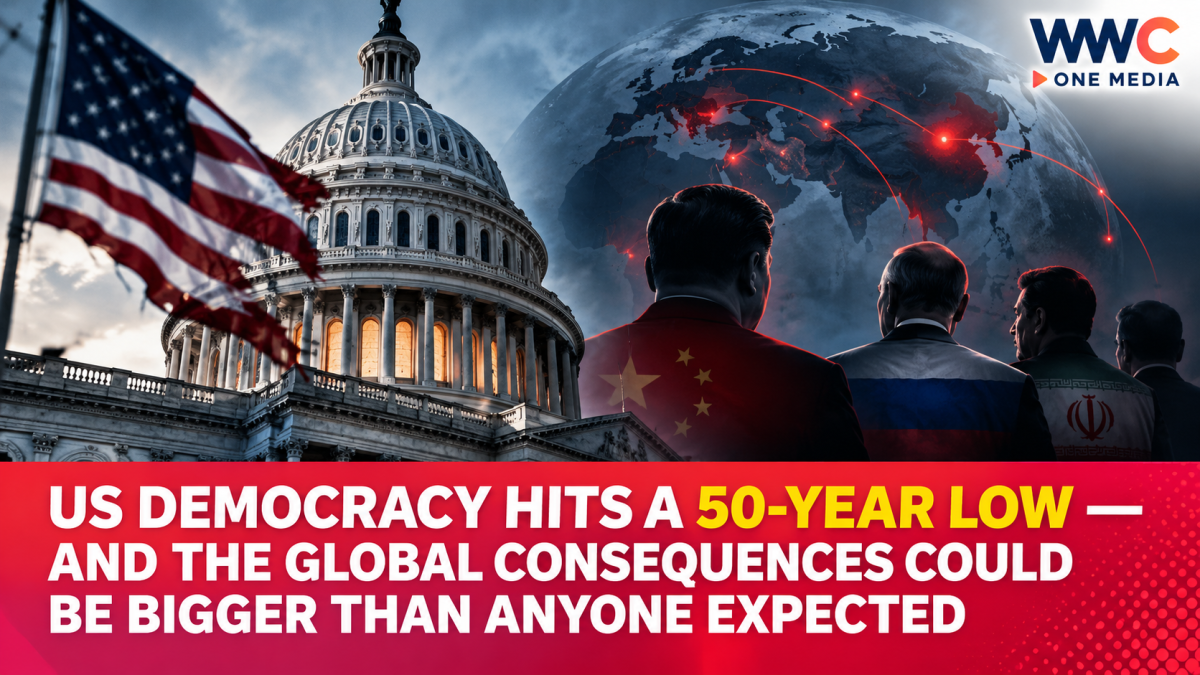
WASHINGTON — Democracy in the United States has deteriorated to levels not seen in decades, according to a major new international assessment that warns the consequences are reaching far beyond American borders.
The findings come from the International Institute for Democracy and Electoral Assistance (International IDEA), whose 2026 Global State of Democracy report was released Tuesday, September 15.
The report, titled “Democracy in an Age of Conflict,” examines democratic performance across 174 countries and warns that declining democratic standards are increasingly intertwined with political instability, weakened institutions and violent conflict.
Among its most closely watched findings is the deterioration of democratic indicators in the United States.
US democratic indicators fall sharply
International IDEA’s assessment points to significant weaknesses in areas including the rule of law, credible elections, freedom of expression, press freedom, judicial independence and access to justice.
Reporting on the findings, The Guardian said key U.S. democracy indicators have fallen to their lowest levels in 50 years. It also reported that International IDEA considers the deterioration in the United States particularly pronounced compared with the broader global decline.
The United States has been considered a democracy experiencing backsliding by International IDEA since 2021, following what the organization described as a visible deterioration beginning several years earlier.
The latest assessment therefore represents more than a snapshot of American politics. It raises a much larger question: what happens to the international democratic system when one of its most influential countries begins moving in the opposite direction?
The world is already in a prolonged democratic downturn
The warning is not limited to the United States.
International IDEA’s research shows that 2025 marked the 11th consecutive year in which more countries experienced democratic decline than improvement—the longest uninterrupted downturn recorded by the organization.
The organization’s 2026 report says democratic stagnation and deterioration can be seen in several key areas, including election credibility, legislative effectiveness, freedom of expression and the press, and access to justice.
The rule of law is particularly troubling. According to reporting on the report’s findings, 71 countries—or about 41% of those assessed—were classified as low-performing in rule-of-law measures in 2025, while 29 countries recorded further deterioration.
That erosion matters because democratic institutions do more than organize elections. Courts, legislatures, independent media, electoral bodies and civil society organizations provide mechanisms for resolving political disputes without violence.
When those institutions weaken, political conflicts can become harder to contain.
Why authoritarian leaders could benefit
The weakening of American democratic leadership also has international implications.
A September analysis by the Carnegie Endowment for International Peace argues that the Trump administration has fundamentally repositioned the United States away from decades of bipartisan policies aimed at promoting democracy overseas.
Carnegie says the administration has reduced or reversed several traditional elements of U.S. democracy support, including democracy assistance, institutional capacity and diplomatic pressure on democratic backsliding abroad. It also argues that the United States has become less focused on partnerships based on shared democratic values.
Carnegie’s analysis warns that the change comes at a particularly vulnerable moment because the world has already experienced roughly two decades of democratic recession.
The concern is not simply that Washington may stop promoting democracy. The bigger issue is what fills the vacuum.
Countries such as China and Russia have developed increasingly sophisticated tools for political influence, information operations and transnational authoritarian influence. A 2026 National Endowment for Democracy analysis described the current international environment as increasingly permissive for authoritarian influence, citing weakened international norms, shifting geopolitical alignments and advances in technology.
That does not mean every authoritarian government is directly following Washington’s example. Rather, weakened democratic leadership can reduce the diplomatic, financial and political pressure that once constrained authoritarian behavior.
Democracy and conflict are becoming increasingly connected
International IDEA’s new report goes further by examining the relationship between democracy and security.
The organization says the world is experiencing violent conflict at levels not seen in decades and finds that democratic decline can be associated with increased conflict risk. Countries that possess some democratic institutions but lack genuine political competition or enforceable rights can be particularly vulnerable.
The findings coincide with separate conflict data showing an exceptionally high level of violent conflict in 2025.
The message from International IDEA is therefore not simply that democracy is a political ideal. It argues that democratic resilience can also be a security issue.
Strong institutions can provide peaceful mechanisms for resolving disputes, while institutional breakdown can make political competition increasingly confrontational.
There are still signs of democratic resilience
Despite the grim global picture, the report does not suggest that democracy’s decline is inevitable.
International IDEA highlights democratic progress and political openings in several countries. Recent youth-led movements in countries including Nepal and Bangladesh, for example, have demonstrated that citizens can still mobilize against entrenched political systems. But the organization also warns that replacing political leaders does not automatically produce deep institutional reform.
This distinction is crucial.
A government can change while the institutions beneath it remain weak. Elections can take place while judicial independence, press freedom or civil liberties continue to deteriorate.
The challenge facing democracies is therefore not simply winning elections—it is maintaining the institutions that make democratic government meaningful.
The bigger question for America and the world
The United States remains one of the world’s most influential political, economic and military powers. That makes its domestic democratic trajectory unusually important internationally.
International IDEA’s assessment suggests that developments in Washington can have consequences far beyond U.S. borders, particularly when other governments are already struggling with democratic backsliding.
Carnegie reaches a similar conclusion from a different angle, arguing that the United States’ retreat from its traditional democracy-support role could weaken international organizations, democratic movements and governments confronting authoritarian pressure.
But the situation is not irreversible.
International IDEA itself emphasizes that democratic deterioration can be reversed. The existence of political openings in several countries demonstrates that democratic decline is not necessarily a permanent condition.
The immediate concern, however, is that the world is entering a period in which democratic institutions are weakening at the same time that geopolitical competition and violent conflict are intensifying.
And that leaves a question that could define the next decade:
If the world’s most influential democracies retreat from defending democratic norms, who will step forward—and what kind of global order will emerge in their place?



Leave a Reply