
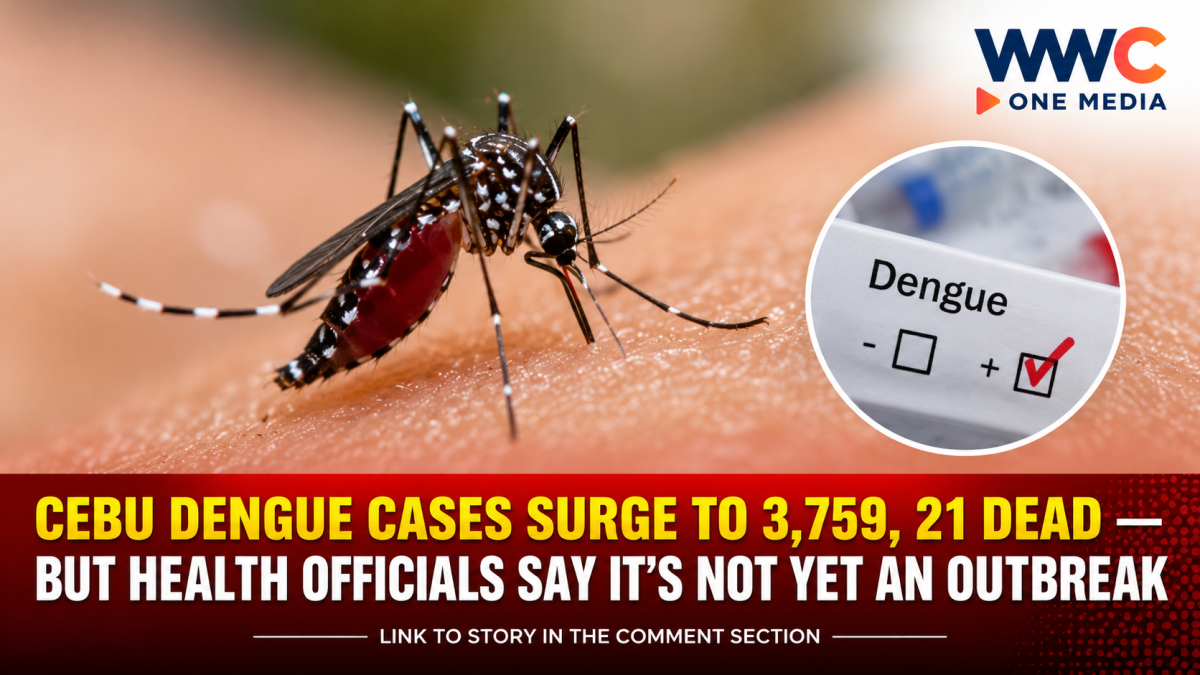
CEBU — Dengue infections in Cebu Province have climbed to 3,759 cases, with 21 reported deaths, putting renewed pressure on health authorities even as officials stress that the province has not yet reached the threshold for declaring a dengue outbreak.
The latest provincial figures come amid a broader rise in dengue infections across Central Visayas, with health authorities stepping up mosquito-control measures and urging residents to eliminate stagnant water where Aedes aegypti mosquitoes can breed.
The increase is particularly concerning because the situation is also worsening in Cebu City, where the City Health Department reported 2,456 dengue cases and 20 deaths from January to September 5, 2026. That compares with 1,485 cases and six deaths during the same period last year.
Cebu Province sees thousands of cases
Recent reports show how quickly the provincial numbers have moved.
The Daily Tribune reported 3,268 dengue cases in Cebu Province from January through August, with cases involving patients ranging from two months old to 93 years old. Talisay City, Medellin, Toledo City, Consolacion, Minglanilla, Cordova and Dalaguete were among the areas reporting the highest numbers.
A separate report from Banat cited 3,251 cases, with 29 additional cases recorded from Sept. 1 at the time of its report. August alone accounted for 1,538 cases, making it the highest monthly tally reported in that update.
The latest figure of 3,759 cases and 21 deaths therefore represents a further increase as September surveillance data are added.
Cebu City is facing an even sharper increase
The situation in Cebu City has also become more serious.
According to The Freeman, dengue cases in the city reached 2,456 as of Sept. 5, compared with 1,485 during the comparable period in 2025 — an increase of roughly 65%.
More alarming was the increase in fatalities: 20 deaths had been reported, compared with only six during the same period last year.
Cebu City Medical Center separately recorded 844 dengue cases between Jan. 1 and Sept. 13, including 297 admissions and 547 consultations. The hospital recorded 16 deaths, while the city’s overall figure of 20 includes reports from private hospitals.
Officials: Rising cases do not automatically mean an outbreak
Despite the sharp increase, DOH-7 said Central Visayas had not yet breached the epidemic threshold.
The Philippine Information Agency reported that Cebu’s aggregate dengue cases from January through August were up by about 1% compared with the same period in 2025. However, the increase was considerably sharper in the region’s highly urbanized cities: Cebu City was up 50%, Mandaue City 76%, and Lapu-Lapu City 38% over the same period.
Health officials use historical surveillance data to determine whether cases have crossed established alert or epidemic thresholds. As of the latest DOH-7 assessment, those thresholds had not yet been breached at the regional level.
That distinction is important: a rapidly increasing number of cases can still represent a serious public-health concern even when authorities have not formally declared an outbreak.
Authorities intensify mosquito-control efforts
Health authorities are urging communities to focus on preventing mosquitoes from breeding.
DOH-7 is promoting the “4Ts” — Taob, Taktak, Tuyo, at Takip — which calls on households to overturn water-holding containers, remove stagnant water, keep surroundings dry and cover water-storage containers. These measures complement the DOH’s established 4S strategy: Search and destroy breeding places, Self-protection, Seek early consultation, and Support fogging or misting when indicated.
In Cebu City, authorities have also intensified misting operations in areas identified through surveillance data rather than waiting for individual barangays to request assistance.
The city has additionally moved toward implementing the Wolbachia Method, a mosquito-control approach being coordinated with the World Mosquito Program. A technical working group was created under Executive Order No. 109, Series of 2026, to prepare for the program’s implementation.
What residents should watch for
Dengue is transmitted through the bite of infected Aedes mosquitoes. Symptoms can include high fever, severe headache, pain behind the eyes, muscle and joint pain, nausea, vomiting, swollen glands and rash.
Severe dengue can lead to abdominal pain, persistent vomiting, bleeding and potentially life-threatening complications.
With cases continuing to rise, health authorities are emphasizing that prevention cannot rely solely on government spraying operations.
The most important battleground may be inside and around homes, schools and communities — where even small amounts of stagnant water can become mosquito-breeding sites.
And with September surveillance still being updated, the next set of figures could determine whether Cebu’s current surge remains below the epidemic threshold — or moves closer to it.
Editorial takeaway
The numbers tell a story that deserves attention without exaggeration: Cebu is experiencing a significant dengue burden, but officials have not declared a provincial outbreak.
The combination of 3,759 provincial cases, 21 deaths, and a separate surge in Cebu City makes sustained prevention and early medical consultation particularly important.




Leave a Reply