
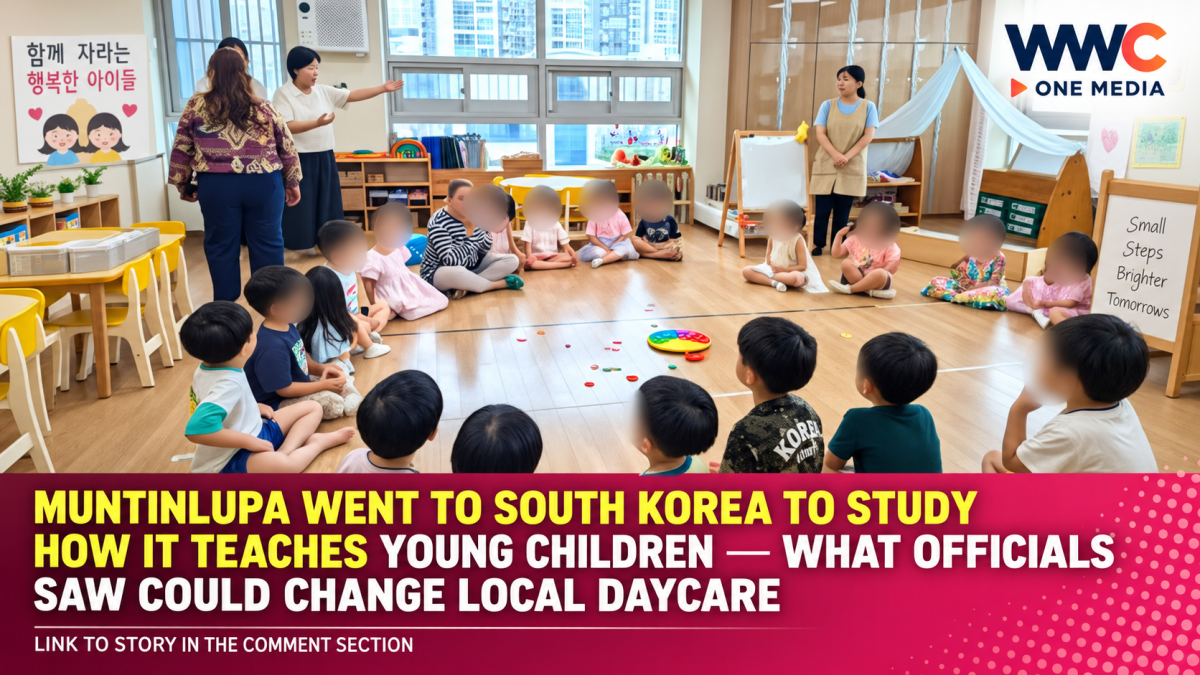
MUNTINLUPA CITY, Philippines — Muntinlupa is looking thousands of kilometers away for ideas that could reshape how its youngest residents learn, play and receive care.
A three-member delegation from the city traveled to Busan, South Korea, from August 30 to September 2 to examine early childhood education and childcare practices, visiting institutions that combine classroom learning with parent support, community services and inclusive child development.
The delegation included Councilor Jedi Presnedi, chairperson of the City Council’s Committee on Education; Early Childhood Education Division chief Jenny Mercado; and child development teacher Johannes May Saclayan.
But the trip was more than an overseas classroom tour.
For Muntinlupa, the bigger question is whether practices observed in one of Asia’s more developed childcare systems can be adapted — rather than merely copied — for Filipino families, teachers and children.
What Muntinlupa officials actually studied in Busan
During the four-day program, the delegation visited daycare centers, kindergartens, childcare-support facilities and educational complexes.
The Philippine Information Agency said officials examined approaches involving inclusive learning, hands-on education, cultural activities and support systems for parents and caregivers.
Korean reports provide an even clearer picture of the itinerary.
On September 1, the delegation met officials and childcare professionals in Yeonje District in Busan, where they visited facilities that included the Yeonje Raemian Lay County 1st Complex daycare center, a kindergarten affiliated with Busan Kyungsang College, Yeonje Cartoon Library and the Yeonje Childcare Support Center.
The goal, according to Korean coverage, was to study how local government, childcare institutions and community facilities work together to support young children and their families.
That distinction matters.
Modern early childhood education is increasingly about more than what happens between a teacher and a child inside a classroom. It also involves nutrition, play, developmental monitoring, parental involvement, inclusion and access to services when a child needs additional support.
Biazon: Investing early means investing in Muntinlupa’s future
Mayor Ruffy Biazon framed the initiative as part of his administration’s broader education policy.
Biazon said education should provide opportunities for residents to “learn, grow, and thrive” from early childhood through later stages of life, linking the program to the education component of his administration’s 7K Agenda.
The city said the lessons gathered in Busan will be studied for possible use in strengthening existing programs serving children across Muntinlupa’s nine barangays.
That means the trip is best viewed as a benchmarking exercise, not an announcement that Muntinlupa will simply transplant South Korea’s education system into the Philippines.
No sweeping curriculum replacement or citywide Korean-style preschool conversion has been announced.
Instead, officials are gathering practices that could be adapted to Muntinlupa’s own resources, laws and community needs.
The Korea partnership did not start with this trip
The Busan visit is actually the latest stage of a relationship that has been developing for nearly two years.
In December 2024, the Muntinlupa City Council authorized Biazon to enter into an agreement with the Korea International Cooperation Agency (KOICA) and the Philippine National Volunteer Service Coordinating Agency (PNVSCA) for the deployment of Korean volunteers to selected early childhood education centers.
Under that arrangement, Korean volunteers were tasked with assisting local child-development workers, sharing Korean practices and helping improve Muntinlupa’s child-development centers.
The city resolution envisioned a three-year collaboration, with KOICA volunteers providing their expertise while the local government assumed mainly administrative responsibilities.
So when Muntinlupa officials traveled to Busan this year, they were not starting a new relationship from scratch.
They were effectively seeing firsthand the system from which many of the ideas already being introduced locally originated.
Korean teachers have already been working with Muntinlupa children
By April 2026, a fourth batch of Korean volunteer educators had already arrived in the city.
Manila Bulletin reported that 16 volunteers were assigned to the Laguerta Bulilit Center, where they helped establish a Korean-style classroom setup and conducted activities involving nutrition, physical education, home-based play and music.
Some members of that batch had previously volunteered in Muntinlupa or elsewhere in the Philippines before returning for another assignment.
The cooperation has also extended beyond children themselves.
KOICA programs in Muntinlupa have worked with parents and caregivers, reflecting a central idea in early-childhood development: what happens at home can be just as important as what happens at school.
Parents are part of the experiment too
In November 2025, KOICA organized a two-day program for 50 Muntinlupa parents and caregivers covering early brain development, age-appropriate activities and support for children with neurodivergent conditions.
The sessions included the “Teach From Home” module developed with the Early Childhood Care and Development Council, the University of the Philippines and UNICEF.
Around 15 children who had been diagnosed with or were suspected of having neurodivergent conditions also took part in a play-based learning activity.
That program illustrates why the Korean partnership is potentially more significant than simply introducing different teaching materials.
Its broader approach treats parents, caregivers, teachers and community institutions as part of one early-development ecosystem.
Technology has become part of the partnership
The cooperation expanded again in June 2026.
KOICA donated 50 Samsung tablets and accessories to Muntinlupa as part of initiatives aimed at strengthening digital education and parent-teacher collaboration.
A KOICA workshop held that month also discussed safe, ethical and age-appropriate technology use among young children and emphasized closer communication between teachers and parents.
The inclusion of digital learning is particularly relevant because early access to technology brings both opportunities and risks.
Devices can expand educational resources and communication, but childhood-development specialists generally stress that technology should complement — rather than replace — physical play, social interaction and direct engagement with caregivers.
The Muntinlupa-KOICA initiative has therefore focused not merely on giving children devices, but on how adults supervise and integrate technology into developmentally appropriate activities.
Why early childhood education is now a bigger national issue
Muntinlupa’s efforts also come as the Philippines is strengthening its national framework for early childhood care.
President Ferdinand Marcos Jr. signed Republic Act No. 12199, or the Early Childhood Care and Development System Act, in May 2025.
The law recognizes ages zero to eight as a crucial stage of educational development, while assigning the ECCD Council primary responsibility for children below five and the Department of Education responsibility for children from five to eight.
It also calls for stronger coordination among education, health, nutrition and social-development services and explicitly supports the inclusion of children with disabilities.
In August 2026, the DILG, DepEd and ECCD Council signed implementing rules designed to create more consistent national standards for early-childhood services.
That makes Muntinlupa’s Korean benchmarking particularly timely.
Local governments will increasingly be expected not simply to maintain daycare centers but to improve quality, teacher skills, facilities, developmental monitoring and links between families and public services.
Korea has lessons — but it also has challenges
South Korea should not be portrayed as having a flawless preschool system.
OECD research notes that Korea has invested heavily in early childhood education and care while continuing to work on improving equity, coordination, funding and quality across the system.
The OECD has stressed the value of stronger data systems, coordinated social and education policies and continuous quality monitoring — areas that countries with advanced early-learning systems still have to refine.
That is why benchmarking can be more useful than imitation.
Muntinlupa can examine what works in Busan while deciding which approaches are realistic for Philippine classrooms, local government budgets and Filipino households.
The real story begins after the delegation comes home
Study visits are easy to announce.
The harder part is turning them into measurable improvements.
The value of Muntinlupa’s Busan trip will ultimately depend on what changes afterward: whether child-development teachers receive better training, whether facilities improve, whether parents receive stronger support, whether children with additional needs are identified earlier and whether successful programs reach families throughout the city.
Muntinlupa already has the Korean volunteers.
It already has workshops, technology assistance and a formal international partnership.
Now its officials have seen parts of the Korean system up close.
The next question is the one that matters most: Which ideas from Busan will actually make their way into a Muntinlupa classroom — and will parents and children notice the difference?




Leave a Reply