
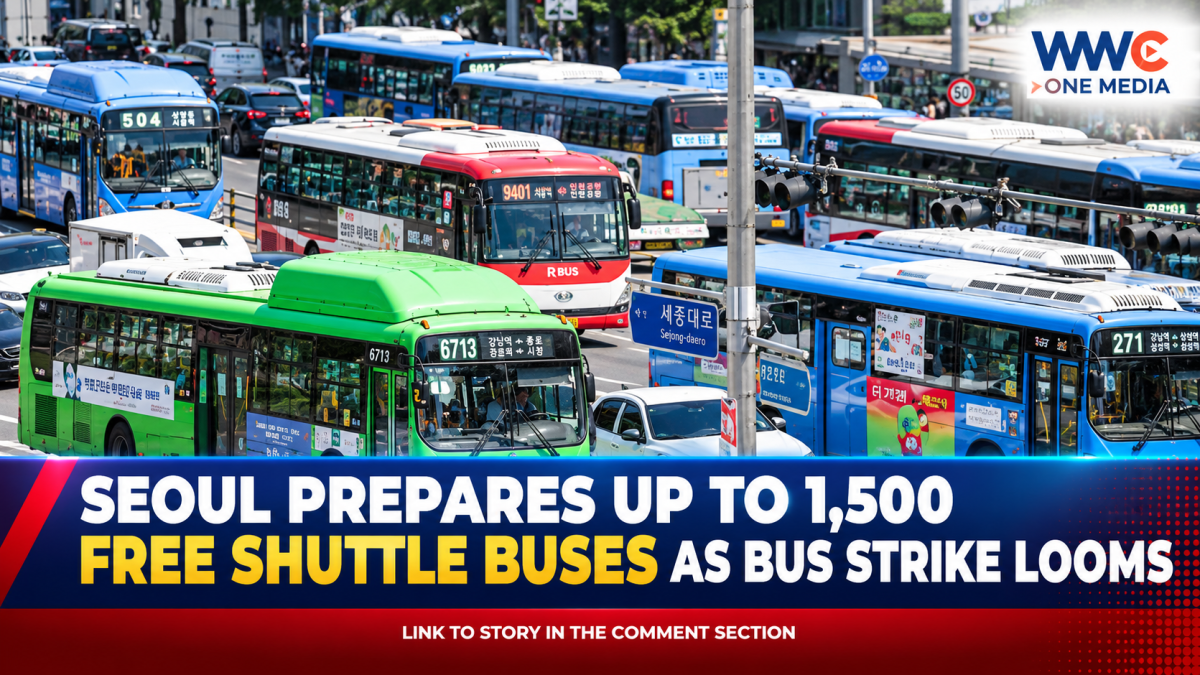
SEOUL, South Korea — Seoul is preparing for potentially major public transportation disruptions as the city government announced plans to deploy up to 1,500 free shuttle buses if unionized city bus workers proceed with a planned strike beginning Wednesday, September 16.
The emergency transportation plan was unveiled Monday as wage negotiations between bus operators and workers remained unresolved. The Seoul City Bus Workers’ Union has voted to strike if a deal is not reached by September 15, raising the possibility of a second citywide bus walkout this year.
Seoul more than doubles emergency shuttle fleet
If the strike goes ahead, Seoul plans to operate around 1,500 free shuttle buses, more than twice the roughly 700 vehicles deployed during the previous bus strike in January.
About 1,300 shuttles will connect major transportation hubs and residential areas in Seoul’s 25 districts with subway stations.
Another roughly 200 buses will operate on 10 major arterial routes, including Gangnam-daero, Tongil-ro and Dobong-ro, helping commuters travel between key areas of the capital.
The city said it could increase the number of arterial shuttle buses further if the strike continues for an extended period.
Subway service to increase by 202 runs
Seoul’s emergency response will not rely solely on buses.
The city government plans to increase subway operations by 202 runs per day, with additional service concentrated during morning and evening rush hours. Operating hours will also be extended, with the final trains scheduled to run until 2 a.m. during the emergency period.
The expanded subway schedule is designed to absorb some of the passengers who normally depend on city buses for their daily commutes.
Community buses and Seoul’s public bicycle-sharing service, Ttareungi, will also be incorporated into the emergency transportation response.
Why the strike is looming
The potential walkout follows a dispute between bus workers and management over wages and related employment issues.
The union’s strike vote reportedly received overwhelming support, with 87.94 percent of participating workers voting in favor of a strike, according to The Korea Herald.
Workers are scheduled to begin a full strike with the first bus services on September 16 if negotiations fail to produce an agreement by September 15.
That deadline leaves only a short window for labor and management to reach a settlement and prevent widespread disruption.
Seoul faces a second bus strike this year
The potential September strike would be particularly significant because Seoul already experienced a major bus walkout earlier this year.
The January strike lasted two days before the union and operators reached a wage agreement and bus services resumed.
The latest emergency plan is therefore significantly larger. Seoul used about 700 free shuttle buses during the January disruption; the new plan could mobilize up to 1,500.
City officials have described the preparations as necessary because another large-scale disruption could place considerable pressure on the capital’s subway network and roads.
More measures ready if buses stop
The city is also preparing for increased private-car traffic.
Under the emergency plan, some curbside bus-only lanes will temporarily be opened to ordinary vehicles during the strike, while median bus-only lanes will remain restricted to buses.
Community-bus operators may also be permitted to use temporary routes and stops to provide additional transportation alternatives.
The city said information about shuttle routes and schedules would be released through Seoul and district government websites ahead of the potential strike.
A crucial deadline arrives Tuesday
For millions of Seoul commuters, the most important date is now September 15, when negotiations must produce an agreement to prevent the planned September 16 walkout.
If no agreement is reached, Seoul’s largest emergency transportation response of the year could be activated almost immediately.
The city is preparing for the possibility, but the final outcome still depends on whether labor and management can close their differences before the deadline.
For commuters, one question now hangs over Seoul: Will the 1,500 free shuttles ever need to hit the streets — or will a last-minute deal prevent another citywide bus strike?




Leave a Reply