
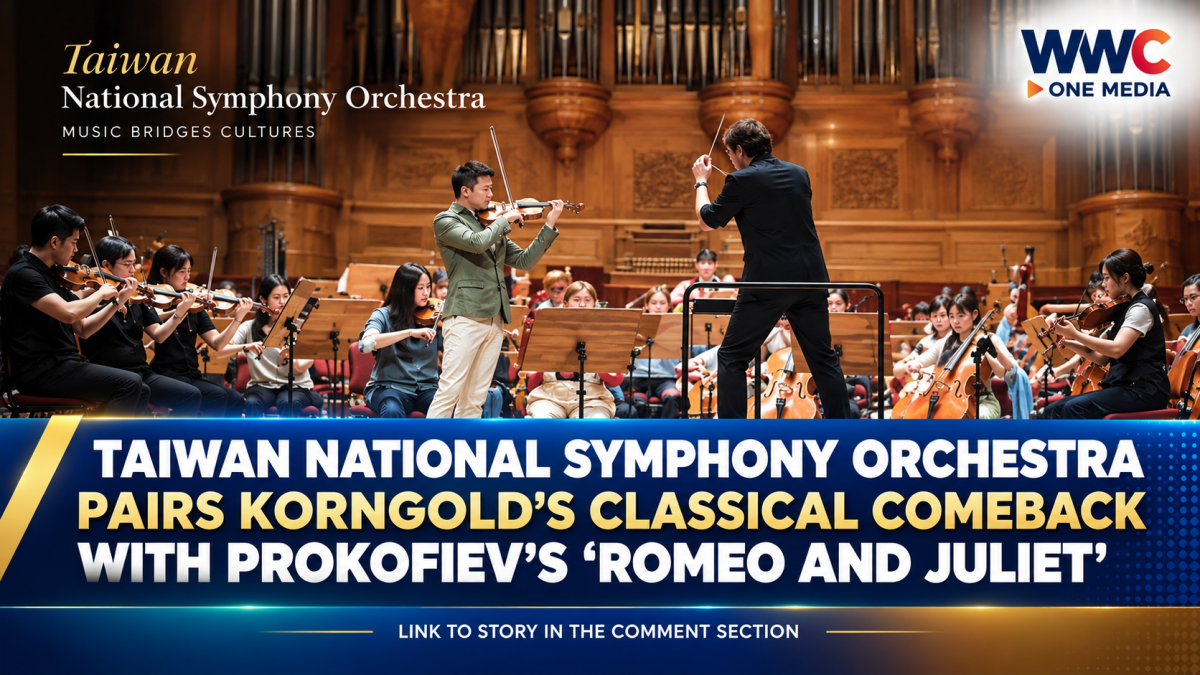
TAIPEI, Taiwan — Taiwan’s National Symphony Orchestra (NSO) is bringing together two dramatically different musical journeys in a program that links Erich Wolfgang Korngold’s return to concert music with Sergei Prokofiev’s powerful interpretation of Shakespeare’s “Romeo and Juliet.”
Led by music director Jun Märkl, the NSO’s program features acclaimed Taiwanese-American violinist Paul Huang performing Korngold’s Violin Concerto in D major, Op. 35, before the orchestra turns to excerpts from Prokofiev’s Romeo and Juliet Suites Nos. 1 and 2.
The performances were scheduled for Taipei’s National Concert Hall on September 11 and the National Kaohsiung Center for the Arts (Weiwuying) on September 13, according to the orchestra and concert venue.
From Hollywood back to the concert hall
Korngold’s story gives the first half of the program a remarkable historical dimension.
Born in Austria, Korngold fled to the United States after the rise of the Nazis in Europe and became one of Hollywood’s most successful film composers. His work on movies earned him two Academy Awards, while his film scores carried the sweeping orchestral language of European Romanticism into Hollywood.
After World War II, however, Korngold attempted to return to concert music at a time when his late-Romantic style was increasingly out of favor.
His Violin Concerto, written during this period, became an important part of that return. NSO music director Jun Märkl has highlighted the concerto’s beauty despite its comparatively lower profile, while Huang has described the work as representing a new beginning rather than simply a reflection of Korngold’s difficult career transition.
The concerto therefore serves as more than a showcase for a virtuoso violinist. It tells the story of a composer attempting to reclaim his place in the classical concert world after years of success in another musical universe.
Paul Huang takes center stage
For the Korngold concerto, the NSO is joined by Paul Huang, an award-winning violinist whose career has included performances with major orchestras and appearances on international stages.
Huang’s role is particularly important because Korngold’s concerto is technically demanding while also requiring a highly expressive, lyrical approach.
The pairing of Huang and Märkl gives the first half of the concert a distinctive focus: a celebrated violinist interpreting a work that itself represents a composer’s return to his classical roots.
From Hollywood memories to Shakespearean tragedy
The program then shifts dramatically to Prokofiev’s Romeo and Juliet.
Written in the 1930s and based on Shakespeare’s tragedy, the ballet score has become one of Prokofiev’s most recognizable works. The NSO program draws from Suites Nos. 1 and 2, allowing the orchestra to present some of the work’s most dramatic and memorable musical episodes.
Prokofiev’s music moves between tenderness, romance, conflict and tragedy, translating Shakespeare’s story into an intensely orchestral language.
That contrast gives the concert its central appeal: Korngold’s deeply romantic violin concerto is followed by Prokofiev’s darker and more dramatic musical world.
A program built around transformation
At first glance, Korngold and Prokofiev might appear to represent very different musical traditions.
But the program connects them through a common theme: transformation.
Korngold transformed his European classical background into a distinctive Hollywood sound before attempting to return to the concert hall. Prokofiev, meanwhile, transformed Shakespeare’s famous story of doomed young lovers into a ballet score that continues to stand on its own in concert programs around the world.
The result is a program that moves from a composer’s personal struggle to reclaim his artistic identity to one of literature’s most enduring stories of love and conflict.
Why the concert matters
The NSO’s latest program also reflects the orchestra’s continuing effort to present major works from the international classical repertoire while collaborating with prominent Taiwanese and Taiwan-based musicians.
For audiences, the combination offers two very different experiences in one evening: the lush lyricism and virtuosity of Korngold’s violin concerto, followed by the sweeping drama of Prokofiev’s Romeo and Juliet.
More than a pairing of famous composers, the program offers a journey through Hollywood, European classical music and Shakespearean drama — all through the sound of a Taiwanese orchestra.
And for Korngold, whose concert music was overshadowed for decades by his Hollywood career, the performance offers another reminder that some musical stories deserve to be heard again.




Leave a Reply