
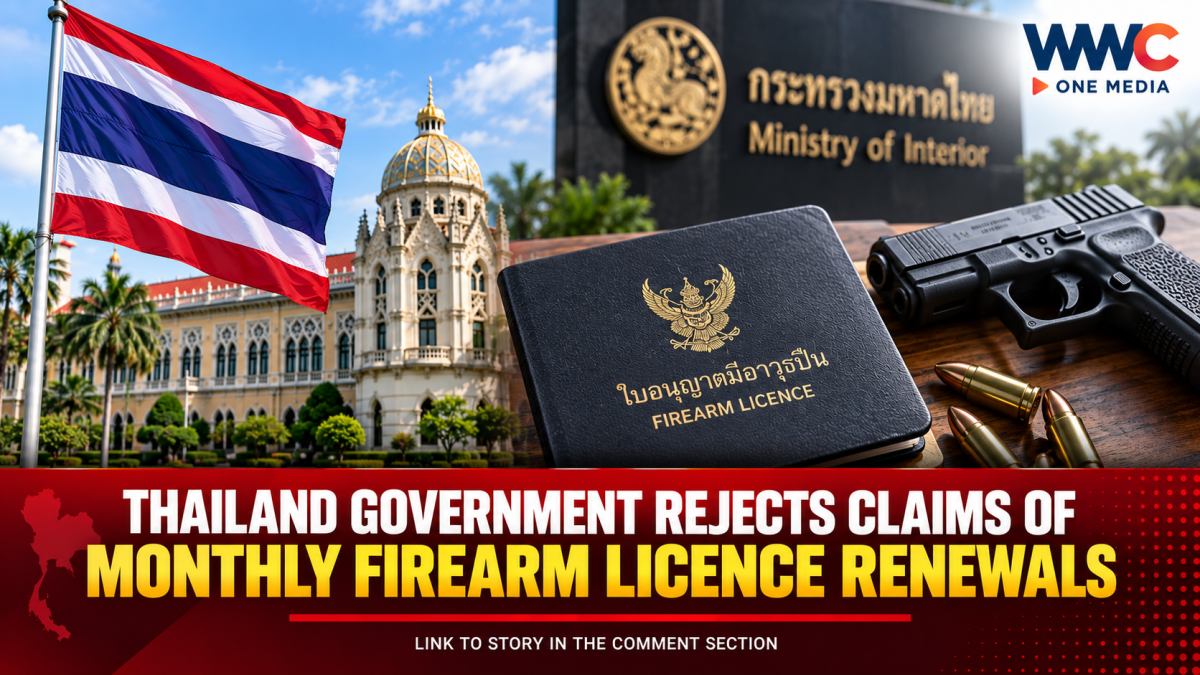
BANGKOK — Thailand’s government has rejected reports claiming that firearm licence holders will soon be required to renew their licences and pay fees every one or two months, saying the widely circulated information does not reflect the government’s current policy.
The clarification comes as Thailand faces renewed pressure to strengthen firearm controls following a series of high-profile shootings that have intensified public debate over gun ownership and regulation.
According to the Bangkok Post, the government dismissed claims that existing firearm licences would be subject to extremely frequent renewal requirements. The reports emerged amid a broader government review of Thailand’s firearm-control system.
Government reviewing Thailand’s firearm-control system
The controversy comes at a time when the administration of Prime Minister Anutin Charnvirakul is pursuing tighter controls on firearms.
In August, following a deadly school shooting, the prime minister ordered a suspension of new firearm purchase permits and said existing licences would be reviewed as authorities worked on a broader overhaul of the country’s gun laws. Reuters reported that the proposed reforms could significantly tighten rules governing who may carry firearms.
The government has also been considering fixed-term firearm licences, rather than the longstanding system under which certain licences have effectively remained valid without routine periodic renewal. A Bangkok Post report in August said fixed-term licensing was being considered as part of a wider review of Thailand’s 1947 firearms legislation.
That policy discussion appears to have contributed to confusion online, with some reports or social-media posts suggesting that licence holders would have to renew their permits every month or two.
The government’s latest clarification indicates that such monthly or one-to-two-month renewal requirements should not be treated as an announced policy.
Gun-control debate intensifies after deadly shootings
The clarification comes against a backdrop of heightened concern about gun violence in Thailand.
In September, a shooting at a kindergarten in Chonburi province killed a teacher and prompted renewed scrutiny of firearm access and school safety. The incident followed an August shooting involving a 14-year-old that killed eight people and injured more than 20, according to the Associated Press.
Those incidents have increased calls for stronger safeguards around legally owned firearms, licensing and access.
Thailand has long had firearm regulations under legislation dating back to 1947, but the effectiveness and enforcement of those rules have increasingly come under public scrutiny. Reuters reported that Thailand had an estimated 10.3 million civilian-held firearms in 2017, according to Small Arms Survey data.
What happens next?
The government’s rejection of the monthly-renewal reports does not mean that Thailand’s firearm regulations will remain unchanged.
Instead, authorities are continuing to examine possible reforms covering firearm licensing and ownership as part of a broader effort to strengthen controls.
The distinction is important: a proposal to introduce fixed-term licensing is very different from an immediate requirement for firearm owners to renew licences every one or two months.
For now, the government’s message is clear: claims about mandatory monthly or bi-monthly firearm licence renewals should not be confused with the reforms actually being considered.
As Thailand moves toward a broader review of its firearm laws, further details will likely emerge as authorities finalize the proposed changes.




Leave a Reply