
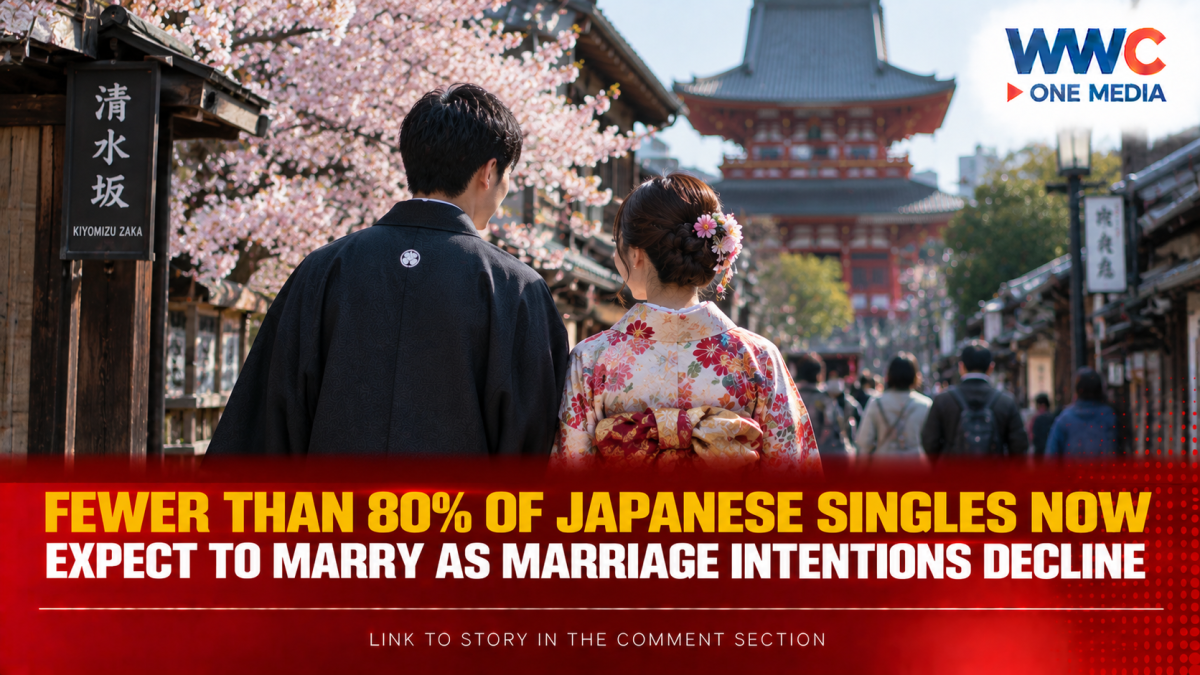
TOKYO — Japan is seeing another warning sign in its long-running demographic challenge: fewer than 80% of unmarried people now say they intend to marry eventually, marking the first time the figure has fallen below that threshold in the survey.
The latest findings highlight how attitudes toward marriage are changing in Japan, where declining marriage rates, later family formation and a shrinking population have become major social and economic concerns.
The survey, reported by Japanese media and Philippine News Agency, found that the proportion of unmarried respondents who said they planned to marry someday had dropped below 80%. The result represents a notable change from earlier survey rounds, when marriage remained an aspiration for a much larger share of Japanese singles.
A major shift in marriage expectations
Marriage has historically been closely linked to family formation in Japan, making changes in people’s intentions particularly significant for the country’s demographic outlook.
The latest result does not mean that most Japanese singles have rejected marriage. Rather, it shows that the proportion who actively expect to marry is declining.
That distinction matters because Japan’s low birthrate is closely associated with its low marriage rate. With births still heavily concentrated among married couples, fewer people entering marriage can have a direct effect on future birth numbers.
The decline is therefore being watched not simply as a change in personal preferences, but as part of a much broader demographic transformation.
Why are fewer people planning to marry?
Experts and previous Japanese government surveys have pointed to several factors affecting marriage decisions, including financial concerns, employment uncertainty, housing costs, changing expectations about relationships and the difficulty of balancing work and family life.
Japan’s economic environment has also changed considerably over the past generation.
Younger adults face high living costs and increasingly complex career choices, while traditional expectations surrounding marriage and family have evolved.
A separate recent survey by Japan’s Children and Families Agency has also attracted attention after reporting that 35% of unmarried respondents said they did not intend to marry.
Taken together, the findings suggest that marriage is no longer viewed as an inevitable milestone by as many Japanese adults as it once was.
The demographic consequences could be significant
Japan has already experienced years of population decline.
Fewer marriages can compound the country’s demographic pressures because marriage remains strongly connected to childbearing in Japan. If fewer people marry, the pool of potential parents also becomes smaller.
That creates a difficult cycle: fewer marriages can contribute to fewer births, while population aging and a shrinking working-age population create additional economic pressure.
The government has introduced a range of measures aimed at making it easier for people to marry and raise children, including policies addressing childcare, parental support and household finances.
But changing marriage behavior is considerably more complicated than simply providing financial incentives.
Young people’s priorities are changing
The survey results also point to a broader generational shift.
For some Japanese adults, marriage may increasingly be viewed as a personal choice rather than a social expectation. Career development, financial independence and individual lifestyles can compete with — or be prioritized alongside — traditional family goals.
That does not necessarily mean younger generations are opposed to relationships or family life.
Instead, the definition of a successful adult life appears to be becoming more diverse.
For policymakers, however, that creates a difficult challenge: government programs can reduce some financial barriers, but they cannot easily change people’s personal priorities or guarantee that marriage and parenthood will become more attractive.
Japan’s demographic clock is still ticking
Japan’s population problem has been developing for decades, and the latest survey adds another piece to the puzzle.
The fact that fewer than four in five unmarried people now say they expect to marry is significant because it suggests the decline in marriage is not simply being driven by people postponing marriage until later.
If a growing share of people ultimately decide not to marry, the demographic consequences could extend well into the future.
Japan’s policymakers are therefore facing a question that goes beyond birth incentives:
How can a society make marriage and family life more compatible with the economic realities and personal choices of a new generation?
There is no simple answer.
But the latest survey makes one thing increasingly clear: Japan’s relationship with marriage is changing — and that change could reshape the country’s demographic future.




Leave a Reply