
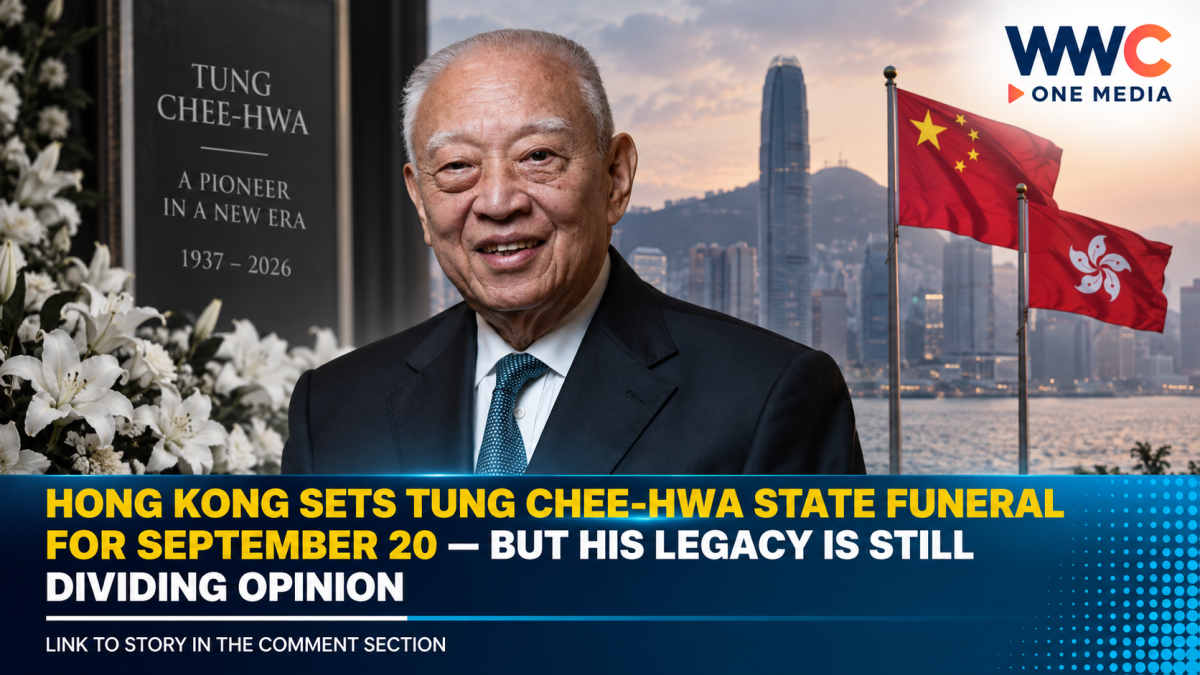
HONG KONG — Hong Kong will hold a state funeral for Tung Chee-hwa on September 20, formally honoring the city’s first chief executive after the 1997 handover to China.
The funeral is expected to bring together senior Hong Kong officials, central government representatives and other prominent figures as the city bids farewell to the former leader, who died on September 8 at the age of 89. The date was confirmed to the South China Morning Post by a source familiar with the arrangements.
The funeral arrangements are being coordinated by the Hong Kong government. The exact details of the ceremony were still being finalized as of September 12, with state leaders and central government officials expected to participate in the funeral committee, according to SCMP.
Why Tung is receiving a state funeral
Tung’s death carries unusual historical weight.
A former shipping tycoon, Tung became Hong Kong’s first chief executive when Britain handed sovereignty of the territory to China on July 1, 1997. He led the newly established Hong Kong Special Administrative Region until his resignation in March 2005.
He later became a vice-chairman of the National Committee of the Chinese People’s Political Consultative Conference (CPPCC), serving from 2005 to 2023.
Hong Kong Chief Executive John Lee said Tung made significant contributions to the implementation of the “one country, two systems” framework and helped steer the city through major challenges, including the Asian financial crisis.
Tung was also awarded Hong Kong’s Grand Bauhinia Medal in 2006, the city’s highest honor.
The Chinese government’s Hong Kong and Macao offices described him as an outstanding contributor to “one country, two systems” and praised his role during the formative years of the Hong Kong SAR.
A rare honor in post-handover Hong Kong
Tung’s state funeral will be notable because the honor has been granted to very few prominent Hong Kong figures since the 1997 handover.
SCMP reported that only two other prominent local figures had previously received state funerals: industrialist Ann Tse-kai in 2000 and businessman Henry Fok Ying-tung in 2006. Both, like Tung, had served as vice-chairmen of the CPPCC National Committee.
That makes the September 20 ceremony more than a private farewell. It is also a highly symbolic event marking the passing of one of the central political figures of Hong Kong’s first years under Chinese sovereignty.
Tung’s legacy was anything but simple
While Chinese and Hong Kong officials have praised Tung’s patriotism, leadership and contribution to Hong Kong’s transition, his record remains deeply contested.
His administration faced a succession of enormous challenges, including the Asian financial crisis, the SARS outbreak and rising political tensions.
The biggest political crisis came in 2003, when Tung’s government attempted to introduce legislation under Article 23 of the Basic Law, covering offenses including treason and sedition.
The proposal triggered one of Hong Kong’s largest mass demonstrations, with hundreds of thousands of people taking to the streets. Tung eventually withdrew the legislation.
Reuters noted that the episode became a major turning point in the relationship between Hong Kong’s government, Beijing and the city’s pro-democracy movement.
The Article 23 legislation was eventually enacted more than two decades later, in March 2024, under a substantially different political environment.
Beijing and Hong Kong pay tribute
Following Tung’s death, tributes came from Hong Kong officials, Beijing authorities, political figures and business leaders.
The Hong Kong government temporarily changed official websites and social-media imagery to black and white as a mark of mourning.
The Legislative Council also paid tribute, describing Tung as a key figure in establishing the Hong Kong SAR and implementing “one country, two systems” during one of the most critical periods in the city’s history.
Tung’s former colleagues similarly remembered him as a leader who placed considerable emphasis on housing, education, welfare and Hong Kong’s economic ties with mainland China.
His death was also acknowledged by Alibaba, where Tung served as an independent director from 2014 to 2022. The company credited his global perspective with helping it expand internationally while remaining rooted in China.
The bigger question surrounding September 20
The September 20 funeral will therefore carry two narratives at once.
For Beijing and Hong Kong’s current leadership, Tung represents a pioneer of “one country, two systems” and a political figure who helped establish the post-1997 order.
For others, his tenure remains a reminder of the difficult contradictions Hong Kong faced in its early years after the handover — particularly the tension between promises of autonomy, political reform and Beijing’s growing influence.
The ceremony is expected to be closely watched not simply as a farewell to Hong Kong’s first post-handover leader, but as a reflection of how Hong Kong now views the political era that Tung helped launch nearly three decades ago.
And on September 20, that history will take center stage one final time.


Leave a Reply