
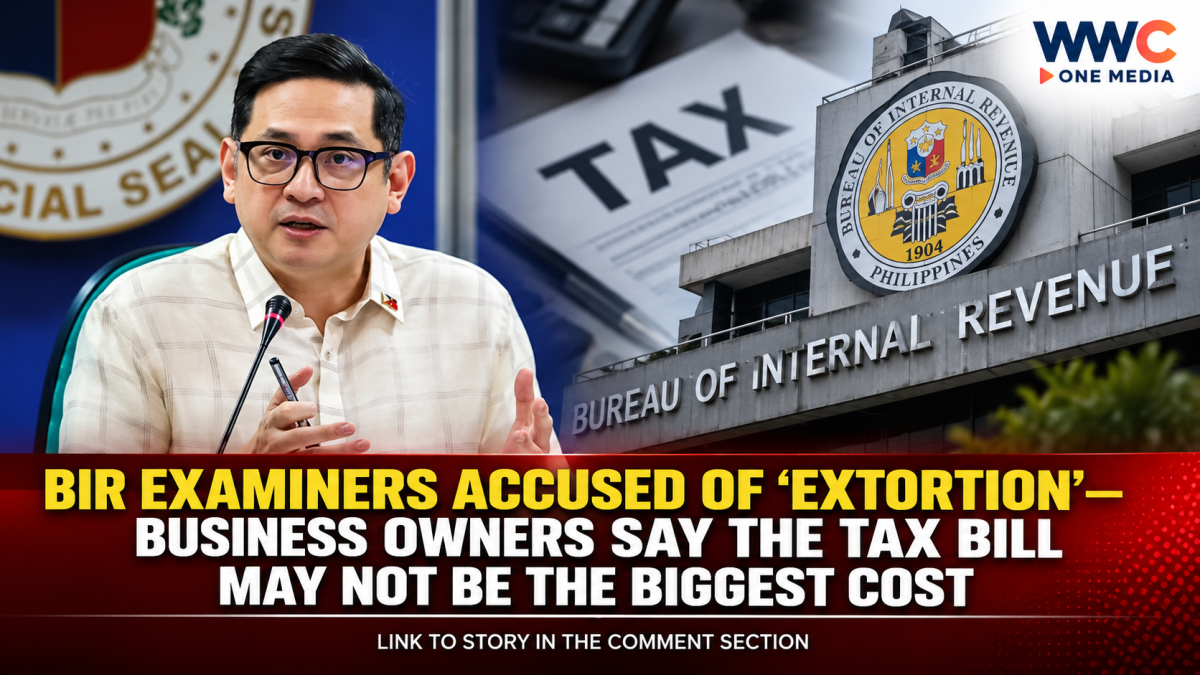
MANILA, Philippines — Allegations of corruption inside the Bureau of Internal Revenue (BIR) resurfaced at the Senate after a business group representative told lawmakers that some BIR examiners continue to allegedly demand under-the-table payments from entrepreneurs during tax assessments.
The allegations were raised Friday during a hearing of the Senate Committee on Trade, Commerce and Entrepreneurship, chaired by Sen. Bam Aquino, where lawmakers examined complaints involving government agencies that businesses say create additional costs and obstacles to operating in the Philippines.
Philippine Chamber of Commerce and Industry (PCCI) vice president Yolanda dela Cruz told the panel that entrepreneurs continue to encounter alleged demands for unofficial payments from BIR personnel after companies receive a Letter of Authority (LOA) for a tax examination.
One case she cited involved a tax assessment dating back to 2022. According to the account presented to the Senate, the BIR was seeking around P3 million, but only approximately P500,000 would reportedly be covered by an official receipt, with the remainder allegedly sought as an unofficial payment.
The testimony triggered renewed questions about whether reforms inside the tax agency have sufficiently addressed long-standing complaints from the business sector.
‘Lagay’ complaints remain a concern
Aquino said entrepreneurs frequently identify government agencies—including the BIR, Bureau of Fire Protection (BFP), and Food and Drug Administration (FDA)—when reporting alleged corruption, excessive requirements and demands for bribes.
He called for a stronger crackdown on employees who allegedly ask for money in exchange for speeding up government transactions or resolving regulatory problems.
For micro, small and medium enterprises (MSMEs), Aquino warned that corruption and bureaucratic delays can have an especially damaging impact because businesses have limited capital and resources.
He also pushed for simpler, risk-based regulation, arguing that government requirements should take into account the size and complexity of a business without compromising tax collection, public safety or consumer protection.
The alleged scheme is not a new complaint
The Senate discussion also echoes concerns raised previously about how tax examinations can allegedly be used to pressure businesses.
Sen. JV Ejercito had earlier described alleged schemes involving multiple LOAs and inflated assessments. One account involved an examiner allegedly offering to reduce a taxpayer’s assessment while indicating that much of the payment would go “for the boys.” These are allegations raised in Senate proceedings and should not be treated as proof of wrongdoing by all BIR personnel.
The issue is particularly significant because a tax examination can place a business under considerable pressure. An assessment can potentially involve substantial liabilities, penalties and prolonged disputes, creating an environment where taxpayers may feel compelled to settle quickly.
BIR says it is pursuing reforms
The allegations come as the BIR under Commissioner Charlito Martin R. Mendoza has publicly promoted reforms aimed at making tax administration more predictable, transparent and accountable.
At an August tax forum organized by the European Chamber of Commerce of the Philippines, Mendoza outlined the agency’s BIR DARES reform agenda.
Among the measures highlighted were digital transformation, audit reform, stronger revenue enforcement, employee development and improved taxpayer services.
The BIR has also emphasized a policy of one Letter of Authority per taxpayer per year, along with an “audit-the-auditors” approach intended to strengthen accountability within the tax examination process.
That reform agenda now faces a critical test: whether businesses on the ground actually experience a reduction in alleged harassment, unofficial payments and unpredictable tax assessments.
Why the allegations matter
The Senate hearing comes at a sensitive time for the Philippine government, which is facing broader scrutiny over corruption and accountability in public institutions.
The allegations against BIR examiners are not equivalent to a finding that the agency or its employees are guilty of extortion. Individual claims must still be investigated and supported by evidence, and the BIR has the opportunity to respond to specific accusations.
But for entrepreneurs, the issue goes beyond individual tax assessments.
If businesses believe that paying an unofficial amount is necessary to settle an assessment, obtain favorable treatment or avoid prolonged government scrutiny, the practice can undermine confidence in the country’s tax system—and place honest businesses at a competitive disadvantage.
The Senate’s challenge now is whether these allegations will lead to concrete investigations and reforms, or become another set of complaints that fades after the hearing.
And that may be the bigger question facing the BIR: if the agency is already promising “audit-the-auditors” reforms, what happens when taxpayers say the problem is still happening on the ground?


Leave a Reply