
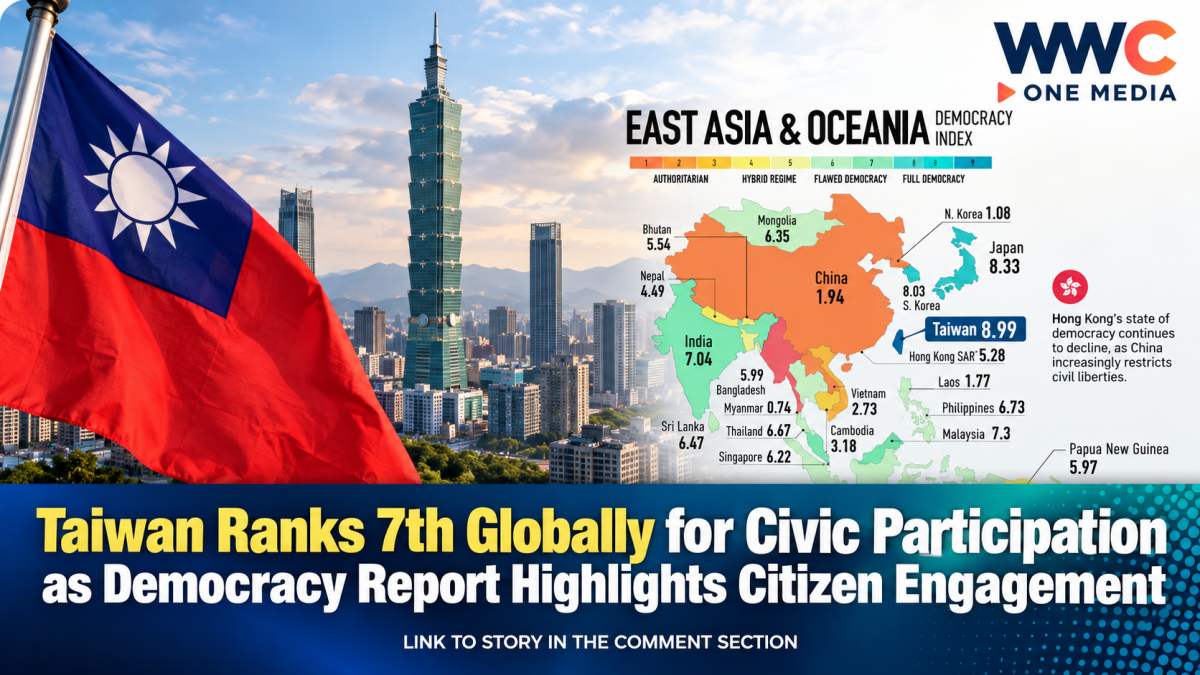
TAIPEI, Taiwan — Taiwan has earned a place among the world’s strongest performers in civic participation, ranking seventh globally and tying with Finland in the latest International Institute for Democracy and Electoral Assistance (International IDEA) assessment.
The ranking, based on data from 2025, highlights Taiwan’s continued strength in citizen participation in political and civic life, even as the country faces challenges in other areas of democratic governance.
The finding comes from International IDEA’s Global State of Democracy 2026 report, which examines democratic performance across areas including credible elections, parliamentary oversight, judicial independence, freedom of expression and access to justice.
Taiwan among the world’s strongest for civic participation
Taiwan’s seventh-place ranking in civic participation was unchanged from the previous year’s assessment.
The category measures how actively people participate in political and civic life, making the result significant for a society where elections, civil-society organizations, public debate and citizen-led initiatives play visible roles in policymaking and political discourse.
Taiwan’s performance also places it ahead of many established democracies on this particular measure, reinforcing its reputation for active public engagement.
However, the ranking should not be interpreted as Taiwan being seventh overall among all democracies. The seventh-place result applies specifically to civic participation.
Parliamentary oversight improves
The report also identified an area where Taiwan made progress: parliamentary oversight.
Taiwan was among only 13 countries worldwide that recorded an improvement in this area during 2025.
That improvement suggests stronger performance in the legislature’s ability to scrutinize government actions and hold the executive branch accountable.
Other countries in the Asia-Pacific region that recorded improvements in parliamentary oversight included Fiji, Papua New Guinea, Tajikistan and Thailand.
But judicial independence raises concerns
Taiwan’s democratic picture was not uniformly positive.
International IDEA reported a decline in Taiwan’s judicial independence during 2025, moving the country from the organization’s top-performing group into its middle-performing group for that aspect of democracy.
Taiwan was not alone. The United States also moved from the top-performing group to the middle-performing group, while Argentina, Belgium, India and Nigeria were among countries that also recorded declines in judicial independence.
That contrast makes Taiwan’s overall democratic performance more complicated than a single ranking might suggest.
The country continues to score strongly in some areas while facing institutional challenges in others.
Taiwan’s civic culture draws global attention
Taiwan has increasingly attracted international attention for its approach to digital democracy and citizen participation.
Government and civil-society initiatives have experimented with digital tools that allow citizens to participate in policy discussions, while Taiwan’s technology community has played a role in developing platforms for public engagement.
The country’s civic space has also received strong international recognition. The International Center for Not-for-Profit Law reported in June that Taiwan remained the only country in Asia with an “open” civic space rating from CIVICUS for a fifth consecutive year.
These developments help explain why Taiwan’s civic-participation performance remains a notable part of its international democratic profile.
Regional tensions add another challenge
International IDEA’s assessment also comes as democratic institutions across the region face pressure from geopolitical tensions.
The report pointed to security tensions, including those surrounding the Taiwan Strait, as factors that can place additional pressure on democratic governance.
For Taiwan, maintaining strong civic participation while dealing with external security concerns creates an increasingly important test of institutional resilience.
A strong ranking, but not a perfect scorecard
Taiwan’s seventh-place civic-participation ranking offers an important snapshot of its democratic strengths—but it does not tell the entire story.
The same assessment points to improvements in parliamentary oversight alongside concerns about judicial independence.
That mixed picture means Taiwan’s democratic standing is best understood not through a single number, but through the broader balance between citizen participation, institutional checks and balances, rights and the independence of state institutions.
Still, the civic-participation result sends a clear message: Taiwan remains one of the world’s more active societies when it comes to citizens engaging in public and political life.
As democratic institutions worldwide face growing pressure, Taiwan’s challenge will be to preserve that high level of civic engagement while strengthening the areas where its latest assessment shows room for improvement.
Taiwan has proven that its citizens are willing to participate—but can its democratic institutions keep pace with an increasingly active public?




Leave a Reply