
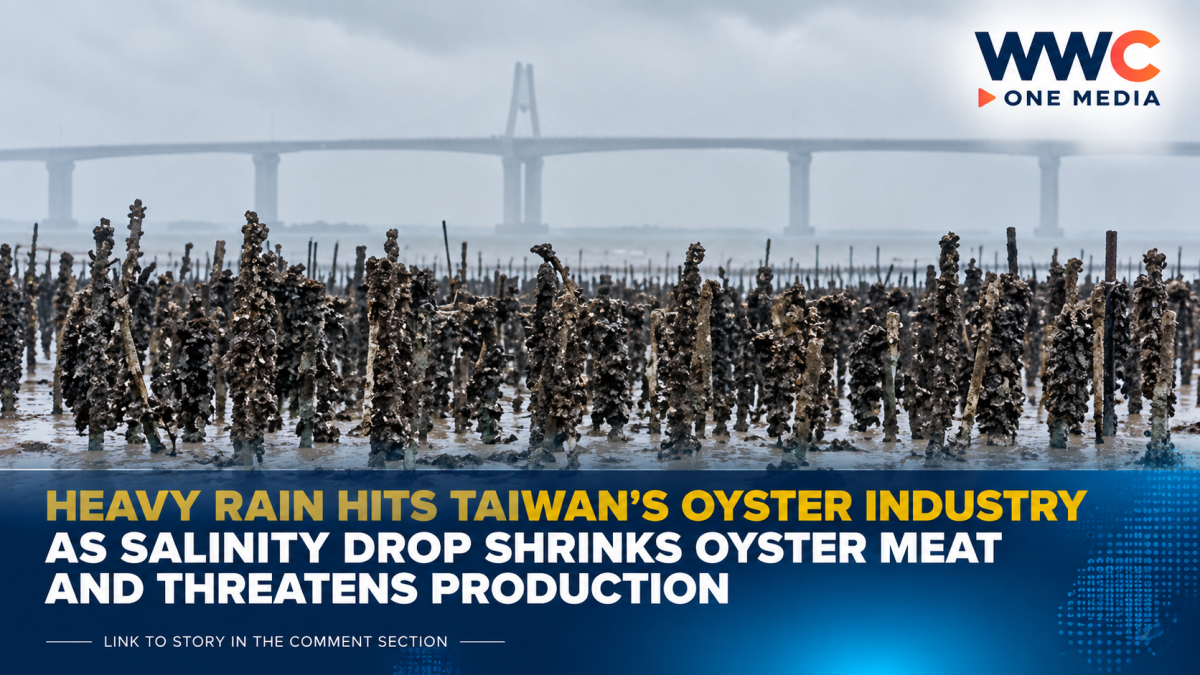
YUNLIN, Taiwan — Weeks of persistent rain along Taiwan’s western coast are putting pressure on the oyster industry, with farmers reporting slower growth, smaller oyster meat and the possibility of a significant drop in production.
The latest damage is being reported in coastal areas of Yunlin County, including Taixi, Kouhu and Sihu, where heavy rainfall has sent large amounts of freshwater into coastal waters.
The sudden change has lowered seawater salinity, making it harder for oysters to adapt to their changing environment.
Local oyster farmers told Taiwan Public Television that some oysters have stopped growing normally and their meat has become noticeably smaller. One industry estimate puts the potential production decline at around 30%.
Why the rain is hurting oysters
Oysters depend on relatively stable coastal-water conditions. Prolonged rainfall can dramatically change the salinity of the water surrounding oyster farms.
The latest reports indicate that the problem is not simply the amount of rain falling directly on the farms.
Rainwater flowing from inland areas into the sea is changing the coastal environment, while increased turbidity is also creating additional stress for oyster farms. Farmers told PTV that oysters can respond to the changing conditions by closing their shells and reducing feeding.
That matters because oysters need adequate food and suitable water conditions to grow.
With less food available and environmental conditions changing, the meat inside the shells can become smaller.
Farmers already seeing smaller oysters
The effects are becoming visible during harvesting.
According to PTV’s report, oyster workers in Taixi have observed that some oysters are significantly smaller and thinner than normal.
One worker said the number of oyster baskets being harvested can vary substantially depending on conditions, illustrating how the prolonged rainfall is affecting production.
The timing is particularly important because Taiwan’s oyster industry is approaching the Mid-Autumn Festival, traditionally a period when demand for oysters can increase.
If production remains depressed, farmers and seafood sellers could face tighter supplies just as consumer demand rises.
The oyster problem is part of a much bigger aquaculture crisis
The damage to oysters follows other serious weather-related losses across Taiwan’s aquaculture sector.
Earlier in June, heavy rain and high tides caused problems in Yunlin’s Taixi aquaculture areas, where fishpond embankments were damaged and seawater intrusion affected milkfish farms. The same rainfall also reduced salinity in ponds, creating risks for clam farming.
In another major blow, Taiwan’s Central News Agency reported that prolonged rain and subsequent heat caused severe clam mortality in Chiayi County.
Officials found mortality rates of 70% to 80% at sampled ponds, prompting the county government to seek government disaster assistance.
Taiwan’s agricultural authorities subsequently designated Budai, Dongshi and Yizhu townships in Chiayi as areas eligible for agricultural disaster cash assistance for clam farming. The approved assistance was set at NT$240,000 per hectare for eligible producers meeting the requirements.
Southern Taiwan also suffered major aquaculture losses
The impact has extended beyond Yunlin and Chiayi.
In Pingtung, consecutive heavy rains caused more than NT$65 million in reported agricultural, fishery and livestock losses by June 27, according to CNA.
The affected products included pineapple, banana, Thai shrimp and grouper, showing how widely extreme rainfall affected agricultural and fisheries production.
Public Television also reported that heavy rainfall in coastal areas of Tainan—including Qigu, Beimen and Jiangjun—diluted pond salinity and contributed to large-scale deaths among clams and white shrimp. Some clam ponds reportedly had survival rates below 30%.
Farmers face a dangerous one-two punch
For aquaculture operators, the problem does not necessarily end when the rain stops.
After prolonged rainfall, sudden hot weather can create another wave of stress.
In Yunlin’s clam farms, PTV reported that reduced salinity from heavy rain was followed by rising temperatures that increased concentrations of harmful substances such as nitrite and ammonia in ponds.
Once animals begin dying, bacterial activity can further worsen water quality and expand the losses.
This combination of heavy rain, freshwater intrusion, changing salinity and post-rain heat can therefore create a delayed impact that farmers may not see immediately.
Food supply and prices could become the next concern
The oyster industry is now watching the weather closely.
At present, reported market prices for oysters in Yunlin have remained relatively stable, according to PTV. However, the combination of smaller oysters and an estimated 30% production decline could create supply concerns if unfavorable conditions continue.
That could become more significant as the Mid-Autumn Festival approaches and demand for seafood traditionally increases.
For farmers, the immediate priority is protecting what remains of their crop.
For consumers, the bigger question is whether Taiwan’s prolonged weather problems will eventually translate into less seafood on the market—or higher prices at the table.
Climate pressure is becoming harder to ignore
The latest oyster losses also highlight a broader challenge for Taiwan’s aquaculture industry.
Farmers have always had to contend with weather, but increasingly unpredictable rainfall and temperature swings can make it harder to maintain stable farming conditions.
The Agriculture Ministry’s disaster reports show that weather-related agricultural and fishery losses continue to accumulate across different regions and commodities.
For Taiwan’s oyster farmers, however, the warning is already visible in the harvest:
The rain may eventually stop—but the damage to the oysters could continue long after the clouds clear.

Leave a Reply