
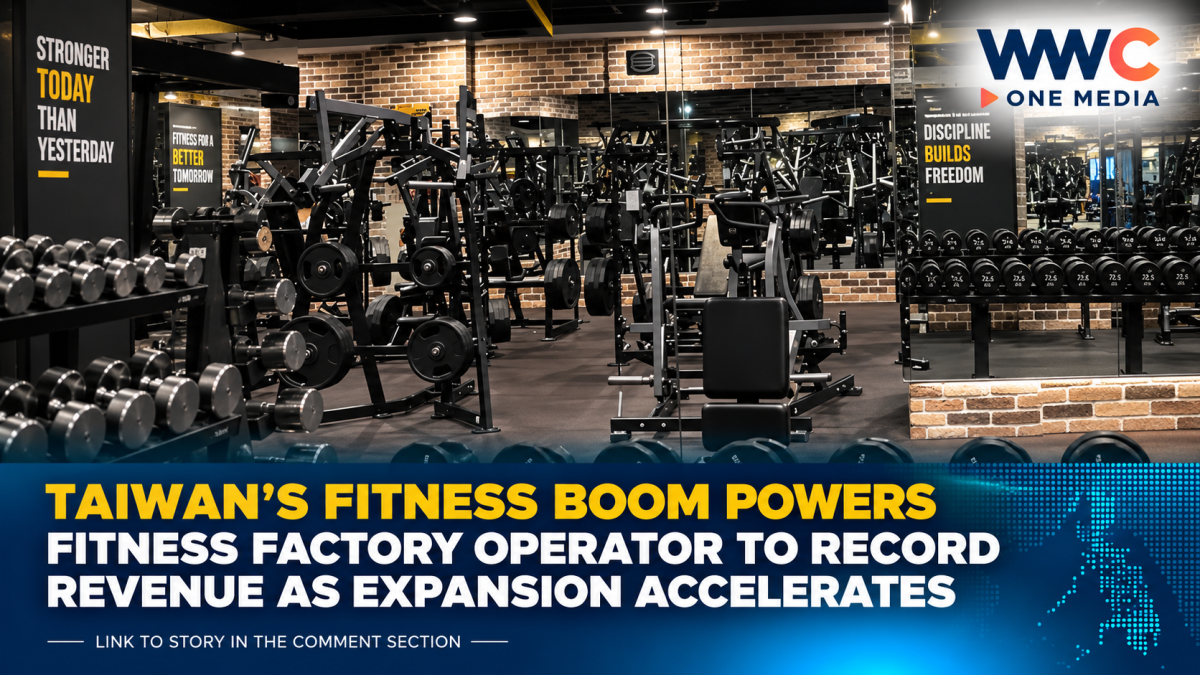
TAIPEI, Taiwan — Taiwan’s growing fitness culture is translating into record sales for Power Wind Health Industry, the company behind the Fitness Factory gym chain, as aggressive expansion and rising demand push the operator to new revenue highs.
Power Wind reported NT$626 million (about US$19.8 million) in consolidated revenue for July 2026, an 18.28% increase from a year earlier, marking another record for monthly revenue, according to Taiwan’s Liberty Times.
The momentum has continued throughout the year. From January through July, Power Wind generated NT$4.028 billion in consolidated revenue, up 19.93% year on year and a record high for the same period.
Fitness and entertainment services accounted for approximately NT$2.5 billion, rising 21.45%, while sports-health services generated about NT$1.392 billion, an increase of 17.42%.
Fitness Factory expansion fuels growth
The company’s growth is closely tied to the continued expansion of its Fitness Factory network.
Power Wind has been adding new locations across Taiwan, with the company targeting at least nine additional Fitness Factory branches in 2026.
One of the newest developments is its partnership with Taiwan’s PX Mart retail network. The new Taichung Gancheng Fitness Factory began presales in August and is scheduled to open in September, while additional facilities in Taoyuan, Taichung, Kaohsiung, Taipei and Tainan are expected to come online later in the year.
The expansion is part of a much larger ambition: Power Wind is targeting 100 Fitness Factory locations by 2027.
The chain’s official website currently lists 86 operating locations and about 400,000 members, highlighting the scale the brand has already achieved.
Taiwan’s fitness market is getting bigger
Fitness Factory’s performance is not happening in isolation.
Taiwan’s overall fitness industry has been experiencing sustained growth, according to Taiwan’s Central News Agency (CNA).
CNA reported that Taiwan’s nationwide fitness-center sales increased from NT$17.08 billion in 2023 to NT$18.66 billion in 2024 and NT$21.24 billion in 2025.
That represents more than 38% growth compared with the year before the COVID-19 pandemic, while the industry’s compound annual growth rate over the latest three-year period was around 12%.
The numbers suggest that fitness is becoming more than a post-pandemic recovery story. Increasing health awareness is turning gym memberships and related services into a more established part of consumer spending.
Bigger gyms, broader services
Fitness Factory has also expanded beyond the traditional gym model.
The company offers group exercise programs, personal training, nutrition-related services and other wellness-oriented facilities. Its official platform says the chain has developed services including fitness management through its membership app, personal training and group classes.
The company has also been expanding into different customer segments.
Business publication Manager Today reported that Fitness Factory is looking beyond its core 25-to-40-year-old customer base and developing offerings aimed at older adults and younger customers, with the goal of creating a broader, multi-generational fitness market.
That diversification could become increasingly important as competition intensifies.
Taiwan’s gym industry enters a shake-up
Despite the strong numbers, the fitness business is not without challenges.
Rising rent, labor, electricity, equipment and expansion costs are increasing the pressure on operators, while the industry is also undergoing consolidation.
Liberty Times reported that the exit of brands including BEING sport and BEING fit from Taiwan’s fitness market is contributing to an industry shake-up, potentially favoring operators with greater scale and stronger economies of operation.
That environment could benefit large chains such as Fitness Factory, which can spread costs across a larger network and membership base.
But expansion also carries its own risks: every new facility requires substantial investment, and operators must maintain membership growth and customer retention to justify the cost of opening additional locations.
From Southern Taiwan to a nationwide fitness network
Fitness Factory began in Kaohsiung in 2006 and has since expanded throughout Taiwan.
The company says it became Taiwan’s first publicly listed fitness-center operator and the first fitness brand in Asia and Taiwan to receive SGS Qualicert international service-quality certification.
Its latest expansion shows how dramatically the business has evolved from its southern Taiwan roots.
With revenue continuing to set records and the company pushing toward 100 locations, Fitness Factory is positioning itself for another major stage of growth.
The bigger question, however, is whether Taiwan’s fitness boom can continue at its current pace as competition increases and operating costs rise.
For now, the numbers are sending a clear signal:
Taiwan’s gym market is no longer simply recovering—it is becoming a major consumer-growth story, and Fitness Factory wants to be one of its biggest winners.


Leave a Reply