
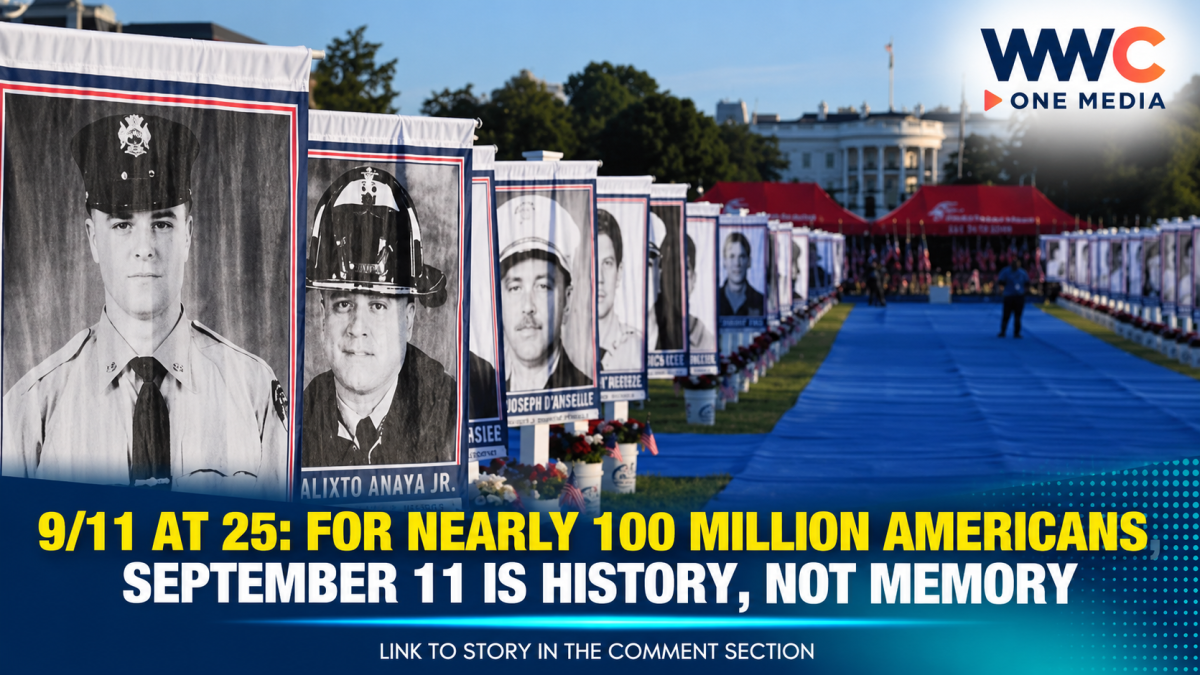
Twenty-five years after the September 11 attacks, a profound generational divide is emerging in the way Americans remember one of the defining events of the modern era.
For roughly 100 million Americans born after the attacks, September 11, 2001, is not a personal memory. It is something they learned about from parents, teachers, documentaries, museums, photographs and increasingly digital media.
That reality is at the heart of the 25th anniversary of 9/11: the country is moving from a generation that remembers the day firsthand to one that knows it primarily as history.
For those who remember, the day remains vivid
For millions of Americans who were alive on September 11, 2001, the memories remain remarkably clear.
A new Pew Research Center analysis found that 83% of U.S. adults who were old enough to remember the attacks say they remember where they were or what they were doing when they learned about them. At the same time, about 10% of adults today were born after the attacks and therefore learned about 9/11 from others.
That distinction is becoming increasingly important as the anniversary arrives.
For people who witnessed the attacks unfold on television, heard the news at work or school, or lived near New York or Washington, September 11 remains connected to personal experiences.
For younger Americans, there is no firsthand memory to draw upon.
A generation knows a post-9/11 America as normal
Many young Americans have never experienced the United States as it existed before September 11.
Airport security procedures, heightened national-security measures, the Department of Homeland Security and the long-running consequences of America’s post-9/11 foreign policy were already part of the world they inherited.
The Associated Press reported that many young people understand 9/11 through the institutions and security measures that emerged afterward rather than through memories of the attacks themselves.
That creates a challenge for educators and families: How do you explain an event to people who have never experienced the world it changed?
The classroom is becoming more important
Schools have increasingly become one of the main places where younger Americans encounter the history of 9/11.
But education about the attacks differs substantially across the United States.
An Associated Press review found that at least 40 states suggest or require some form of 9/11 education, although the depth and emphasis vary. Some curricula address the attacks themselves, while others also examine the Patriot Act, the wars in Afghanistan and Iraq, national security and civil liberties.
That variation means two American teenagers can learn very different versions of the same historic event depending on where they attend school.
The challenge is not simply remembering what happened.
It is understanding why it happened, what followed and how those consequences continue to affect American society.
The memorial is racing against time
The National September 11 Memorial & Museum has made educating younger generations a central priority.
In 2026, the organization launched a major fundraising campaign designed in part to reach the approximately 100 million Americans born after the attacks.
The effort includes educational materials, exhibitions and teacher-training programs intended to preserve firsthand stories and provide younger generations with historical context.
That urgency reflects another uncomfortable reality: firsthand witnesses and survivors are aging, while memories that once passed directly from eyewitnesses to children are increasingly being preserved through archives and institutions.
The legacy is much bigger than one day
The September 11 attacks killed nearly 3,000 people and fundamentally changed American national security, foreign policy and everyday life.
The aftermath included the creation of the Department of Homeland Security, wars in Afghanistan and Iraq, expanded counterterrorism programs and major changes to airport security and government surveillance.
Twenty-five years later, Americans continue to debate whether many of those post-9/11 policies made the country safer and whether their costs were justified.
A new Reuters/Ipsos poll illustrates how dramatically perceptions have shifted. In the 2026 survey, 33% of Americans identified domestic terrorism as the biggest threat to their safety, compared with 20% who pointed to foreign terrorism. Meanwhile, 60% said they still periodically reflect on 9/11.
The event may therefore be becoming less immediate without becoming irrelevant.
The memory is changing—but it has not disappeared
The 25th anniversary comes at a moment when America is confronting a difficult question: what does “Never Forget” mean when millions of Americans literally cannot remember?
For older generations, remembrance can mean recalling exactly where they were when the news broke.
For younger Americans, remembrance must mean something different: learning the history, understanding the human cost and examining the decisions that followed without reducing the event to a single photograph or slogan.
Across Washington, New York and other communities, museums, memorials and cultural institutions are marking the anniversary with exhibitions, performances and firsthand accounts. In Washington, for example, museums are displaying artifacts connected to the World Trade Center, Pentagon and Flight 93 as part of the 25th-anniversary commemorations.
Twenty-five years later, the question is no longer simply whether America remembers
It is how America remembers.
The generation that experienced September 11 firsthand will eventually become a minority of the population.
The generation that comes after it will inherit the memorials, photographs, records and stories—and will have to decide what lessons remain important.
Twenty-five years after the attacks, 9/11 is still deeply personal for millions.
But for nearly 100 million Americans born afterward, it is becoming something fundamentally different: a defining chapter of American history that they never personally witnessed.
And that may make the responsibility to preserve an accurate memory more important—not less.
WWC ONE MEDIA G.A




Leave a Reply