
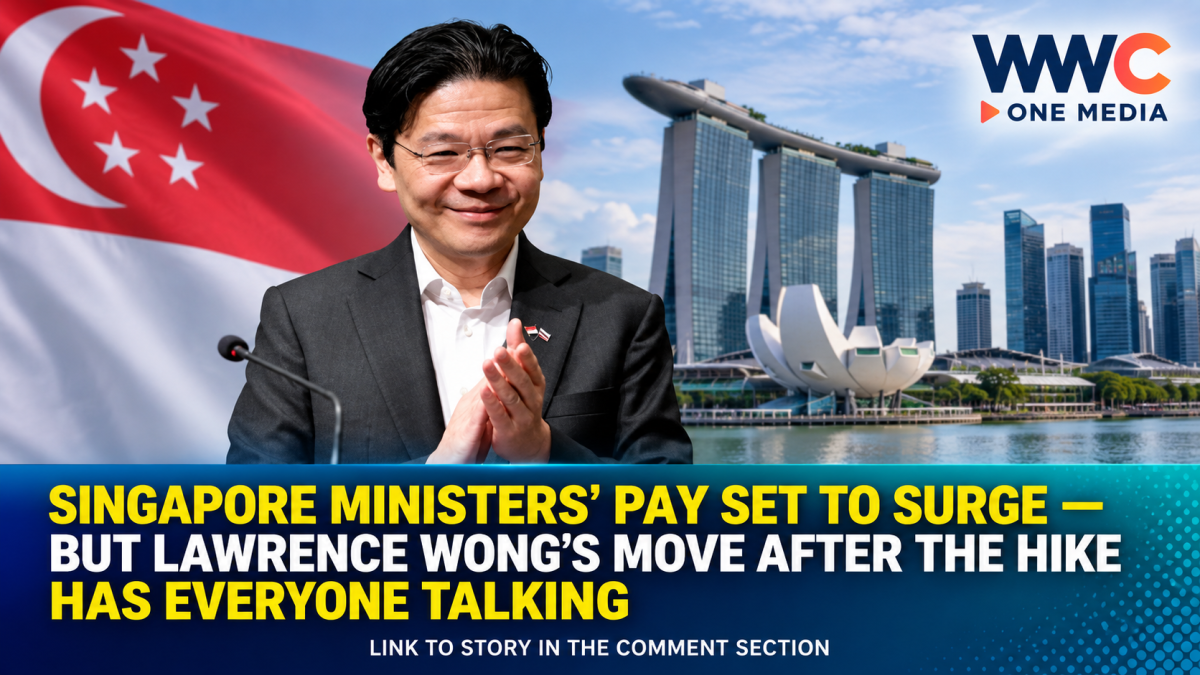
SINGAPORE — Singapore is set to overhaul the pay framework for its political leaders, ending a 15-year period without a salary adjustment and reigniting debate over how much the country’s ministers should earn.
Prime Minister Lawrence Wong announced in Parliament on September 8 that the government has accepted recommendations from an independent committee reviewing political salaries.
But while the new benchmark for an entry-level minister will jump sharply — from S$1.1 million to S$1.8 million a year — existing ministers will not immediately receive the full benchmark amount.
Instead, current political office holders will receive a one-off adjustment of up to 9% from October 15, 2026, with the actual increase depending on factors including individual performance and responsibilities.
A 15-YEAR PAY FREEZE IS FINALLY OVER
Singapore’s political salary framework was established in 2011 and implemented from 2012. A review in 2017 reaffirmed the framework, but the government chose not to make salary adjustments at the time.
A scheduled review in 2023 was also deferred because of economic uncertainty.
The latest review was launched in December 2025 and examined the salaries of political appointment holders as well as Members of Parliament.
The government says the revised framework preserves three central principles: calibre, commitment and a “clean wage.”
Under the system, the benchmark for an MR4 minister is linked to the median annual income of Singapore’s top 1,000 earners, with a 40% discount intended to reflect the ethos of political service.
MINISTERS WON’T GET S$1.8 MILLION OVERNIGHT
The headline figure of S$1.8 million is a reference benchmark, not an automatic salary cheque for every minister.
For an MR4 minister currently receiving the old S$1.1 million reference salary, the maximum immediate adjustment would bring annual remuneration to roughly S$1.2 million.
Future changes will depend on individual performance and responsibilities rather than automatically moving everyone to the new benchmark.
The government says this approach is intended to prevent a sudden windfall while allowing the salary framework to catch up with changes in private-sector compensation.
According to The Business Times, the updated S$1.8 million benchmark represents an annualised increase of about 3.6% over the 15-year period, which the government says remains below wage growth experienced by median- and lower-income Singaporeans over the same period.
LAWRENCE WONG’S SALARY COULD REACH S$3.6 MILLION
The change also affects the Prime Minister’s remuneration.
Under Singapore’s framework, the Prime Minister’s total annual salary is set at twice the MR4 reference salary. With the updated framework, Prime Minister Lawrence Wong’s annual remuneration will rise from about S$2.2 million to S$3.6 million, including variable components.
That figure would reinforce Singapore’s position as having one of — and according to several international comparisons, the highest-paid — national political leadership positions in the world. Reuters noted that Singapore’s political salaries have long stood well above those of leaders in major Western economies.
But Wong has made a notable personal commitment.
He said he will donate his entire salary increase to suitable good causes for the next five years.
MP ALLOWANCES WILL ALSO RISE
The review does not only affect ministers.
Monthly allowances for Singapore’s Members of Parliament will increase from S$13,750 to S$18,500, effective October 15.
The government has also agreed to study whether MP and mayor allowances should eventually be delinked from the ministerial salary benchmark, because their responsibilities differ from those of full-time political office holders.
The salaries of the President, Speaker of Parliament and Deputy Speaker will also be adjusted under the revised framework.
PERFORMANCE WILL PLAY A BIGGER ROLE
Another important change involves the National Bonus, a variable component of political remuneration.
The bonus is tied to national outcomes, including:
- Singapore citizen unemployment
- Real income growth for median-income citizens
- Real income growth for lower-income citizens
- Real GDP growth
The government has accepted recommendations to tighten the targets attached to these indicators. The National Bonus can range from zero to six months of pay depending on national performance.
The government is also exploring whether a stronger quality-of-life measure should eventually be incorporated into the framework.
WHY THE GOVERNMENT SAYS THE HIKE IS NECESSARY
Wong defended the adjustment by arguing that Singapore cannot indefinitely maintain a salary framework that has fallen behind changing market conditions.
The government says competitive compensation is necessary to ensure capable Singaporeans are not discouraged from entering politics because of the financial sacrifice involved in leaving lucrative private-sector careers.
At the same time, the framework is designed to retain a discount from private-sector benchmarks and tie a significant portion of remuneration to performance and national outcomes.
The government also stresses that political office holders receive a “clean wage”, meaning their remuneration is intended to be transparent and free from undisclosed perks or hidden compensation.
THE POLITICAL DEBATE IS FAR FROM OVER
The salary increase nevertheless comes at a politically sensitive moment.
Singapore’s ministers were already among the world’s highest-paid political leaders, while the country’s high cost of living and income disparities remain important public concerns.
Reuters reported that the issue has continued to generate debate over whether high political salaries are necessary to attract talent or whether the system risks appearing disconnected from ordinary Singaporeans.
The government maintains that the benchmark is not simply about paying ministers more. Instead, it argues that the system is designed to preserve a pipeline of capable leaders while maintaining high standards of integrity and accountability.
The revised framework will take effect October 15, 2026, while changes to National Bonus targets linked to calendar-year indicators will begin on January 1, 2027.
And that leaves Singapore with a question that goes well beyond the numbers:
How much should a country pay for political leadership — and where should the line be drawn between attracting top talent and maintaining public trust?



Leave a Reply