
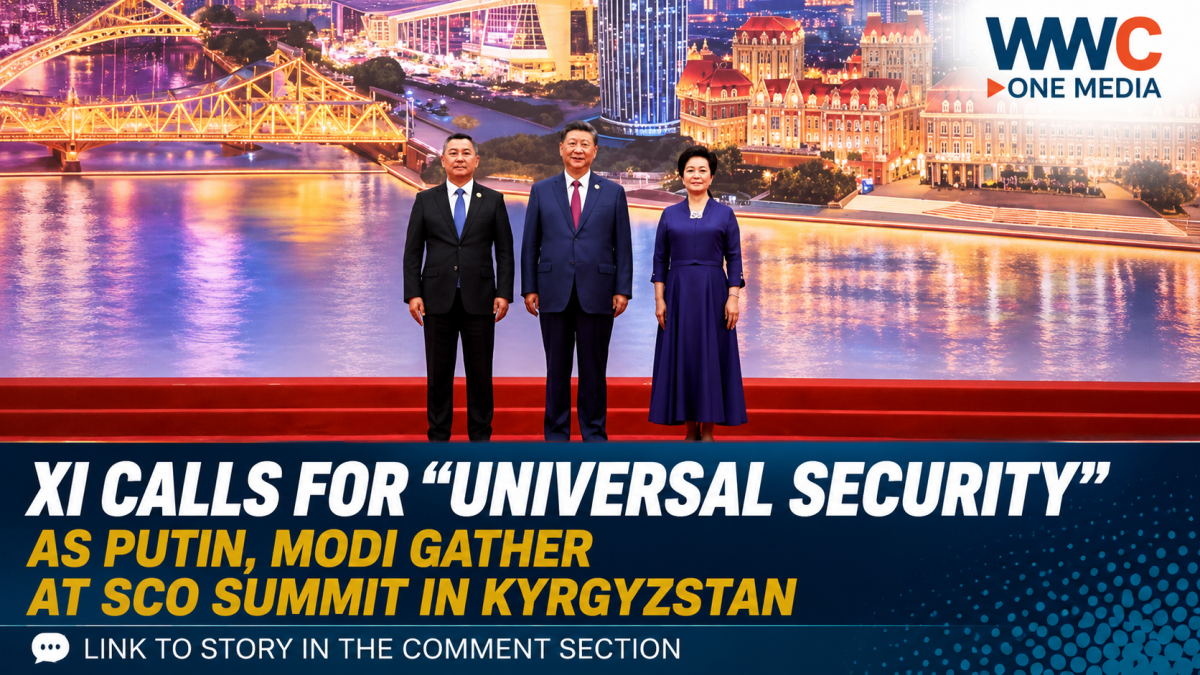
BISHKEK, Kyrgyzstan — Chinese President Xi Jinping has called on the Shanghai Cooperation Organisation (SCO) to make regional security a central priority and create what he described as an environment of “universal security,” as leaders including Russian President Vladimir Putin and Indian Prime Minister Narendra Modi gathered in Bishkek for the bloc’s summit.
Xi made the remarks on Tuesday, September 1, at the 26th Meeting of the SCO Council of Heads of State, held in Kyrgyzstan’s capital. The summit comes as tensions and conflicts continue to reshape the international landscape, including the wars involving Ukraine and Iran.
Xi pushes SCO toward a bigger security role
In his address, Xi urged the 10-member organization to prioritize security while also pursuing development and cooperation.
He called for the SCO to safeguard regional stability, promote dialogue and consultation, and improve governance in what he described as a fair and orderly manner.
Xi also said China was prepared to help develop the SCO into an important platform for implementing Beijing’s Global Security Initiative, alongside its Global Development, Global Civilization and Global Governance initiatives.
The message gives the SCO an increasingly prominent role in Beijing’s vision of a more multipolar international system.
Putin and Modi add weight to the gathering
The summit brings together some of Eurasia’s most influential leaders, including Putin, Modi, Xi and Iranian President Masoud Pezeshkian.
The gathering also comes as China and Russia seek closer strategic coordination while India continues to balance relationships with both Moscow and Beijing.
Xi and Putin already held talks on the sidelines of the summit on August 31. Xi said the foundation of China-Russia relations would become stronger and that both countries should work with other SCO members to strengthen regional stability and push forward reform of global governance.
Putin, meanwhile, said Russia and China should strengthen coordination within the SCO and play a guiding role in the organization. Moscow also signaled interest in expanding cooperation with Beijing in areas including trade, energy, transportation, industry and technology.
Modi’s presence carries its own message
Modi’s participation is particularly significant because India has maintained a more cautious relationship with the SCO than China or Russia.
The Indian prime minister attended the Bishkek summit after India skipped the 2024 SCO summit in Astana. His return reflects New Delhi’s interest in using the organization to advance its own priorities on security, connectivity and economic cooperation, while avoiding being seen as simply aligning with either Beijing or Moscow.
Modi also met Putin at the summit and briefly exchanged greetings with Xi. Indian media reported that Modi has emphasized counterterrorism, connectivity and opportunities for economic cooperation as key priorities for India’s SCO engagement.
A summit shaped by a changing world order
The SCO now has 10 full members, including China, Russia, India, Iran and Pakistan, and represents more than 40 percent of the world’s population and roughly one-quarter of global GDP, according to reporting from the summit.
That gives the organization considerable economic and geopolitical weight, even though its members do not share identical interests.
India, for example, maintains strategic ties with the United States and other Indo-Pacific partners, while simultaneously maintaining close defense and energy relationships with Russia. China and Russia have increasingly emphasized multipolarity and greater cooperation outside Western-led institutions.
Analysts therefore caution against interpreting the presence of Xi, Putin and Modi at the same summit as evidence of a formal three-way alliance. Instead, the SCO remains a forum where countries with sometimes competing interests can cooperate on selected areas while pursuing their own strategic goals.
China also deepens ties with Kyrgyzstan
Xi’s visit extends beyond the SCO summit.
During talks with Kyrgyz President Sadyr Japarov, China and Kyrgyzstan signed agreements aimed at strengthening their strategic partnership and permanent good-neighborly relations.
The two sides also committed to advancing the China-Kyrgyzstan-Uzbekistan railway, expanding financial cooperation and increasing the use of local currencies in bilateral trade and investment settlements.
The railway is particularly significant because it could strengthen transportation links between China and Central Asia and eventually improve connectivity toward wider Eurasian markets.
Why this matters
Xi’s call for “universal security” is more than a statement about regional stability.
It reflects Beijing’s broader effort to position the SCO as an influential platform for security cooperation, economic development and the reform of global governance.
For Russia, the organization provides another venue for maintaining international partnerships amid continued pressure from Western countries.
For India, it offers an opportunity to engage simultaneously with China, Russia, Central Asia and other regional powers without abandoning its broader strategic partnerships.
And for the wider Global South, the SCO is increasingly being presented by its largest members as part of a move toward a more multipolar world order.
The question now is whether the organization can turn those ambitions into concrete cooperation—or whether its members’ competing national interests will limit how far the SCO can go.
WWC ONE MEDIA J.M.D




Leave a Reply