
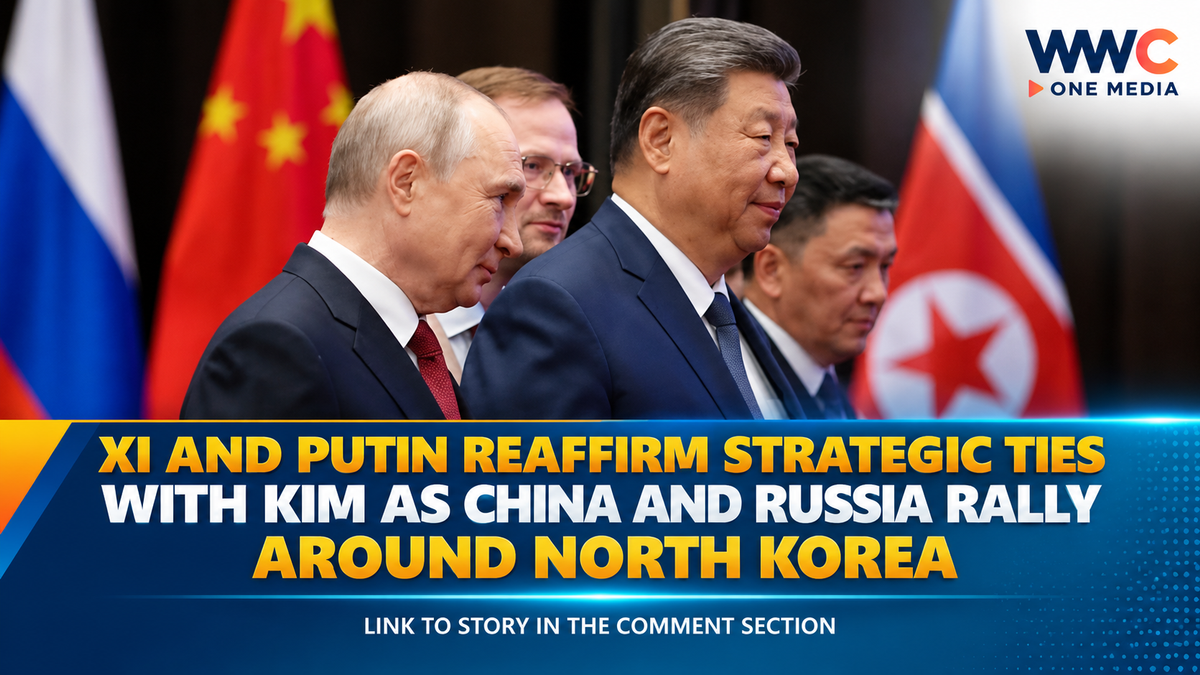
SEOUL — Chinese President Xi Jinping and Russian President Vladimir Putin have publicly reaffirmed their close strategic relationships with North Korea, sending congratulatory messages to Kim Jong Un as Pyongyang marked the 78th anniversary of the country’s founding.
The messages, prominently published by North Korean state media, underline the increasingly important role Pyongyang is playing in the regional geopolitical landscape — and come as both China and Russia seek to deepen their influence amid growing tensions with the United States and its allies.
Xi and Putin each used the anniversary to signal that their relationships with North Korea remain strategically important.
For Kim, the messages offer another highly visible reminder that Pyongyang is no longer as internationally isolated as it once was.
For Beijing and Moscow, they demonstrate that North Korea remains an important partner in a rapidly changing Northeast Asian security environment.
Xi tells Kim China will strengthen strategic guidance
In his message to the North Korean leader, Xi said China was willing to continue strengthening the strategic direction of relations between Beijing and Pyongyang.
According to North Korea’s Korean Central News Agency, Xi said strengthening and developing China–North Korea relations remained a consistent and unwavering policy of China’s ruling Communist Party and government.
Xi also said he was prepared to work with Kim to advance bilateral development and deepen cooperation between the two countries.
The language is notable.
China has historically been North Korea’s most important economic partner and remains crucial to the country’s external trade.
But Pyongyang’s growing military and political relationship with Moscow has increasingly changed the strategic balance around Kim’s government.
China is still North Korea’s dominant economic partner.
Russia, however, has emerged as an increasingly important political, military and strategic partner.
That gives Kim more room to manoeuvre between the region’s two major powers.
Putin promises even closer work with Kim
Putin’s message carried an equally strong signal.
The Russian president said Moscow would continue its closest joint work with Kim to further strengthen the countries’ comprehensive strategic partnership.
Putin said stronger Russia–North Korea relations would contribute to regional security and help build what he described as a more just, multipolar world order.
The message comes after more than two years of rapidly expanding cooperation between Moscow and Pyongyang.
Russia and North Korea signed a comprehensive strategic partnership treaty during Putin’s visit to Pyongyang in June 2024.
Since then, the relationship has expanded dramatically.
North Korea has also become one of Russia’s closest partners amid Moscow’s continuing war in Ukraine.
Russia and North Korea are growing closer than they have in decades
The latest message from Putin comes just days after Russia and North Korea opened their first road connection across their shared border.
The new bridge over the Tumen River links Russia’s Far East with North Korea and is expected to expand trade and other exchanges between the two countries.
Russian and North Korean officials described the new infrastructure as an important step for boosting economic, technological and cultural cooperation.
The bridge is particularly significant because Russia and North Korea have traditionally relied heavily on limited transport links.
A new road connection could make the expanding relationship between the two countries even more practical.
But it has also raised concerns among analysts over the possibility that stronger transport infrastructure could facilitate the movement of goods subject to international sanctions.
North Korea’s support for Russia has changed the relationship
The relationship between Moscow and Pyongyang has transformed dramatically since Russia’s invasion of Ukraine.
North Korea has been accused by the United States, South Korea and other governments of providing military support to Russia.
Pyongyang has also sent troops to support Russia, with North Korean forces playing a role in fighting connected to Russia’s Kursk region.
Putin publicly praised North Korea’s contribution after Russia declared it had regained control of territory in the region.
The military cooperation has turned what was once largely a historical relationship into a modern strategic partnership.
North Korea has described its support for Russia as part of a broader alliance based on their comprehensive strategic partnership.
China remains North Korea’s most important economic lifeline
While Russia’s importance has grown dramatically, China remains North Korea’s most important economic partner.
According to recent reporting, China accounts for the overwhelming majority of North Korea’s external trade.
That means Beijing continues to have enormous economic influence over Pyongyang.
China and North Korea also share a long political and historical relationship dating back to the Korean War.
But Beijing’s relationship with Kim has sometimes appeared more cautious than the increasingly visible warmth between Kim and Putin.
That makes Xi’s latest message particularly important.
China is making clear that Moscow’s rise as a major partner for Pyongyang does not mean Beijing is stepping back.
Instead, Xi is publicly reaffirming that China–North Korea relations remain strategically important.
Kim is now balancing two powerful partners
For years, China was widely regarded as North Korea’s overwhelmingly dominant external partner.
That picture is becoming more complicated.
Kim now has:
🇨🇳 China
North Korea’s largest economic partner and long-standing political ally.
🇷🇺 Russia
An increasingly important military, political and strategic partner.
The growing relationship with Moscow gives Kim greater diplomatic flexibility.
It also potentially reduces North Korea’s dependence on China alone.
This does not mean Beijing and Moscow are competing openly for influence over Pyongyang.
China and Russia themselves continue to deepen strategic relations.
Xi recently told Putin that the foundations of China–Russia ties would become stronger under their strategic guidance and joint efforts.
But North Korea’s growing importance means Pyongyang is increasingly positioned at the intersection of three major strategic relationships.
China–Russia.
Russia–North Korea.
China–North Korea.
The messages appeared on North Korea’s front page
The significance of the anniversary messages was reinforced by their placement.
North Korea’s ruling Workers’ Party newspaper, Rodong Sinmun, published the messages from Xi and Putin on its front page.
In North Korea’s tightly controlled political system, such prominent coverage carries symbolic weight.
It sends a clear message to domestic audiences:
North Korea has powerful partners.
The anniversary also brought congratulatory messages from leaders of several other countries, including Vietnam, Laos, Cambodia, Mongolia, Sweden, Belarus, Singapore, Switzerland and Zimbabwe, according to KCNA.
North Korea was founded on Sept. 9, 1948.
This year’s anniversary marks its 78th year.
Why the timing matters
The messages come at a period of heightened geopolitical uncertainty across Northeast Asia.
The region is facing pressure from several directions.
These include:
- North Korea’s weapons programmes
- Military tensions on the Korean Peninsula
- China’s growing strategic competition with the United States
- Russia’s continuing war in Ukraine
- Closer military cooperation among the United States, Japan and South Korea
- Expanding ties between Moscow and Pyongyang
In this environment, diplomatic messages are rarely just ceremonial.
They can also serve as strategic signals.
Xi’s message tells Kim that China remains committed to the relationship.
Putin’s message signals that Russia wants even closer cooperation.
And together, the two messages show that North Korea remains central to an increasingly complex regional power struggle.
Is a China-Russia-North Korea bloc emerging?
That question is becoming increasingly common among security analysts.
The answer is complicated.
China, Russia and North Korea clearly share overlapping strategic interests in opposing aspects of US-led pressure and in promoting what Beijing and Moscow often describe as a multipolar world order.
But they are not identical partners.
China has its own economic and diplomatic interests.
Russia is deeply focused on its war and strategic confrontation with the West.
North Korea is pursuing its own security and weapons priorities.
Still, the growing alignment is difficult to ignore.
Last year, Xi, Putin and Kim were all seen together during China’s massive military parade marking the 80th anniversary of the end of World War Two.
The event became one of the most striking images of the changing geopolitical landscape in Asia.
Now, less than a year later, Xi and Putin are again publicly reaffirming their strategic relationships with Kim.
The biggest winner may be Kim Jong Un
The diplomatic shift gives Kim something North Korean leaders have historically sought:
Strategic flexibility.
For decades, Pyongyang depended heavily on China.
Now, Russia offers North Korea another powerful relationship.
That could provide:
- Greater diplomatic support
- Expanded economic opportunities
- More strategic cooperation
- Increased international visibility
- Additional political leverage
It may also make international efforts to isolate North Korea more difficult.
The stronger Pyongyang’s relationships with Beijing and Moscow become, the harder it may be for Washington, Seoul and Tokyo to build broad international pressure against Kim’s government.
But China and Russia also need North Korea
The relationship is not entirely one-sided.
North Korea offers strategic value to both countries.
For China
A stable North Korea provides a geopolitical buffer on China’s northeastern border.
Beijing also wants to avoid instability or collapse in North Korea, which could create a major refugee and security crisis.
For Russia
North Korea has become an increasingly important partner during Russia’s confrontation with Western governments.
Moscow and Pyongyang have also developed a far closer strategic relationship since 2024.
For both
North Korea represents another important partner in a regional environment where alliances and rivalries are becoming increasingly defined.
What does this mean for South Korea, Japan and the United States?
The growing ties are likely to be watched closely in Seoul, Tokyo and Washington.
South Korea has repeatedly raised concerns about military cooperation between Russia and North Korea.
Japan has also warned about North Korea’s weapons development and the broader regional consequences of closer Moscow–Pyongyang cooperation.
Meanwhile, the United States has strengthened security partnerships with South Korea and Japan.
That means Northeast Asia increasingly appears to be developing into a region of stronger strategic groupings.
On one side:
The United States, South Korea and Japan.
On the other, a growing alignment involving:
China, Russia and North Korea.
The relationships are not formal mirror-image alliances.
But the strategic direction is becoming increasingly difficult to ignore.
The new road bridge adds another layer
The opening of the new Russia–North Korea road connection could also have wider implications.
The bridge expands the physical infrastructure linking the two countries.
Infrastructure may sound less dramatic than military agreements or summit meetings.
But it can have long-term strategic consequences.
Better connections can support:
- Trade
- Tourism
- Labour movement
- Technology exchanges
- Business cooperation
- Government engagement
For North Korea, additional connections to Russia could reduce its reliance on a single economic route through China.
For Moscow, it creates another pathway into Northeast Asia.
The bottom line
Xi Jinping and Vladimir Putin used North Korea’s 78th founding anniversary to send Kim Jong Un a powerful message: China and Russia both want strong strategic relationships with Pyongyang.
Xi said Beijing remained committed to strengthening and developing ties with North Korea.
Putin pledged the closest joint work with Kim to deepen Russia and North Korea’s comprehensive strategic partnership.
The messages come as Russia and North Korea continue to rapidly expand cooperation and days after the two countries opened their first road connection across their shared border.
For Kim, the growing relationships offer something valuable:
More powerful friends.
More diplomatic options.
And potentially more leverage.
For the rest of Northeast Asia, however, the development raises a bigger question.
Is North Korea simply strengthening separate relationships with China and Russia — or are the foundations being laid for a new and increasingly coordinated strategic alignment?
The answer could shape the security landscape of Asia for years to come.
WWC ONE MEDIA J.M.D




Leave a Reply