
KATHMANDU — The images coming out of Nepal and the Tibetan borderlands could hardly be more terrifying: valleys buried beneath mud and shattered rock, bridges ripped apart, pilgrimage routes cut off and families searching for thousands of people still missing.
Yet the same Himalayan landscape devastated by the August 26 catastrophe is also one of the most powerful tourist magnets on Earth.
And that apparent contradiction helps explain something bigger about Nepal.
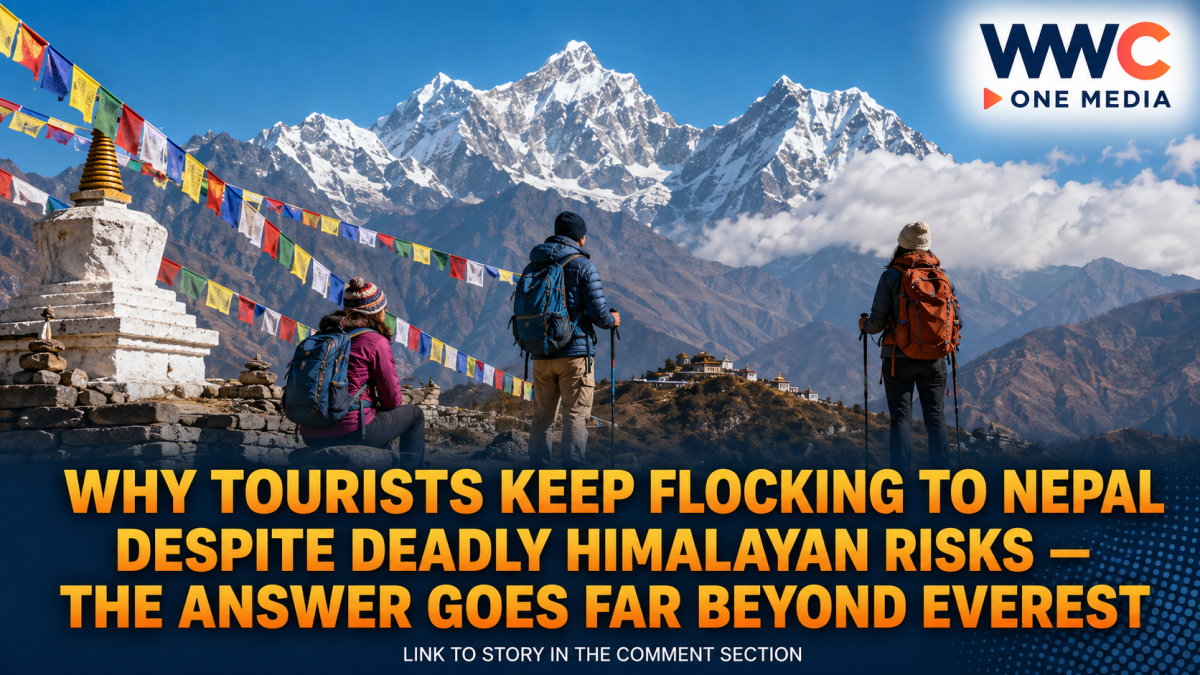
Travelers do not come here only to see Mount Everest. They come for a rare combination of extreme adventure, ancient religious traditions, living Himalayan cultures, wildlife, centuries-old cities and landscapes that exist almost nowhere else.
The latest disaster has now put that attraction—and the risks that accompany it—under an unforgiving spotlight.
A disaster strikes one of Asia’s great travel corridors
The catastrophic flooding that swept through the Nepal-China border region was triggered by a collapse high in the Himalayas that sent ice, rock, mud and debris racing through river valleys below.
By August 29, Reuters reported at least 626 deaths in Nepal and seven in Tibet, putting the combined toll at 633. Nearly 3,000 people remained missing as rescue operations faced bad weather, destroyed roads and continuing concerns over unstable upstream lakes.
Hundreds of those missing are foreigners.
Many were not ordinary vacationers. They were pilgrims traveling toward Mount Kailash and Lake Manasarovar, sacred destinations in Tibet that attract believers from several religious traditions.
The tragedy therefore hit directly at one of the reasons Nepal attracts so many international visitors: it is both a destination and a gateway to some of Asia’s most important spiritual and mountain landscapes.
Everest made Nepal famous—but Nepal became much bigger than Everest
For generations, Nepal’s international image has been inseparable from the Himalayas.
Mount Everest, called Sagarmatha in Nepal, rises to more than 8,848 meters and remains the world’s highest mountain. But only a tiny fraction of visitors ever attempt its summit.
Far more come simply to experience the Everest region.
Trekkers walk through mountain villages and valleys toward Everest Base Camp, stay in teahouses, cross suspension bridges and travel through communities whose livelihoods have become deeply connected with trekking and mountaineering.
The Sherpa people in particular have played an extraordinary role in the history of Himalayan climbing.
Everest’s modern global mythology accelerated after New Zealand’s Edmund Hillary and Nepal-born Tenzing Norgay reached the summit in 1953. Seven decades later, demand has barely faded.
During the 2026 climbing season, Nepal issued hundreds of Everest permits despite higher expedition costs and growing concerns about congestion and changing glacier conditions. Veteran climber Kami Rita Sherpa, who has reached Everest’s summit a record 32 times, has even called for limits on climber numbers because of overcrowding and safety concerns.
That tells its own story: even as Everest becomes more expensive and its risks more visible, people keep coming.
Nepal offers something adventure tourism cannot manufacture
Nepal’s appeal is not simply altitude.
The country compresses extraordinary geographic variety into a relatively small territory.
Travelers can move from Himalayan trekking routes to Kathmandu’s dense historic neighborhoods and then south toward subtropical forests where one-horned rhinoceroses roam.
The World Bank says more than 45% of tourists visiting Nepal are drawn to its natural resources, illustrating how central wilderness and protected landscapes are to the country’s tourism economy.
Sagarmatha National Park surrounds the Everest region and contains glaciers, deep valleys, dramatic peaks and settlements closely associated with Sherpa culture.
Far to the south, Chitwan National Park offers a completely different Nepal.
Its forests and grasslands are famous for the greater one-horned rhinoceros, while visitors also come for wildlife observation, canoe trips, forest excursions and encounters with the cultural traditions of local Tharu communities.
For travelers accustomed to destinations built largely around a single attraction, Nepal can feel like several countries compressed into one.
Then there is the spiritual pull
For millions of people, the Himalayas are not merely mountains.
They are sacred geography.
That is particularly important in understanding why so many pilgrims were traveling through the Nepal-Tibet region when the disaster struck.
Mount Kailash, located in Tibet, is revered in Hinduism, Buddhism, Jainism and the Tibetan Bon tradition. Pilgrims traditionally undertake a roughly 53-kilometer circumambulation of the mountain, an arduous journey at extreme altitude.
Nearby Lake Manasarovar is also regarded as sacred.
Nepal has become an important access point for international pilgrimage traffic heading toward the region, particularly through Kathmandu and the northern border corridors.
But travelers seeking religious experiences do not necessarily have to leave Nepal.
In Kathmandu, Pashupatinath is one of Hinduism’s most important temple complexes. It forms part of UNESCO’s Kathmandu Valley World Heritage property.
For Buddhists, Lumbini, traditionally recognized as the birthplace of the Buddha, is another major international pilgrimage destination.
Together they make Nepal something unusual: a place where adventure tourism and religious pilgrimage overlap, sometimes on the same journey.
Kathmandu is an attraction in its own right
Some descriptions of Nepal tourism focus so heavily on Everest that they overlook one of the country’s strongest draws.
Kathmandu Valley contains an extraordinary concentration of historic architecture, temples, stupas, palaces and public squares.
UNESCO’s Kathmandu Valley World Heritage property consists of seven monument zones: the Durbar Squares of Kathmandu, Patan and Bhaktapur; the Buddhist sites of Swayambhu and Boudhanath; and the Hindu temple complexes of Pashupati and Changu Narayan.
Nepal has four UNESCO World Heritage properties overall: Kathmandu Valley, Lumbini, Sagarmatha National Park and Chitwan National Park.
That combination of cultural and natural heritage is a major reason Nepal’s tourism identity extends far beyond mountaineering.
More tourists were coming back
Nepal’s tourism sector had already been showing strong signs of recovery and renewed international demand.
Official Nepal Tourism Board data show 92,573 international visitor arrivals in January 2026, up 15.7% from January 2025 and nearly 14% above January 2019, before the COVID-19 pandemic.
India was the largest source market that month, followed by China and the United States, underscoring Nepal’s appeal to both regional travelers and long-haul visitors.
Tourism also matters far beyond hotels and tour companies.
World Bank data estimate travel and tourism contributed about 6.4% of Nepal’s GDP and 15.2% of employment in 2024. Trekking, guiding, restaurants, transportation, handicrafts and accommodation spread tourism income into communities where alternative sources of employment may be limited.
That makes a disaster affecting major tourism corridors not only a humanitarian tragedy but a potential economic shock.
The uncomfortable reality: beauty and danger occupy the same mountains
The Nepal disaster has also exposed an increasingly difficult truth.
Many of the landscapes that attract visitors are becoming more fragile.
Scientists have warned that warming temperatures are changing Himalayan glaciers and increasing the potential for cascading hazards involving ice, rock, landslides and glacial lakes.
Reuters reported that Nepal has lost nearly a third of its glacier ice over roughly the past three decades, while researchers examining the latest disaster have pointed to increasingly unstable high-mountain conditions.
Those risks exist alongside familiar Himalayan dangers: avalanches, altitude sickness, earthquakes, landslides, extreme weather and sudden floods.
Tourism therefore creates a difficult balancing act.
Nepal needs visitors. But the country also needs safer infrastructure, stronger early-warning systems, better emergency communications and tourism development that does not overwhelm fragile mountain environments.
The August catastrophe could intensify that debate.
So why do people keep going?
Because Nepal offers something that is increasingly difficult to find in modern tourism: a sense that the destination has not been completely separated from the forces that created it.
The mountains are genuinely enormous.
The journeys can still be difficult.
Religious traditions are centuries old rather than designed for visitors. Communities along trekking routes maintain cultures that predate the tourism industry surrounding them.
And the country’s attractions span experiences that normally require several different trips—Everest and Annapurna, Buddhist and Hindu pilgrimage sites, medieval cities, jungle wildlife and remote Himalayan settlements.
The danger revealed by the latest flood does not erase that appeal.
But it does change the conversation surrounding it.
For Nepal, the challenge after the rescue operation ends will not simply be convincing tourists to return. The country has recovered from devastating shocks before, including the 2015 earthquake.
The harder question is whether one of the world’s greatest adventure destinations can protect the people who live there—and the travelers who keep coming—as the Himalayas themselves become increasingly unpredictable.
That may ultimately determine not whether the world continues to love Nepal, but what traveling to Nepal will look like in the decades ahead.




Leave a Reply