
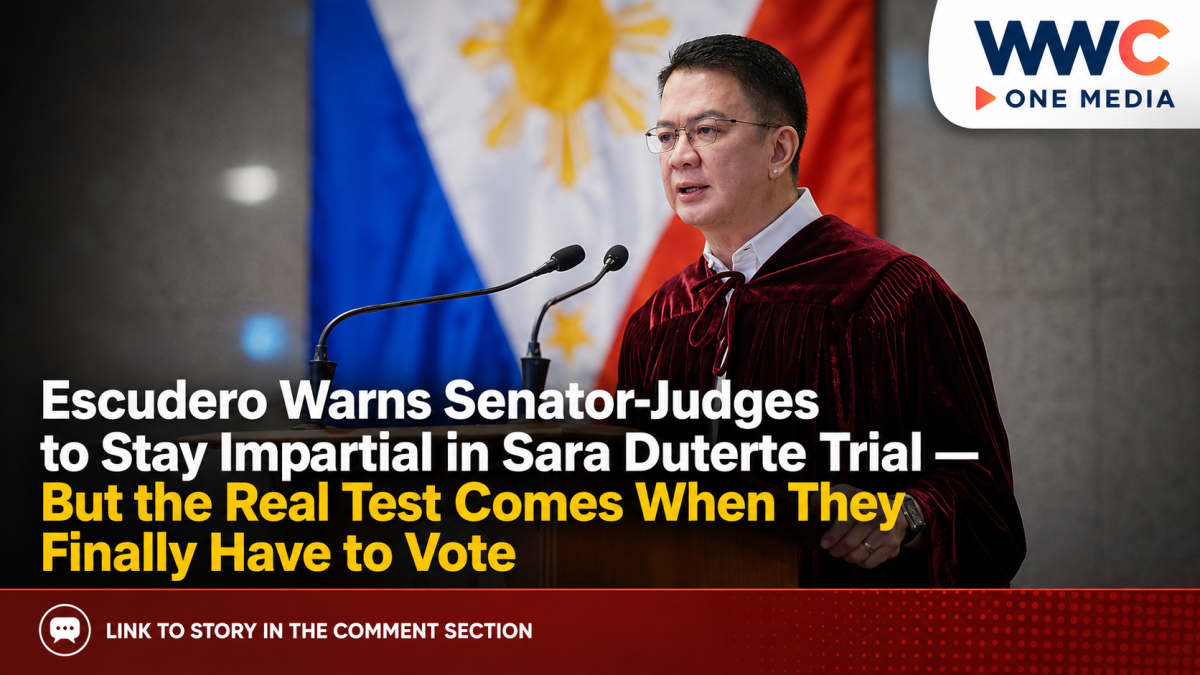
MANILA, Philippines — The impeachment trial of Vice President Sara Duterte entered a potentially decisive new phase after presiding officer Sen. Francis “Chiz” Escudero ordered senator-judges to demonstrate political neutrality, warned lawyers against “trial by publicity,” and imposed tougher penalties for public comments that could undermine the proceedings.
Escudero’s August 26 ruling effectively draws a line around what senators, prosecutors, defense lawyers, witnesses and Duterte herself may say while the historic case is pending — with the Senate impeachment court attempting to keep an increasingly combative political battle focused on evidence presented inside the chamber rather than arguments fought on television and social media.
The warning comes as Duterte’s impeachment trial moves deeper into allegations involving confidential funds and after weeks of highly charged exchanges among lawyers, witnesses and senator-judges.
Escudero to senator-judges: Questions must seek truth, not become speeches
Escudero reminded the Senate that its members are not merely legislators during the proceedings.
They are sitting as senator-judges, bound by an oath to render impartial justice according to the Constitution and Philippine laws.
While senator-judges are permitted to directly question witnesses and lawyers to clarify testimony, Escudero said those questions must remain relevant, material and directed toward finding the truth.
He warned that questioning must not become harassment, partisan advocacy or a declaration that a senator has already reached a conclusion before all the evidence has been heard.
The distinction could become increasingly important as the trial progresses.
Impeachment is inherently political because elected senators ultimately decide the fate of another elected official. But Escudero’s ruling underscores that once senators take their oath as impeachment judges, their conduct is expected to reflect judicial restraint as well as political accountability.
The presiding officer also urged senator-judges to avoid personal attacks, accusations of improper motives and other remarks inconsistent with parliamentary decorum.
His message was unmistakable: the final judgment should come from the evidence and the Constitution — not political allegiance or public pressure.
Complaints against senator-judges? Take them to Senate ethics panel
Escudero also clarified what can happen when a senator-judge is accused of violating the impeachment oath or the Senate’s rules.
Instead of turning the impeachment floor into a separate proceeding over the alleged misconduct of individual senators, complaints may be filed or referred to the Senate Committee on Ethics and Privileges under the chamber’s internal rules.
That ruling is significant because questions over the impartiality of senator-judges have surrounded Duterte’s impeachment proceedings.
Legal experts previously noted that the impeachment oath imposes an obligation of impartiality, while the Senate’s rules do not provide a simple mechanism allowing one side to automatically remove a senator-judge it considers biased.
Escudero’s latest ruling now provides a clearer institutional route: alleged ethical violations involving senator-judges can be brought before the Senate ethics committee.
Rule 18 gets teeth: reprimand first, ₱30,000 fine after
Escudero also ordered strict enforcement of Rule 18 of the Senate impeachment rules, which restricts public comments concerning the merits of a pending impeachment case.
Under the new enforcement framework, a first violation can result in a severe public reprimand and stern admonition entered into the record.
A second and subsequent violation may carry a fine of up to ₱30,000 for each offense.
For lawyers, the consequences could extend beyond the impeachment court.
Escudero said violations may be referred to the Supreme Court, Office of the Bar Confidant or Integrated Bar of the Philippines for possible disciplinary consideration under the Code of Professional Responsibility and Accountability. Reports also said an offending lawyer could face restrictions on participation in the trial when warranted.
Past conduct was effectively given a reset.
Escudero said the court would exercise liberality regarding earlier statements, but stressed that from his ruling onward, Rule 18 would be strictly enforced.
Sara Duterte herself is covered
Perhaps the most politically explosive part of the ruling was Escudero’s explicit reminder that Vice President Sara Duterte is also covered by the restrictions.
The issue surfaced almost immediately.
While Escudero was announcing the stricter rules, Duterte released a statement accusing the prosecution of relying on what she characterized as theatrics, insults and speculation and challenged prosecutors to prove the accusations against her with evidence.
House lead prosecutor Rep. Gerville Luistro raised the statement before the impeachment court.
Escudero said that because Duterte’s statement was issued while the ruling was being announced, the court would apply its new sanctions prospectively rather than immediately punish her.
But he instructed Duterte’s defense lawyers to remind their client to comply going forward.
That means future statements by the Vice President discussing the merits of her own impeachment case could potentially trigger action from the court.
Prosecution says it will comply — but still wants to inform the public
The House prosecution team said it would respect Escudero’s ruling while insisting that the rules should be applied equally to everyone covered by them.
Former Surigao del Norte lawmaker Robert Ace Barbers, an adviser and spokesperson for the prosecution, said the panel would comply with the court’s directive but expected the same standard to apply to Duterte and the other parties.
Deputy Speaker Janette Garin later said the restrictions would affect the prosecution’s communications strategy but would not prevent it from providing factual information about developments in the trial.
The prosecution could reorganize its spokesperson system so people who are not restricted from discussing the merits can continue explaining publicly available developments without violating the court’s rules.
That creates a delicate balancing act.
Impeachment proceedings involve matters of enormous public interest, and Filipinos have a legitimate interest in knowing what evidence is being presented. But Escudero is drawing a distinction between reporting what happened in court and using public platforms to argue the merits of the case while the senator-judges are still weighing the evidence.
Why Escudero acted now
The crackdown did not emerge in a vacuum.
One immediate controversy involved House private prosecutor Amando Ligutan, who had defended a Facebook post concerning misleading questions during examination of witnesses following a tense courtroom exchange involving defense lawyer Kristine Ferrer and private prosecutor Lorna Kapunan.
Escudero’s broader concern, however, appears to extend far beyond one post.
The impeachment trial has increasingly spilled outside the Senate chamber, where comments by lawyers, political allies and public officials can rapidly spread online and influence public perception before senator-judges finish hearing the evidence.
Escudero warned against allowing media campaigns to substitute public outrage for evidence — effectively telling both camps that the impeachment battle must be won inside the courtroom, not through viral posts outside it.
The stakes go far beyond courtroom etiquette
Duterte’s trial formally opened in July 2026 amid deep political divisions and with potentially enormous consequences for the country’s political future.
The House prosecution is pursuing four articles of impeachment, involving allegations of misuse of confidential funds, unexplained wealth, bribery and threats involving President Ferdinand Marcos Jr. and other officials.
Duterte has denied wrongdoing and has portrayed the impeachment proceedings as politically motivated.
One of the biggest components of the prosecution case concerns approximately ₱612.5 million in confidential funds — ₱500 million associated with the Office of the Vice President and ₱112.5 million with the Department of Education during Duterte’s tenure as education secretary. Prosecutors allege irregularities in their use and liquidation; Duterte and her defense are entitled to contest those allegations and the evidence supporting them.
The Senate impeachment court has also allowed subpoenas covering certain financial and tax records sought by prosecutors in connection with the separate unexplained-wealth allegation.
That is why Escudero’s impartiality ruling matters beyond courtroom manners.
As financial records, witnesses and allegations involving hundreds of millions of pesos enter the proceedings, every question from a senator-judge — and every public statement made outside the chamber — could feed accusations that the process is either a legitimate search for accountability or a predetermined political prosecution.
The bigger question: Can senators really separate politics from judgment?
Escudero can order decorum.
He can punish violations of the impeachment court’s rules.
He can tell prosecutors and defense lawyers to stop trying their case through Facebook posts and press conferences.
What he cannot easily regulate is the political history, alliances and ambitions of the senators who will eventually vote.
And that may become the ultimate credibility test of the Duterte impeachment trial.
The impeachment court’s legitimacy will not be measured only by whether procedural rules were followed. It will also depend on whether Filipinos believe the senator-judges listened to the evidence before deciding how to vote.
Escudero has now publicly reminded them of precisely that obligation.
The question is whether the chamber can live up to it once the evidence becomes more politically explosive — and the pressure outside the Senate becomes even harder to ignore.



Leave a Reply