
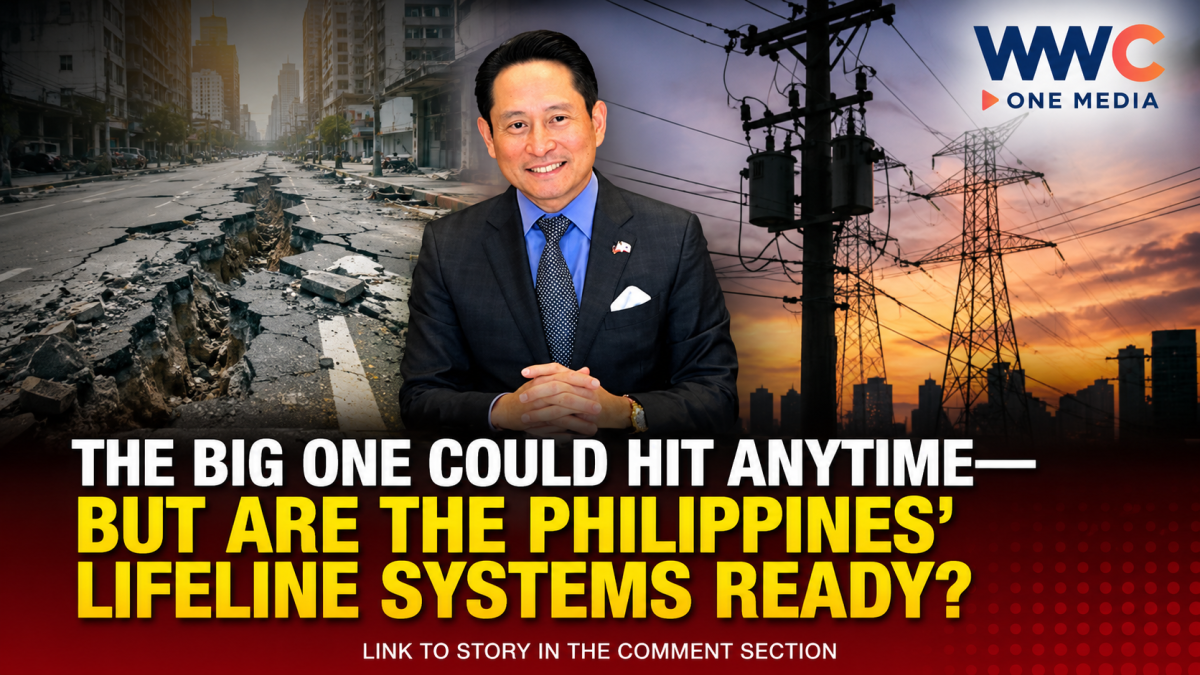
MANILA, Philippines — The question is no longer simply whether Filipinos can survive the shaking of a massive earthquake. A growing concern is what happens after the ground stops moving.
As the Philippines prepares for the possibility of the long-feared “Big One,” disaster resilience experts are raising alarms over gaps that could disrupt the country’s ability to restore electricity, water, telecommunications and other essential services when they are needed most.
Atty. Michael Toledo, an adviser to the Philippine Disaster Resilience Foundation (PDRF), warned that operational and regulatory gaps between government agencies and private utility operators must be addressed to ensure a coordinated response to a major earthquake.
“There are operational and regulatory gaps that need to be addressed if we are to ensure effective coordination with government and the private sector in addressing the Big One,” Toledo said during the “Powering Resilience: Strengthening Utility Systems” forum.
The danger of a cascading crisis
A powerful earthquake does not affect just one sector. Damage to a single critical system can trigger a chain reaction across an entire city.
Without electricity, water pumps and telecommunications networks can be affected. Damaged roads and infrastructure can slow emergency responders and delay repairs. Communication failures can make it harder for families to receive warnings, locate loved ones or access vital information.
That interdependence was at the center of the forum’s discussions, which examined how energy, water, telecommunications and infrastructure systems can continue operating—or recover quickly—following a major earthquake.
Experts also discussed the minimum level of functionality needed to keep essential services running, the impact of prolonged outages and the urgent need to protect vulnerable communities during the recovery period.
The warning comes as recent discussions about earthquake preparedness have renewed public attention on the country’s vulnerability to a major seismic disaster.
The “Big One” threat remains a serious concern
The term “Big One” is commonly associated with a potentially devastating earthquake along the West Valley Fault, which runs through parts of Metro Manila and nearby provinces.
DOST Secretary Renato Solidum Jr. has reiterated that preparedness remains the country’s strongest defense against earthquakes, emphasizing the importance of safer buildings, compliance with engineering standards and evaluating older structures that may require retrofitting or strengthening.
Solidum has said experts consider a magnitude 7.2 earthquake along the West Valley Fault as the worst-case earthquake scenario that could directly affect the National Capital Region. He also stressed that the consequences of a major earthquake in a densely populated urban area could be far more severe than those of a similar event occurring offshore.
Recent reporting has also highlighted the enormous human stakes. The Metro Manila Earthquake Impact Reduction Study has been widely cited in discussions of a major West Valley Fault earthquake, with estimates pointing to tens of thousands of potential deaths and injuries and widespread structural damage under a worst-case scenario.
Preparedness is more than earthquake drills
While earthquake drills remain essential, disaster experts and government officials have repeatedly stressed that true preparedness goes beyond knowing how to “Drop, Cover and Hold.”
It also means ensuring that homes, schools, hospitals, bridges and other critical structures are safe; that emergency plans are regularly tested; and that government agencies, local communities and private companies know exactly how to work together when normal systems fail.
Solidum has urged the public and institutions to prioritize building safety, inspections and household preparedness, while reminding Filipinos that every locality faces its own earthquake risks depending on nearby active faults.
For a country where millions depend daily on interconnected power, water, communications and transportation networks, the challenge is clear: a disaster response plan is only as strong as the systems and partnerships behind it.
The real test comes after the shaking
The Philippines has made progress in disaster preparedness, public awareness and hazard mapping. But Toledo’s warning underscores a critical reality: a major earthquake could test not only the strength of buildings, but also the strength of coordination between the public and private sectors.
When the “Big One” comes, restoring normal life may depend on whether essential services can keep operating—and whether those responsible for them can act as one.
Because in a catastrophe of that scale, the first few minutes may determine who survives the shaking.
But the hours and days that follow could determine how quickly an entire nation recovers.

Leave a Reply