
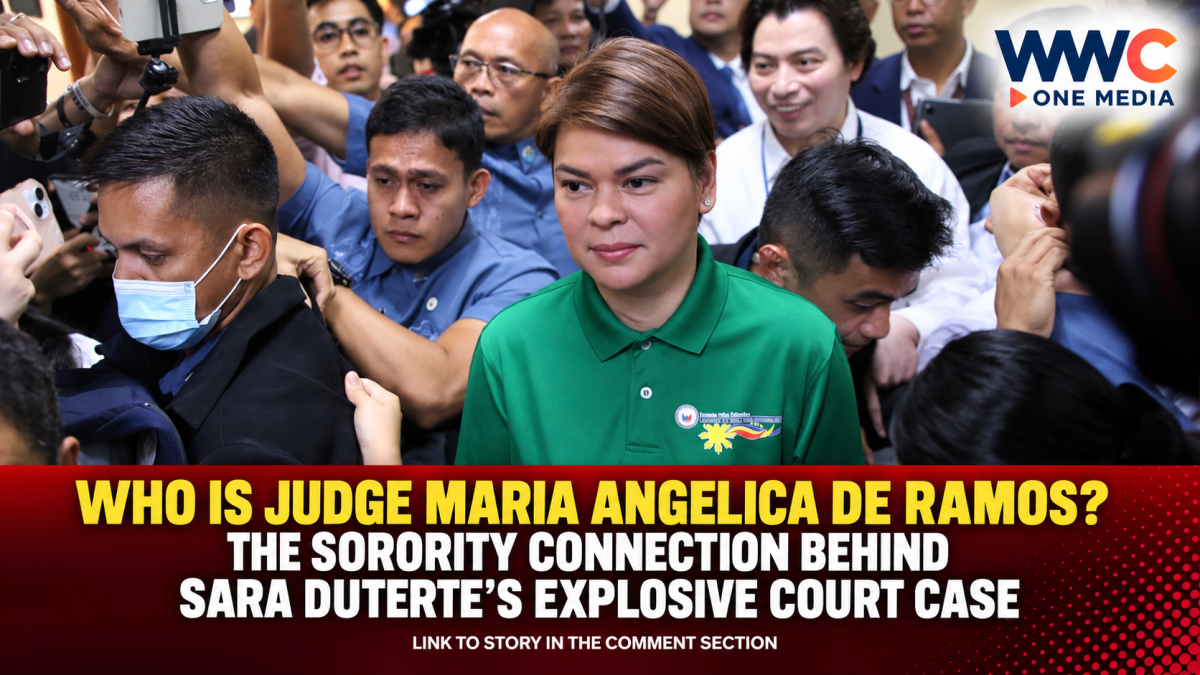
MANILA, Philippines — As Vice President Sara Duterte faces an arrest warrant over three counts of grave threats, attention has shifted to the Quezon City judge who signed the order—and to a personal connection between the magistrate and the vice president that had already been disclosed in court.
The judge is Maria Angelica P. De Ramos, the presiding judge of Quezon City Regional Trial Court Branch 98, the court handling Duterte’s criminal case.
The Supreme Court’s official directory confirms De Ramos as the presiding judge of Branch 98, located at the Quezon City Hall Complex in Diliman.
On September 4, 2026, De Ramos issued a warrant for Duterte’s arrest in connection with three counts of grave threats filed by the Department of Justice under Article 282 of the Revised Penal Code in relation to the Cybercrime Prevention Act of 2012. Bail was set at P120,000 for each count, or P360,000 in total.
But De Ramos is drawing particular attention because she and Duterte have something in common: both were members of Sororitas Reginae Juris, a law-school sorority at San Beda College of Law.
The judge disclosed the connection during earlier proceedings involving Duterte’s bid to dismiss the criminal charges. The disclosure was reported by multiple Philippine news outlets and came before the court proceeded with arguments in the case.
Who is Maria Angelica P. De Ramos?
De Ramos is a career lawyer and member of the Philippine judiciary who currently presides over RTC Branch 98 in Quezon City.
Her appointment to the position is documented in official Judiciary records. In a 2024 Judicial and Bar Council shortlist for the Quezon City RTC Branch 98 vacancy, De Ramos was among the seven candidates considered for the post.
The following year, the Supreme Court announced that De Ramos was among 78 newly appointed judges who took their oath of office before then-Chief Justice Alexander Gesmundo. The official list identifies her as the judge appointed to RTC Branch 98, Quezon City.
Her Branch 98 court has since handled criminal proceedings, including a case that resulted in a conviction earlier this year.
On August 14, Philippine Star reported that De Ramos sentenced former PNP Custodial Service Unit chief PLtCol. Jigger Noceda to 12 years in prison in a sexual-harassment case involving former Ozamiz City Vice Mayor Princess Nova Parojinog. The court also ordered payment of P150,000 in civil indemnity, moral damages and exemplary damages.
Why is her connection to Sara Duterte significant?
The revelation that De Ramos and Duterte belonged to the same law-school sorority has naturally attracted public attention because the judge is presiding over a case that could potentially expose the vice president to criminal liability.
However, the existence of a former school or sorority relationship does not establish that the judge is biased or that the proceedings are improper.
What makes the matter noteworthy is that De Ramos herself disclosed the relationship before the case proceeded further.
The issue has nevertheless prompted discussion about judicial impartiality and whether the judge should continue hearing the case. Reports indicate that the connection was acknowledged by the parties during earlier proceedings, while De Ramos continued to preside over the matter.
That distinction is important: the public disclosure of a relationship is a fact; allegations of actual bias would require evidence.
The case that put Judge De Ramos in the spotlight
The criminal case stems from Duterte’s controversial remarks during an online press conference on November 23, 2024.
During the briefing, Duterte said she had spoken to an individual and instructed that person to kill President Ferdinand Marcos Jr., First Lady Liza Araneta-Marcos and then-House Speaker Martin Romualdez if she herself were killed.
Duterte later argued that her statements had been taken out of context and characterized them in the context of an alleged threat against her own life.
The Department of Justice subsequently pursued criminal charges, resulting in three counts of grave threats filed before the Quezon City RTC.
GMA News reported in August that Branch 98 had allowed oral arguments concerning Duterte’s effort to have the charges dismissed. The defense had challenged the court’s jurisdiction, while prosecutors maintained their case.
The court ultimately proceeded to issue the arrest warrant on September 4.
What the arrest warrant actually means
The warrant does not mean Duterte has been found guilty.
It means the court has ordered her arrest in connection with the pending criminal case. The case must still proceed through the judicial process, and Duterte retains the right to challenge the charges and pursue available legal remedies.
Her lawyer, Paul Lawrence Lim, said Duterte had no intention of evading the law and would continue pursuing her legal remedies regardless of the jurisdictional issues raised by her defense.
The National Bureau of Investigation also indicated that arrangements could be made for Duterte to post bail, with the court setting bail at P120,000 for each of the three charges.
A criminal case unfolding alongside an impeachment trial
The arrest warrant comes at an extraordinary moment for Duterte.
She is simultaneously facing impeachment proceedings before the Philippine Senate, which is sitting as an impeachment court.
The alleged threats against Marcos, his wife and Romualdez are also part of the broader political controversy surrounding Duterte.
International outlets have highlighted the significance of the development because it places the sitting vice president under criminal proceedings while she is also fighting an impeachment case. Time reported that the warrant is connected to the same November 2024 remarks concerning Marcos, Liza Araneta-Marcos and Romualdez.
Al Jazeera, citing AFP and Reuters, likewise reported that the Quezon City court issued the warrant after Duterte’s lawyers sought to delay the proceedings.
The Palace: Respect the court’s decision
Malacañang has said it respects the court’s action.
Palace Press Officer Claire Castro said the administration respects decisions and orders issued by the judiciary, reinforcing the government’s position that the matter should proceed through the legal process.
Meanwhile, Duterte’s legal team continues to contest the case.
Former chief presidential counsel Salvador Panelo has also questioned the proceedings, arguing that constitutional and jurisprudential questions surrounding immunity and the simultaneous impeachment proceedings should be considered. Those arguments remain positions advanced by Duterte’s camp and have not established that the criminal case is invalid.
What happens next?
For Judge Maria Angelica P. De Ramos, the spotlight is now much larger than her courtroom.
She is presiding over a case involving one of the country’s highest-ranking officials, while her previously undisclosed-to-the-public-but-court-disclosed connection to Duterte as a fellow San Beda law-school sorority member has become a major point of public discussion.
For Duterte, meanwhile, the immediate legal issue is the arrest warrant and the posting of bail, while the larger battle continues on two fronts: the criminal case before the Quezon City RTC and the impeachment proceedings before the Senate.
What remains unresolved is the central question that will ultimately have to be answered in court: whether Duterte’s 2024 statements legally constitute grave threats under Philippine law.
For now, Judge De Ramos’ role is not to decide the political debate surrounding Duterte—but to preside over the criminal proceedings according to the law and the evidence presented before her.
Leave a Reply