
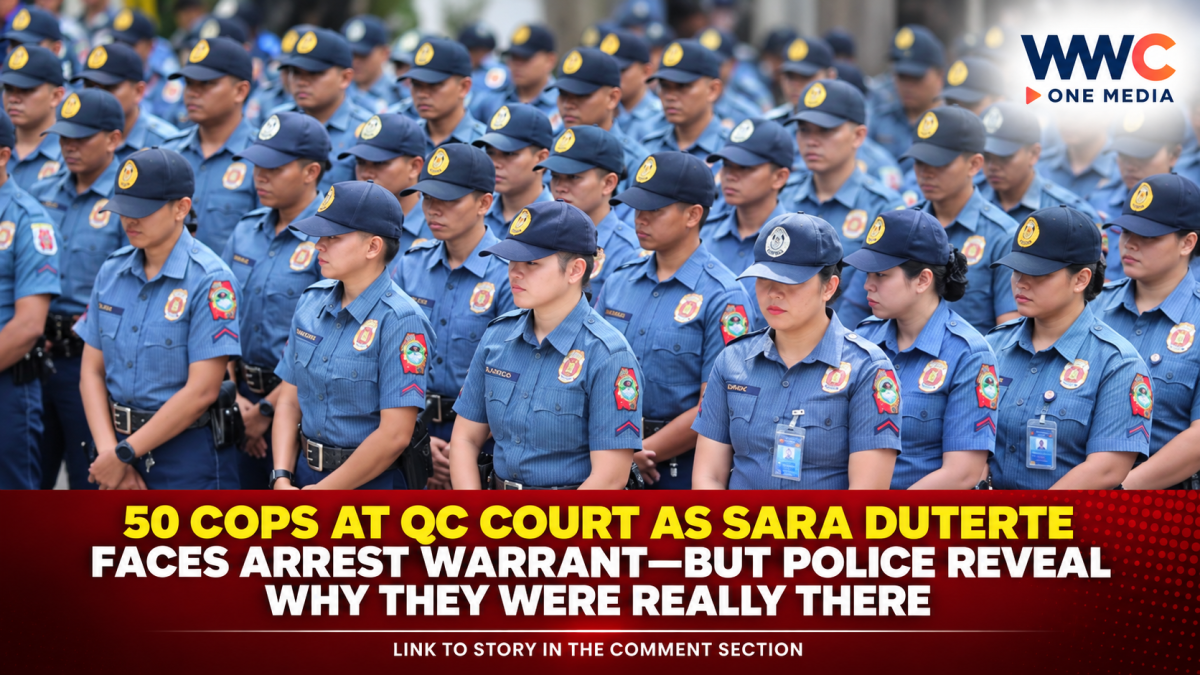
MANILA, Philippines — The presence of dozens of police officers at the Quezon City Hall of Justice sparked speculation Friday after a court issued an arrest warrant against Vice President Sara Duterte—but the Quezon City Police District (QCPD) said the deployment was primarily about court security, not a special operation to capture the vice president.
Around 50 police officers were deployed to the Hall of Justice following a request from court authorities, QCPD Director PBGen. Christopher Olazo said, according to reports.
The clarification came hours after Quezon City Regional Trial Court Branch 98 issued a warrant of arrest against Duterte over three counts of grave threats.
The two developments are connected by timing, but they should not be confused: the court issued the arrest warrant, while the QCPD said its personnel were deployed to secure the premises. Reports indicated that the police presence was in response to the court’s security request following the issuance of the warrant.
Arrest warrant already issued
The QC court found probable cause to hold Duterte for trial on three counts of grave threats and ordered her arrest.
The court set bail at P120,000 for each count, bringing the total bail amount to P360,000 if all three counts are considered together. The Department of Justice said it respects the court’s decision and reaffirmed its commitment to the rule of law.
The criminal case stems from Duterte’s controversial remarks during an online press conference in November 2024, when she said she had arranged for an individual to kill President Ferdinand Marcos Jr., First Lady Liza Araneta-Marcos and then-House Speaker Martin Romualdez if she herself were killed.
Duterte has denied threatening the three officials and has argued that her statements were taken out of context.
Why were police seen at the courthouse?
The sudden appearance of police officers at the Quezon City court naturally fueled speculation that Duterte’s arrest was imminent.
GMA News reported that additional police forces arrived after the warrant was issued, while court personnel were also seen preparing the premises. However, the QCPD later clarified that the deployment was made to secure the court premises following a request from the Hall of Justice, rather than as a standalone operation specifically designed to arrest Duterte.
That distinction matters.
An arrest warrant has already been issued, meaning law enforcement has a legal order to implement. But the mere presence of police at the courthouse does not by itself establish that Duterte was being arrested there at that moment.
As of Friday evening, Duterte had not appeared at the QC court.
Her lawyer, Paul Lawrence Lim, said the vice president had no intention of evading the law and would continue to pursue the legal remedies available to her.
Can a sitting vice president be arrested?
The question immediately became one of the biggest issues surrounding the case.
University of the Philippines College of Law Assistant Dean and constitutional law professor Paolo Emmanuel Tamase told Inquirer that the Constitution does not grant the vice president the same immunity from suit enjoyed by the sitting president.
He also stressed that being an impeachable official is not the same as being immune from criminal prosecution.
The distinction is particularly significant because Duterte is simultaneously facing an impeachment trial before the Senate. The criminal case and the impeachment proceedings are separate legal processes, even though some of the underlying allegations overlap.
Arrest warrant is not a finding of guilt
The issuance of the warrant does not mean Duterte has been convicted.
The court’s finding of probable cause means the case can proceed to trial. Duterte remains entitled to due process and the opportunity to contest the allegations in court.
House impeachment prosecution spokesperson Zia Alonto Adiong likewise stressed that the warrant is not itself a finding of guilt, while fellow lawmaker Terry Ridon said Duterte would have the opportunity to present her defenses.
This distinction is crucial as the case unfolds: probable cause, arrest, trial and conviction are separate stages of the criminal justice process.
A second legal battle is already underway
The arrest warrant arrives at an especially sensitive moment for Duterte.
She is already undergoing an impeachment trial before the Senate, where allegations involving her alleged threats against Marcos, the First Lady and Romualdez are also part of the case.
Reuters reported that a conviction in the impeachment proceedings could remove Duterte from office and affect her political ambitions, including a potential 2028 presidential bid. She also faces separate allegations involving the alleged misuse of public funds, which she has denied.
The timing has already generated political debate.
Senator Bong Go questioned why the criminal case reached the arrest-warrant stage while the impeachment trial is ongoing, raising questions about whether the timing could influence public perception. At the same time, government officials have maintained that the judiciary acted independently and that the executive branch did not dictate the court’s decision.
What happens next?
For now, the immediate issue is the implementation of the arrest warrant and Duterte’s legal response.
Her camp has indicated that she intends to use available legal remedies and post bail rather than evade the proceedings. Because the charges are bailable, the next steps could involve the bail process and subsequent court proceedings rather than an extended detention.
The bigger political question, however, may be harder to answer.
Duterte is now confronting two separate but politically consequential proceedings at the same time: a criminal case arising from her 2024 remarks and an impeachment trial that could determine her political future.
And while the QCPD insists that the police presence at the QC court was about security, the fact remains that an arrest warrant is already in force.
What happens when authorities move from securing the courthouse to actually implementing that warrant could become the next major turning point in one of the Philippines’ most closely watched political and legal battles.



Leave a Reply