
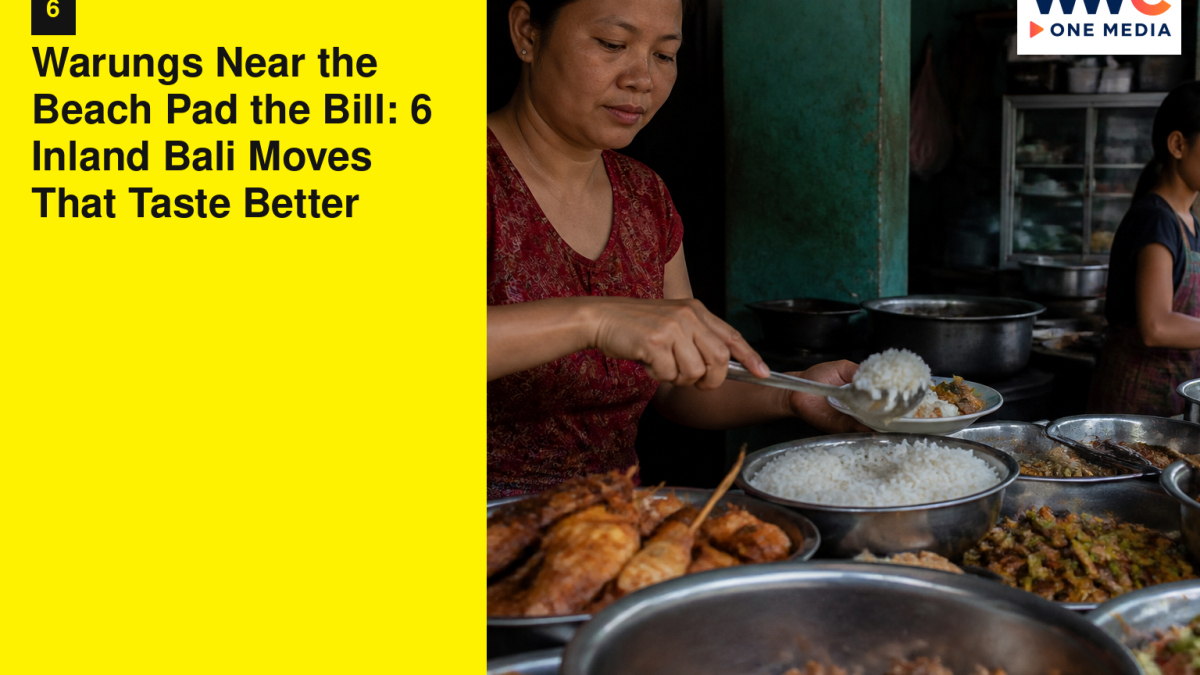
CANGGU, Indonesia — Warungs near the beach pad the bill. That is not a scandal. It is rent, a view, a bottle of water that appeared without a sentence, a service charge that shows up as a habit on a printed slip, a “sambal” that was never a conversation, a second rice, a lime that became a line item. Kuta does it. Legian does it. Batu Bolong at the hour when Echo Beach light is the product does it. The sunset is on the payroll. Inland Bali — ten minutes on a scooter toward Kerobokan, a shophouse in Denpasar, a lunch warung on the way to Seminyak that does not face the reef, a tray in Gianyar if your day already went that way — still sells the same satay logic, the same ayam betutu energy, the same nasi campur that actually looks like a plate someone from here would eat at noon. Six inland Bali moves that taste better are not a ranking of secret warungs. They are habits: where you sit, what you order, what you check, when you leave.
This is not a percentage lecture. We will not invent a service-charge figure and call it island law. Some places add service, some add tax, some add both, some add a water you did not want, some round a bill because you were already standing. Padding is a set of habits, not one official rate. Beach warungs sell a horizon. Inland warungs sell food. You can have the horizon at 6 p.m. with a drink you chose. You do not have to have it with lunch. Canggu’s Batu Bolong strip, Kuta’s beachfront sprawl, the cafes that became warungs that became cafes again — they are allowed to charge for location. You are allowed to eat inland first.
Scoot or Grab. Helmet. The coastal road is a crawl when the sun is a product. Inland streets toward Kerobokan and Denpasar still jam; they jam with people who have a plate in mind, not a reel. Bring cash and e-wallet patience. Read the menu if there is a menu. If there is no menu, you are in a conversation. Conversations can be honest. They can also be the padding.
1. Warungs near the beach pad lunch; eat the heavy meal inland instead
Rice does not require a horizon. Nasi campur, nasi goreng, a grilled fish that is a fish, babi guling on a day you already planned for a specific place, satay with rice — these plates are lunch. Lunch in Canggu facing the beach is a view with a wait, a speaker, a smoothie menu, a water that arrives in glass and leaves as a line. Inland, a warung with motorbikes parked nose-in at noon is still in the food business. Kerobokan backstreets, a Denpasar lunch room, a place on the way from Canggu toward the administrative city, a tray near a market in the middle of the island — that is the first of six inland Bali moves that taste better.
Do the split on purpose. Heavy meal inland at 11:30 or 12:30, when kitchens are moving. Beach later, if you want the water, as a sit with something you pointed at. Warungs near the beach pad the bill because the sit is the product. If you give them lunch plus sunset plus two waters plus a “sharing plate” you did not finish, you paid for a day. Inland lunch plus a later coconut you walked to is a day with a better sambal and a bill you can still read.
What not to do: ride to Echo Beach starving at 1 p.m. and call the first English menu fate. Hunger is how padding feels like hospitality. Eat inland first. The reef will still be loud after rice.
Kuta is the same split with worse traffic. A warung off the beach, even a few blocks inland toward the denser streets, is often still a warung. The sand-facing row is a different rent. Legian blurs. Seminyak blurs harder, because Seminyak has been blending cafe and warung until the word warung is a font. Inland of Seminyak — Kerobokan, a side street without a valet personality — is where the six moves still look like lunch.
2. Printed prices beat “market price” on every fish and a menu that never sits still
If the fish is always market price and the market is never named, you are in a conversation that can go anywhere. Inland warungs that feed workers and families often have a board, a printed sheet, or a default plate that does not require a negotiation. That is the second move. Not because inland people are saints. Because the customer already knows what nasi campur costs in that room, and the room has to live with them tomorrow.
Beach menus pad with extras that sound like care: garlic bread, a side of fries, a garden salad that travelled, imported juice, a smoothie that is a dessert. None of that is illegal. All of it is how a bill grows while the satay stays the same size. Inland, order the plate that is already on other tables. Point. If you want fish, ask the price of that fish, today, before it hits the grill. If the number cannot be said, walk. There is another grill toward Denpasar. There is another grill in a market. Bali is not a single beach.
Canggu English menus are a climate. You can eat well inside that climate. You can also watch the extras. Inland menus in Bahasa with food pictures that have been photocopied into ghosts are often more honest about rice and ayam. Read both. If a beach warung has clear prices, use it. The move is prices, not a boycott of the coast.
Service charge and tax as habits: look at the bottom of the slip. They appear. They also appear inland at places that have decided to be restaurants. Do not treat a service line as a scam by default. Treat an unexplained water, a double rice, a “complimentary” plate that was not complimentary, as the padding to catch. Habits, not a fake percentage we will not print as fact.
3. Follow scooters with local plates at noon, not the parked rental row at 2 p.m.
Noon is the tell. Motorbikes with Bali plates, helmets on hooks, a queue that is a queue of people in work clothes and school-run energy — that warung is moving food. Two p.m. at a beach place with rental scooters in a line and a Bluetooth speaker is moving a sit. Follow the noon scooters inland. Kerobokan, a street behind a football field, a warung near a school, a place on the Denpasar side of the sprawl. You will not get a secret. You will get a tray that has to be good enough for people who could eat there tomorrow.
This is not a rule that locals never eat on the beach. Of course they do. It is a rule that a packed local lunch and a packed tourist sunset are different machines. Warungs near the beach pad the bill when the machine is the sunset. Inland noon is still rice.
If you cannot read plates, read hands. Are people eating with the urgency of a break, or grazing with the urgency of a laptop? Both are allowed. Only one is the inland move. Canggu has laptops at lunch inland too now. The laptop is not a poison. The empty plate with a long-stay water bill is a tell. Order food. Eat it. Pay. The six inland Bali moves that taste better include leaving before you become a cafe.
GrabBike and scooters both work. If you do not ride, pin a warung that is not on the sand and go. Do not let the driver choose a cousin’s beach place unless you asked for a beach place. Say makan siang, say not on the beach if that is the point. Drivers are not villains. They are in the same rent story.
4. Share plates, skip the imported drinks, drink what the room already pours
The coconut can wait for a moment you chose. The smoothie can wait forever. Inland, teh panas, air putih you asked for, a local juice that is fruit, es campur if dessert is the point — those drinks belong to the meal. Imported beer, wine lists, a cold brew personality, a kombucha that flew — those belong to a beach bill that is doing cafe work. Skip them at lunch. That is the fourth move.
Share satay. Share a fish if the fish is large. Do not order three mains and two sides because the English menu made you feel like a table in a different country. Warungs near the beach pad the bill through volume as much as through view: extra plates “for the table,” extra water, extra sambal that was already on the table. Inland, the sambal is usually just there. If it is not, ask. If it appears as a charge, you now know the room.
Water: ask if it is free, priced, or a large bottle they assumed. This is a habit, not a conspiracy. Beach rooms assume the bottle. Inland rooms often assume you will ask for a glass or buy a bottle from a fridge with a price on it. Neither habit is a printed island law. Looking is the move.
If you want a cocktail at sunset, budget it as sunset, not as lunch. Canggu sunset is a product with a queue for a photo. Pay for that product if you want it. Do not mix it with a padded nasi goreng and then decide Bali is expensive as if inland Denpasar had not been serving rice the whole time.
5. Check the bill line by line before you stand up, including water and service as habits
Padding loves a standing customer. The fifth inland move is the same move on the beach, but inland you can still catch it because the slip is shorter. Sit. Read. Water, extra rice, extra sambal, extra lime, service, tax, a round-up, a dish you did not eat. Point at the line. Ask. Pay the rest. This is ordinary. It is not a scene. Warungs near the beach pad the bill because the room is loud, the light is pretty, and you already want to catch a Grab before the one-way system eats you.
Inland, the TV is on, the room is fluorescent, the slip is still worth reading. Places that are used to regulars make fewer “mistakes.” Places that are used to a rotating villa crowd make more. Canggu and Kuta train a room to expect confusion. Denpasar lunch rooms expect you to know the plate. You should still read.
Do not invent a standard service percentage and yell it as fact. Look at this slip. If service is there, it is there. If a staff person also wants a tip on top, you decide. Habits stack. Stacking is how a modest plate becomes a story about Bali prices that was actually a story about not reading.
Cash: have some. Cards and QR exist widely and also fail at the exact warung you loved. Inland warungs may prefer cash. Beach cafes may prefer the opposite. Carry both. Fumbling at the end is how you skip the line-by-line.
If the bill is wrong and they fix it, say thank you and leave. If they do not, you have feet. You do not need a viral video. You need lunch tomorrow at a different room.
6. Leave before the DJ, the sunset rush, and the hour when the warung becomes a club
Lunch that becomes a club is a different budget. The sixth inland move is a clock. Eat, pay, go. Inland rooms at noon already understand this. Beach rooms at 4 p.m. start a second shift: speakers, a DJ who is a playlist, a cocktail board, a host who wants you to stay because staying is the rent. Warungs near the beach pad the bill in that second shift even if the food was honest at 12:30.
If you want sunset, go to the beach without the lunch tab open. Walk Batu Bolong as a walk. Sit on the sand if the sand is the point. Buy a drink with a price you heard. Inland, you already ate. That is the whole architecture of six inland Bali moves that taste better: rice away from the reef, prices you can see, scooters at noon, drinks the room already pours, a bill you read, a departure before the music becomes a fee.
Ubud is inland and has its own padding — tourist rents, juice, a service habit, a monkey-forest hunger that makes any menu look reasonable. Inland does not mean “the opposite of scam.” Inland means “closer to a kitchen that still needs local lunch.” Ubud’s centre is a different postcard. A warung on the way into town, a lunch room used by people who work there, a plate in a side street that is not the main crawl — that is Ubud as the sixth clock, not as a spiritual upgrade.
Sanur is slower beach. Padding still exists. The same six moves apply: eat off the sand, read the menu, follow noon, skip imported lunch drinks, check the slip, leave before the sit becomes the night.
What padding looks like without fake percentages
Water you did not order. A second rice. A “tasting” plate. Garlic bread. A lime. A coconut that was a greeting. Service plus a suggested tip plus a round number. A fish that never had a number. A smoothie that arrived because the table looked like a smoothie. None of these need a statistic. They need a finger on the slip.
Warungs near the beach pad the bill because they can mix restaurant habits with warung language. Inland rooms that still look like warungs mix fewer of those habits. Rooms inland that look like Canggu cafes will pad like Canggu cafes. Judge the room, not the postcode. The six moves are a bias toward inland lunch, not a fairy tale that Kerobokan cannot print a smoothie.
How to ride the split without turning it into a personality
You can still eat on the beach. Eat small. One plate, one drink you asked for, a bill you read, a leave. The inland moves are the default for hunger. The beach is the default for water and sky. Canggu will try to merge them into a day that is all bill. Kuta will try to merge them into a day that is all heat. Denpasar will not care about your sunset. That is why Denpasar lunch tastes like lunch.
Helmets. Sunscreen. A phone that works for maps. A pin that is a warung, not “Canggu” as a blob. If you are staying in a villa in Pererenan or Berawa, inland might be ten minutes the other way from the beach you keep opening. Use that ten minutes at noon. Use the beach at six. Warungs near the beach pad the bill. Your schedule does not have to help them.
Villa kitchens, minimarkets, and the water you already paid for
If you are in a villa in Canggu, Berawa, or Pererenan, you already have a fridge. That fridge is part of the inland logic. Buy water at a minimarket. Buy fruit at a morning stall that is not facing the reef. Cook eggs if the villa has eggs. Then go inland for the plate you cannot be bothered to cook: a soup, a grilled chicken, a nasi campur that is a map of small dishes. Warungs near the beach pad the bill harder when you arrive dehydrated and treat a coconut as medicine. Medicine was in the minimarket.
This is not a lecture about never eating out. It is a lecture about not paying beach rent for thirst. Inland warungs still sell drinks. Buy them if you want them. Do not let thirst design the table. The six inland Bali moves that taste better work better if you are not starving and not sun-dizzy. Eat a banana. Then scoot toward Kerobokan.
Groups pad faster than two people. A villa of six will order “for the table” on Batu Bolong and then argue about the split. Split inland too, but split a printed menu. Assign one person to read the slip. Sunset plus six waters plus service as a habit is how a house chat turns mean. Do the heavy meal at noon inland. Let the beach be a walk. Let the villa fridge be a fridge.
If you only have Kuta and a day, walk inland of the beach road until the menus get shorter and the scooters look like errands. That may be enough. You do not need a pilgrimage to Gianyar for the method to work. You need a plate that is still in the food business.
Bottom line
Warungs near the beach pad the bill with view, water, extras, and a sit that turns into sunset. Six inland Bali moves that taste better: eat the heavy meal off the sand in Kerobokan or Denpasar, insist on prices instead of a floating fish, follow noon scooters, skip imported lunch drinks, read water and service as habits on the slip, and leave before the DJ. No fake percentages, no secret stall league, no villa folklore. Canggu and Kuta will still sell the horizon. Rice does not need it.




Leave a Reply