
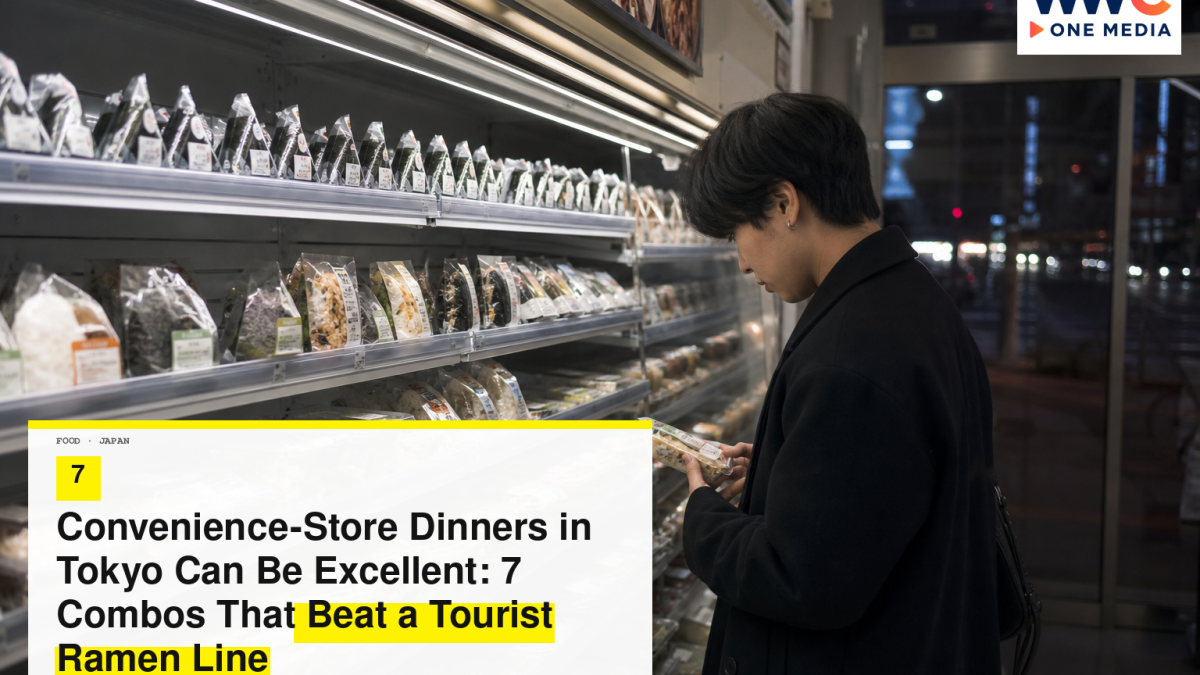
TOKYO, Japan — Convenience-store dinners in Tokyo can be excellent. That sentence still offends people who flew in for a ramen line in Shinjuku and treated a 7-Eleven, a FamilyMart, or a Lawson as a failure of Japan. They are not a failure. They are a type: heated cases, onigiri shelves, a coffee machine, oden when the season says so, a salad that will actually get eaten if you buy the one you like, a microwave, a pair of chopsticks, a city that already uses this room as a kitchen. Seven combos that beat a tourist ramen line are not a claim that ramen is bad. Ramen is fine. A tourist ramen line at 9 p.m. in Shinjuku, when you still have a last train, a hotel toward Shin-Okubo or a connection through Shibuya, and a body that has been on the Yamanote since morning, is a wait you do not always need. The konbini is open. The combos are a plate if you build a plate.
This is not a yen menu. Prices move. Campaigns move. We will not print a fake list of current facts as if a newspaper had the till. 7-Eleven, FamilyMart, and Lawson are types, not a review score. Each has a slightly different fried-chicken personality, a different coffee, a different pudding. Walk into the one that is actually on your block. Shinjuku has all three, often in the same cluster, often with a basement of a station attached. Last train is a clock. The ramen line is not. If the line is a hobby, join it on a night you already budgeted. If dinner is the job, build a combo and eat it upright.
Eat at a counter, a station bench that allows food, a hotel table, a park if the park allows it and you will bin the rubbish. Beds turn dinner into crumbs. Convenience-store dinners in Tokyo can be excellent when they look like rice plus hot plus something green, not like seven sweet things and a second dessert walk. The tourist ramen line will still be there tomorrow. The last train will not.
1. Convenience-store dinners in Tokyo start here: onigiri plus karaage plus a salad you will open
The first combo is the default that beats a tourist ramen line without pretending to be a restaurant. One or two onigiri — salmon, tuna mayo, kombu, the spicy one you already know — plus a hot fried chicken from the case, plus a small salad or a pack of vegetables you will actually unclip. 7-Eleven, FamilyMart, Lawson all do a version of this. The chicken is a type: hot, salty, a reason the meal is dinner. The onigiri is rice. The salad is the thing visitors skip and then call konbini food junk. Open it. Put dressing on it. That is a plate.
Shinjuku last train makes this combo useful because it is fast. You can build it in five minutes, heat what needs heat, and still walk toward the platform. A ramen line does not care about your platform. If you are staying in a hotel above a station, eat at the konbini counter or take it upstairs and sit at the table, not the bed. If you are changing at Shinjuku, eat before you go down into the maze. The maze plus hunger is how you buy a second snack and miss the train anyway.
Do not buy three onigiri and no hot thing because the onigiri was cute. Cute is not dinner. Do not buy the chicken without rice unless you already had a bun. The combo is the point. Convenience-store dinners in Tokyo can be excellent when they copy a teishoku in miniature: carb, protein, a vegetable, done.
Tea or barley tea from the fridge, not a second dessert drink, unless dessert is a separate, small decision. You can have a pudding. You cannot have pudding as the architecture.
2. Oden (when the season is oden) plus rice plus takoyaki or a roll
Oden in the heated pot is a winter-and-shoulder-season type, not a law of every month. When the pot is on, at Lawson especially as a type, and at others when they run it, this combo is stew energy: daikon, egg, a fish cake, kombu, the broth in a bowl they will pack. Add an onigiri or a small rice, add something extra only if you are still hungry — a karaage, a roll. That beats a tourist ramen line because it is already hot and already a bowl.
If the pot looks tired, skip it. A tired oden pot is a tell. A busy pot is a tell. You do not need a ranking. You need steam. After a day in Shinjuku, steam is the whole personality you actually wanted from ramen. You can have it without the queue.
Carry oden carefully. Broth travels badly on a packed stair. Eat near the store or at a counter. Last train plus a leaking oden bag is a story other passengers do not want. Convenience-store dinners in Tokyo can be excellent and still require basic physics.
Off-season, this combo becomes a stew from the hot case or a microwave soup plus rice. Same idea. Heat plus rice. The tourist ramen line is heat plus wheat. You are allowed to substitute.
3. Pasta or yakisoba from the case plus a vegetable plus soup
FamilyMart and 7-Eleven and Lawson all run packaged pasta, yakisoba, and other pan-fried or sauced noodles that microwave into a meal. This is the combo for people who wanted ramen’s noodle feeling without the Shinjuku line. It will not be a tonkotsu pilgrimage. It will be dinner. Add a salad or steamed vegetables from the fridge, add a miso soup if the store has the cup or the pack, eat it with the lid as a plate if you have no plate.
Noodles plus noodles is a mood, not a combo. If you buy yakisoba, do not also buy a cup ramen unless you are two people. Two people can split. One person will regret the salt at 1 a.m. in a hotel toward Kabukicho that was supposed to be a convenience, not a thirst.
This combo travels. Microwave at the store if you can, or at the hotel. Station microwaves and store microwaves are part of the type. If there is a queue for the microwave, that queue is still shorter than a tourist ramen line on a Saturday. Shinjuku last train still wins if you heat it and walk.
Pick a flavour you already understand. Mystery sauce is how you waste a meal. Convenience-store dinners in Tokyo can be excellent when you repeat a pasta you liked yesterday instead of hunting.
4. Sandwich plus miso soup plus fruit
The fourth combo is lighter and still a dinner if the day was already heavy. Egg sandwich, katsu sandwich, the fruit sandwich if you want something sweet-adjacent, plus a hot soup, plus a banana or a cut-fruit pack you will eat tonight. 7-Eleven egg sandwiches have a reputation because people repeat them, not because this newsdesk is issuing a medal. FamilyMart and Lawson have their own. Try the one in front of you.
This beats a tourist ramen line when you are too full of day to face a bowl, but not so full that you should skip dinner and then raid the sweets at 23:40. Shinjuku after a museum, a crossing, a department basement — the sandwich combo is a reset. Sit. Soup is the hot element that makes it dinner. Without soup, it is a snack. With only fruit, it is a mood.
Fruit sandwiches leak. Eat them soon. Bananas travel. Cut fruit is a same-night product. Do not store it as if the hotel mini-fridge were a kitchen from home.
If you need more protein, add a boiled egg from the fridge case or a piece of chicken. The combo is a structure, not a prison. Convenience-store dinners in Tokyo can be excellent at this lighter weight. They cannot be excellent as three sandwiches and a doughnut because the doughnut was at eye level.
5. Hot-case bento plus pickles plus tea
The bento in the heated case or the bento you microwave — grilled fish, karaage set, a hamburger-style set, a karē if they have it — is the closest the konbini gets to a tray meal. Add pickles if they are not already there. Add tea. Eat it as a tray. This combo beats a tourist ramen line because it is already composed: rice, a main, a side. You are not inventing dinner from snacks.
Look at the rice. Look at whether the case is turning over. A lonely bento under a lamp at 22:30 might still be fine and might be a bento that has been rehearsing. Pick one that looks like it has been restocked. Shinjuku stores near the station restock because the city is a machine. A quiet residential Lawson might restock on a different clock. You are standing in a specific store. Use your eyes.
Do not buy a second bento “for later” unless later is a night shift you can name. Later is the fridge smell. Convenience-store dinners in Tokyo can be excellent as one tray. Two trays is a plan for a hike, not a hotel night.
Last train: this is the combo to eat before you go underground. It needs a surface. It needs five extra minutes. Those five minutes are still not a ramen line.
6. Cup noodles done properly plus gyoza plus an egg
Sometimes you want the ramen feeling. The tourist line is not the only ramen in Tokyo. A cup, hot water at the counter, the three-minute wait that is actually three minutes, plus a pack of gyoza from the fridge you microwave, plus a boiled egg or an egg you add if the cup wants an egg — that is the sixth combo. It is not a joke if you sit down and treat it as dinner.
Do it with hot water filled to the line. Wait. Do not walk immediately into a Shinjuku stair with a full cup. Physics again. Lawson, 7-Eleven, FamilyMart all have the shelf. Pick a cup you know, or pick once and repeat. The gyoza makes it a meal. The egg makes it a meal. The cup alone is a snack with sodium.
This combo beats a tourist ramen line on a weeknight when the line is the attraction. If you are a ramen person with a list, go to a shop that is not a theatre. That shop may still have a line. A local line at 19:00 is a different animal from a tourist line at 21:30 in a cluster designed to be mapped. We will not name a ranking. We will say: if the line is phones, the konbini combo is allowed to win. If the shop is feeding a neighbourhood, eat there when you have time. Convenience-store dinners in Tokyo can be excellent without declaring war on noodles.
Add a salad if the cup-and-gyoza night is becoming a habit. Habits need a vegetable eventually. The store sells one.
7. Shinjuku last-train combo: something hot that travels plus onigiri plus a cold drink with a lid
The seventh combo is the clock. Last train from Shinjuku is not a vibe. It is a timetable you check before you enter a ramen line. If the buffer is gone, you build a bag that can move: a karaage or a nikuman (when the bun case is on), an onigiri, a drink with a lid, maybe a small salad if it is sealed. Eat the hot thing before you go down, or at a counter. Carry the onigiri. Do not carry soup down a packed staircase unless the lid is a fact.
7-Eleven, FamilyMart, Lawson as types all sit on the Shinjuku web — west exit, east exit, underground, the street toward Kabukicho, the walk toward Yotsuya, the walk toward Shin-Okubo. Pick the store on the way to your platform, not the store that requires a surface crossing you will regret. Convenience-store dinners in Tokyo can be excellent because they respect the last train. A tourist ramen line does not.
If you miss it, you have a night bus, a taxi, or a very long walk. Build the combo so you do not miss it. That is the combo’s job. If you meant to miss it, you are in a different night: budget the ride, then you can wait for ramen. Honesty about the clock is the whole Tokyo skill.
Nikuman and the heated bun case are seasonal and campaign-based. If they are on, they travel. If they are not, chicken and onigiri still travel. Do not invent a year-round menu here. Look at the case in front of you.
How to shop the three types without a scorecard
7-Eleven, FamilyMart, Lawson are different companies with overlapping jobs. One may have the chicken you like. One may have the coffee you like. One may have oden when you want oden. Walk into the closest. If you hate the chicken, try the other type tomorrow. That is enough. A newsdesk that ranks them as if they were restaurants is doing a different genre.
Pay with whatever actually works: IC card, cash, a phone wallet you already set up. Do not discover a payment problem after the microwave. The counter will survive. Your last train may not.
Bin the rubbish in the store if you ate in the store. Japan’s bins are a map of their own. Convenience-store dinners in Tokyo can be excellent and still make you a person who carries a wrapper until a bin appears. Do not leave a salad clamshell on a Shinjuku ledge.
What the tourist ramen line is still for
A planned bowl. A shop you walked to because you wanted that bowl, at an hour that is not the last train, with a stomach that did not already eat a department-store basement. Sit. Eat. That is a good night. The seven combos are for the other nights: transfer nights, late Shinkansen-into-town nights, “we walked Shinjuku for five hours” nights, hotel nights when the group cannot agree. Convenience-store dinners in Tokyo can be excellent on those nights specifically. They are not a personality you owe the city. They are a plate.
If your group insists on the line, one person can sit it and the rest can konbini, or you can split and stop being a committee. Hunger committees pick the worst of both: a long wait and a snack from the visor rack.
The hotel microwave, the counter, and the bed you should not eat on
Hotel rooms in Shinjuku, Shibuya, Ueno, asakusa-side walks — some have a microwave, some have a kettle, some have a table that is a lie. If there is a kettle, soup and cup noodles work. If there is a table, the bento works. If there is only a bed, eat at the store counter or in a station area that allows it. Crumbs in a duvet are not Japan. They are you.
Lawson and FamilyMart and 7-Eleven counters are designed for this. Use them. Five minutes upright. Then the last train, or the elevator.
If you land late at Haneda or Narita and Shinjuku is the only plan
A late landing is how convenience-store dinners in Tokyo can be excellent before you even have an opinion about ramen. Airport food after immigration is its own trap. Once you are on the train toward the city, the konbini at the transfer — or the 7-Eleven / FamilyMart / Lawson on the hotel block — is dinner. Build combo seven if the last train is close. Build combo one if you have a table. Do not walk into a tourist ramen line with luggage. You will hate the luggage, the line, and the bowl.
If your hotel is in Shinjuku, you will pass three stores before the lobby. Pick one. Heat the chicken. Sit. Shower. The city will still be there in the morning, when a neighbourhood shop is a better ramen plan than a neon queue you chose because you were afraid of missing Japan. You do not miss Japan by eating a konbini plate. You miss a train by standing in a line with a suitcase.
Morning is a different konbini: coffee, egg sandwich, a banana. That is breakfast. Do not merge breakfast and the leftover bento from 23:10 unless you like that. The fridge in the room is small and loud. Eat dinner as dinner.
Bottom line
Convenience-store dinners in Tokyo can be excellent: seven combos that beat a tourist ramen line when the line is a wait and the last train is a fact. Onigiri-chicken-salad. Oden and rice when the pot is on. Pasta or yakisoba with a vegetable. Sandwich, soup, fruit. Hot bento as a tray. Cup noodles with gyoza and an egg. A Shinjuku last-train bag that travels. 7-Eleven, FamilyMart, Lawson as types, not scores. No fake yen list. Sit up. Heat the hot thing. Check the timetable. The ramen shop will still be steaming tomorrow.



Leave a Reply