
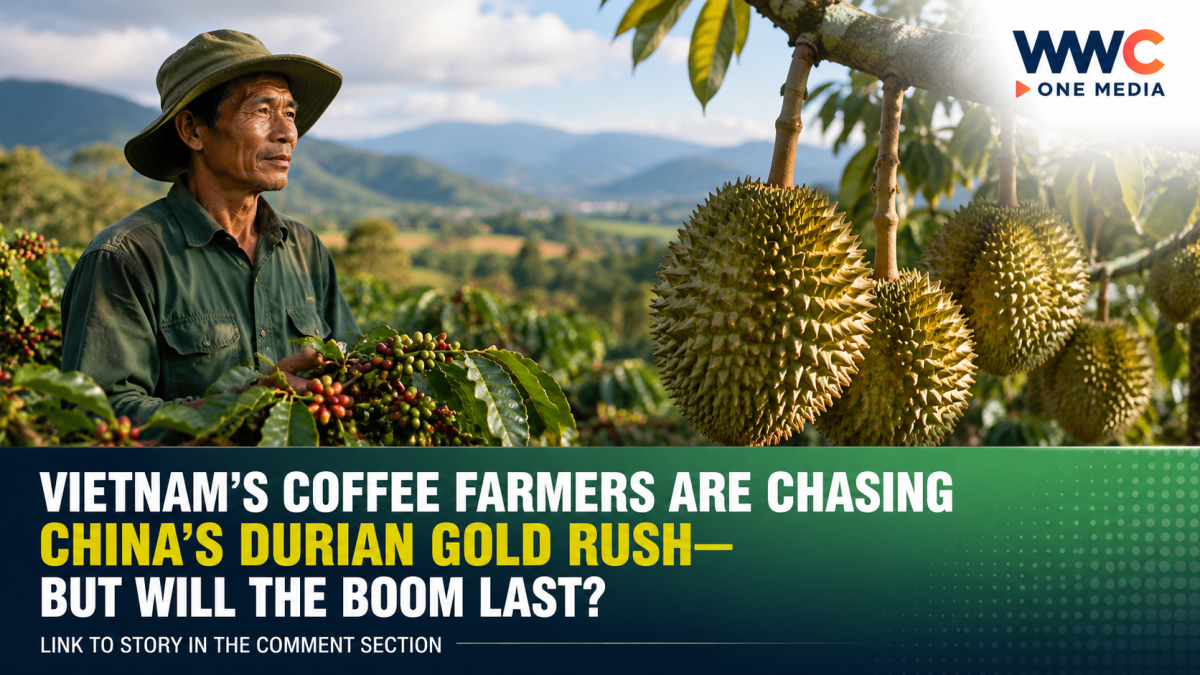
DAK LAK, Vietnam — For generations, Vietnam’s Central Highlands have been synonymous with coffee. Today, however, a growing number of farmers are looking beyond the coffee bean and toward a far more lucrative crop: the spiky, pungent durian.
Driven by soaring demand from China, Vietnam’s durian industry has exploded into one of Southeast Asia’s biggest agricultural success stories. Farmers who once relied almost entirely on coffee are planting durian trees in hopes of earning significantly higher returns—but behind the billion-dollar boom are growing concerns about oversupply, quality and the risks of depending too heavily on a single market.
Vietnam officially gained access to China’s fresh durian market under a trade protocol signed in 2022. Since then, exports have surged, and Vietnam became China’s largest durian supplier by volume last year, ending Thailand’s long-standing dominance, according to reporting by CNA and AFP.
In Dak Lak province, farmer Pham Xuan Lan says durian transformed his family’s fortunes. His 400 trees produce around 60 tonnes of fruit, and he expects to earn about US$76,000 this year—far more than the roughly US$10,000 he estimates he could have earned from coffee alone.
Across Vietnam, the shift has been dramatic. The area planted with durian has expanded more than fivefold over the past decade to around 200,000 hectares, according to Vietnam’s agriculture ministry. Farmers are increasingly betting on varieties such as Ri6, Dona and Musang King as China’s appetite for the fruit continues to grow.
China’s Appetite Is Changing Southeast Asian Farms
China remains the engine behind the durian boom. The country imported nearly US$7.5 billion worth of fresh durian last year, while social media platforms have helped turn the once-expensive tropical fruit into a mainstream obsession among younger consumers.
Vietnam’s durian exports are projected to reach US$4 billion in 2026, up dramatically from about US$180 million in 2021, with roughly 90% of exports heading to China, according to the CNA/AFP report.
But the boom is not limited to Vietnam. China’s total durian imports rose sharply in the first half of 2026, with Thailand maintaining a dominant share by value and Vietnam ranking second during that period, according to Chinese customs data cited by regional media. The competition underscores just how valuable—and crowded—the Chinese market has become.
A Golden Opportunity—or a Dangerous Bet?
Vietnamese authorities are already warning that the rapid expansion of durian farms could create problems if production grows faster than demand or quality standards fail to keep pace. The government warned earlier this month about the risks of oversupply and weakening quality control as more land is converted to durian cultivation.
Those fears are not theoretical. Malaysia recently experienced a sharp drop in durian prices amid abundant supply, while growers across Southeast Asia are also grappling with extreme weather and rising production costs. An Associated Press report this month highlighted how floods, heat, unpredictable rainfall and higher input costs are putting pressure on Malaysian durian farmers despite China’s booming demand.
For Vietnam, climate risk could also complicate the rush away from coffee. Recent research and reporting have warned that Vietnam’s robusta coffee production is vulnerable to heat and drought, while broader climate pressures are expected to challenge tropical agriculture across the region.
Durian itself is no easy replacement crop. It requires careful management of water, humidity, fertiliser and disease, and not every farmer who abandons coffee succeeds. One farmer interviewed by AFP said he eventually returned to coffee after struggling to produce durians that met the quality standards demanded by the export market.
The Real Test Is Still Ahead
Vietnam’s durian boom is reshaping the Central Highlands and creating life-changing opportunities for farmers. But the industry’s greatest challenge may be ensuring that today’s rush for higher profits does not become tomorrow’s agricultural bubble.
Industry experts have recently called for Vietnam to strengthen its supply chain, traceability and quality controls to build a more sustainable long-term presence in China rather than relying on rapid expansion alone.
For now, the rewards are difficult to ignore. Coffee may still provide a dependable livelihood, but for thousands of Vietnamese farmers, durian represents something far more tempting: the possibility of striking it rich.
The question now is whether China’s appetite can keep growing fast enough—or whether Southeast Asia’s next great fruit boom could eventually produce more durians than the market can handle.

Leave a Reply