
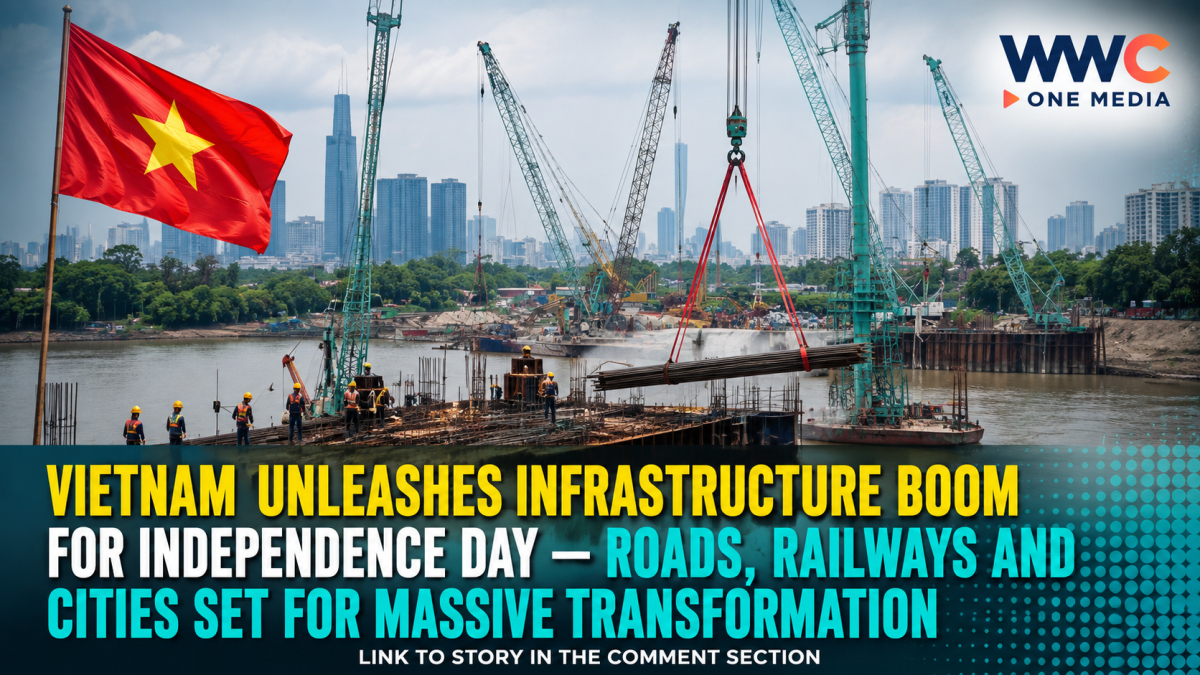
HANOI — Vietnam is marking its 81st National Day with a sweeping wave of infrastructure launches and inaugurations, turning the September 2 independence celebrations into a showcase of the country’s increasingly ambitious development push.
Across the country, major projects spanning railways, roads, urban development, housing, water infrastructure and industrial facilities have been launched or brought into operation in the days surrounding National Day. The moves come as Hanoi seeks faster economic growth and a more modern infrastructure network.
A national infrastructure push
The latest projects demonstrate that Vietnam’s infrastructure drive is extending well beyond traditional highway construction.
In Hanoi, authorities have launched or inaugurated 17 flagship projects worth approximately US$15.27 billion as part of National Day activities. Eleven have already been inaugurated or technically opened, while six others have entered the groundbreaking stage.
The projects cover transportation, railways, water supply and drainage, urban redevelopment and improvements around the iconic West Lake.
One of the biggest is the Vinh Hung urban renovation and redevelopment project, with estimated investment of about US$7.14 billion across roughly 447 hectares. Another major urban project in Binh Minh and Tam Hung is valued at about US$4.27 billion and is designed to provide housing and support development around Hanoi’s southern gateway.
Hanoi bets heavily on rail
Rail infrastructure is emerging as one of the most important pieces of Vietnam’s long-term modernization strategy.
Hanoi has broken ground on the Ngoc Hoi–Kim Son section of the Eastern Ring Railway, a project with preliminary investment of about VND27.75 trillion (US$1.06 billion).
The main section will stretch roughly 31.3 kilometers and feature an electrified double-track railway capable of speeds of up to 120 kilometers per hour. It is scheduled for completion in December 2028.
A separate project will relocate a 26.5-kilometer section of the Hanoi–Ho Chi Minh City railway, with another three-kilometer connection to the Bac Hong–Van Dien railway.
Together, the projects are intended to reorganize Hanoi’s railway network, improve passenger and freight capacity, reduce pressure on existing routes and strengthen connections between economic areas.
Ho Chi Minh City is also accelerating
The infrastructure push is not limited to the capital.
In Ho Chi Minh City, authorities held ceremonies for 16 projects covering transportation, technical infrastructure and social housing.
One major urban-renewal project in the former District 1 involves nearly VND16.37 trillion (US$627 million) in investment and is expected to provide 2,253 resettlement apartments.
The city is also advancing water-environment infrastructure, hospital expansion and multiple social-housing projects.
The scale reflects a broader effort to improve living conditions while creating additional space for housing, industry and economic activity.
Vietnam’s bigger highway ambition
The National Day projects are also part of a much larger transportation strategy.
Vietnam’s government has been pushing to accelerate major expressway projects, particularly in the country’s southeast and southwest.
A government directive issued in August identified 10 expressway investment projects divided into 21 component projects in those regions. Sixteen component projects were already under construction, while others were still undergoing investor selection or feasibility assessment.
Vietnam has also set an ambitious longer-term target: 5,000 kilometers of expressways by 2030.
The government says the expansion is intended to improve regional connectivity, reduce logistics costs, strengthen competitiveness and create additional space for economic development.
But Vietnam needs enormous amounts of capital
The infrastructure boom comes with a major financial challenge.
Vietnam’s development ambitions require investment on a scale that cannot easily be financed through domestic banks and public funds alone.
Recent reporting has highlighted Hanoi’s effort to attract greater amounts of international capital for infrastructure and broader economic transformation. The country is increasingly looking toward private investment, public-private partnerships and foreign capital to supplement government resources.
At the same time, the government is attempting to remove bottlenecks that have historically delayed major construction projects.
Reuters reported in August that Vietnam proposed changes to land-acquisition rules intended to accelerate housing and infrastructure development by addressing delays surrounding compensation and resettlement.
The proposed reforms reflect the government’s broader goal of removing institutional obstacles that can slow infrastructure investment.
Why this matters for Southeast Asia
Vietnam’s infrastructure push comes as the country tries to position itself as one of Southeast Asia’s major manufacturing, logistics and investment hubs.
Better highways, railways, airports, industrial parks and urban infrastructure can reduce transportation costs and improve connections between production centers, ports and major cities.
That matters for companies looking to diversify supply chains in Southeast Asia.
Vietnam is also targeting double-digit economic growth, making infrastructure investment a central component of its strategy to increase productivity and attract investment.
Independence Day becomes a development showcase
The timing is significant.
Vietnam’s National Day commemorates September 2, 1945, when Ho Chi Minh declared independence in Hanoi. Eighty-one years later, authorities are using the anniversary not only for national celebrations but also to highlight the country’s development ambitions.
The latest infrastructure launches follow a similar large-scale National Day program in 2025, when Vietnam inaugurated or broke ground on 250 projects with combined investment of roughly VND1.28 quadrillion (about US$48.7 billion).
The difference now is that Vietnam’s infrastructure campaign is becoming part of a much broader economic transformation strategy — linking transportation, housing, industrial development, urban renewal and investment reform.
The message is increasingly clear: Vietnam is not simply building more roads and railways. It is trying to build the infrastructure base for its next phase of economic growth.
And with billions of dollars already committed to projects in Hanoi, Ho Chi Minh City and other regions, the infrastructure race could reshape Vietnam’s economic map — and its position in Southeast Asia — over the next decade.
WWC ONE MEDIA G.A




Leave a Reply