
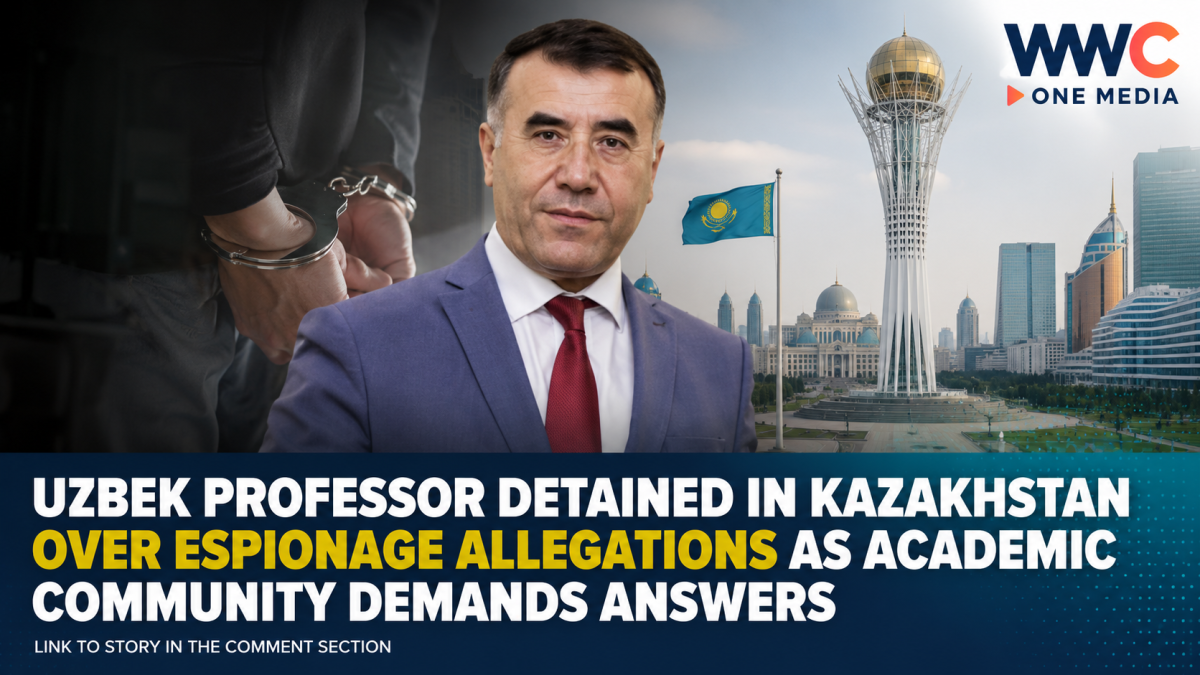
ASTANA, Kazakhstan — The detention of an Uzbek academic in Kazakhstan has triggered growing concern among scholars and colleagues, with questions mounting over the secrecy surrounding the case and what it could mean for academic freedom in Central Asia.
Ikboljon Qoraboyev, a 46-year-old Uzbek citizen and international-relations scholar, was reportedly detained in Astana on July 3, 2026, on suspicion of espionage. His relatives told the BBC’s Uzbek service that several men in civilian clothing came to his home and took him away. His phone and laptop were reportedly confiscated and his workplace searched.
Nearly two months after his reported detention, however, the precise allegations against him remain largely undisclosed.
That information gap has become the central issue surrounding the case.
What is Qoraboyev accused of?
According to reporting by the BBC Uzbek service, relatives said Qoraboyev was accused of espionage under Article 176 of Kazakhstan’s Criminal Code.
The provision concerns activities involving state secrets and certain information gathered or transferred for a foreign state, international or foreign organisation, or foreign intelligence. For the offence described in the law, the potential sentence can reach 10 to 15 years in prison.
But authorities have not publicly explained what information Qoraboyev allegedly obtained or transferred, which foreign state or organisation was allegedly involved, or what evidence investigators have gathered.
One allegation reported by multiple outlets is that investigators may have linked him to contact with an employee of the Uzbek consulate in Astana. The nature of that alleged contact, however, has not been publicly established.
An allegation of espionage is not a conviction, and the available reporting does not establish Qoraboyev’s guilt.
Kazakhstan’s security service finally responds
The latest development came from Kazakhstan’s National Security Committee (KNB).
After inquiries from Kazakh media, the security agency confirmed that the Uzbek side had been officially notified through diplomatic channels.
However, the KNB declined to disclose details of the pre-trial investigation, citing Article 201 of Kazakhstan’s Criminal Procedure Code, which restricts disclosure of investigative materials. The agency did not publicly provide further details about Qoraboyev’s procedural status or the substance of the allegations.
That response has done little to resolve the questions surrounding the case.
Who is Ikboljon Qoraboyev?
Before his detention, Qoraboyev had built an international academic career focused on international relations, comparative regionalism, Eurasian affairs and Central Asia.
The United Nations University identifies him as an Associate Research Fellow at UNU-CRIS, with a PhD in public international law from the University of Toulouse and master’s degrees from the University of Montpellier. Its profile also describes his research as focusing on comparative regionalism, Eurasian and Central Asian regionalisms.
He had also been associated with Maqsut Narikbayev University (MNU) in Astana, where he worked in international relations and led the university’s Center for Global and Regional Governance.
University records show that Qoraboyev was deeply involved in research and academic programming at MNU, including work examining regional governance and Central Asian affairs.
His academic work has also extended into sensitive geopolitical subjects.
In April 2026, Qoraboyev was involved in a workshop on critical minerals and connectivity that brought together policymakers, diplomats and scholars from Kazakhstan, Uzbekistan, the Netherlands, France and the European Union.
That background is significant because critical minerals have become increasingly important to Central Asia’s economic and geopolitical relationships.
His research included Central Asia’s critical minerals
Qoraboyev’s research interests included the political and strategic dimensions of Central Asia’s growing importance in global affairs.
A Hague Research Institute publication lists him as a professor of international relations at MNU and highlights his work on critical raw materials and Central Asia’s geoeconomic importance.
Central Asia’s mineral resources have attracted growing attention from China, Russia, the European Union and other major powers, making research involving regional economic strategy and international relations increasingly relevant to policymakers.
But there is no publicly available evidence establishing that Qoraboyev’s academic research was the reason for his detention.
University distances itself from current employment status
Maqsut Narikbayev University told Vlast that Qoraboyev was not currently a professor at the university and directed questions about his detention to the relevant authorities.
Vlast also reported that his profile had remained visible on the university’s website at the time of its reporting, although the university did not clarify when his employment relationship ended.
The distinction matters because reporting about the case has sometimes described him simply as a “professor,” while his current employment status appears to have changed.
Why scholars are alarmed
The case has moved beyond a criminal investigation into a wider debate about academic freedom, due process and the risks faced by researchers working across borders.
An appeal signed by members of the international academic community calls for a fair and transparent review of the case. The appeal says the lack of publicly available information has made it difficult for Qoraboyev’s family, colleagues and the wider academic community to assess whether his rights are being respected.
The appeal specifically calls for access to independent legal counsel and, where applicable, consular assistance, as well as fair judicial proceedings and an independent review of the evidence.
Those demands do not amount to a finding that Kazakhstan’s allegations are false. Rather, they reflect concern that a serious espionage case involving an internationally active scholar should be handled with sufficient transparency and due process.
The case is attracting attention beyond Kazakhstan
The detention has now been reported by several Central Asian outlets, including Vlast, Orda.kz, Asia-Plus and Central Asia Wire, alongside reporting from the BBC Uzbek service.
The reports broadly agree on the core timeline: Qoraboyev was reportedly detained on July 3 and accused of espionage, while authorities have provided limited public information about the underlying case.
Kazakh outlet Kursiv reported on September 2 that the KNB had confirmed Uzbekistan was notified through diplomatic channels but declined to reveal further details because the investigation remains confidential.
As of September 3, 2026, Kazakhstan has therefore confirmed diplomatic notification but has not publicly laid out the evidence behind the espionage allegations.
Why this case matters for Central Asia
The controversy comes at a particularly sensitive moment for Central Asia.
Kazakhstan and Uzbekistan are strengthening economic and diplomatic cooperation while simultaneously navigating competition among larger powers over trade routes, critical minerals, energy and regional influence.
Academics who study these issues frequently interact with diplomats, government officials, international organisations and researchers from multiple countries.
That makes the Qoraboyev case especially consequential for the region’s academic community.
If authorities ultimately demonstrate that classified information was illegally obtained or transferred, the case could become an important national-security prosecution.
But if the allegations cannot be substantiated, questions over prolonged secrecy and the treatment of an internationally connected scholar could have a very different consequence — potentially chilling legitimate academic research and cross-border scholarly cooperation.
What happens next?
For now, the biggest unanswered question remains remarkably simple:
What exactly is Kazakhstan accusing Ikboljon Qoraboyev of doing?
The KNB says Uzbekistan has been notified through diplomatic channels, but investigators have withheld the details of the case. Qoraboyev’s relatives and academic colleagues continue to seek clarity, while members of the international academic community are calling for due process and transparency.
Until authorities disclose more information or the case moves into a stage where evidence can be examined publicly, the espionage allegations remain allegations — not a proven finding of guilt.
And that unresolved question is precisely why the detention is becoming a major test not only of Kazakhstan’s security system, but of how safely scholars can conduct internationally connected research in Central Asia.
WWC ONE MEDIA G.A

Leave a Reply