
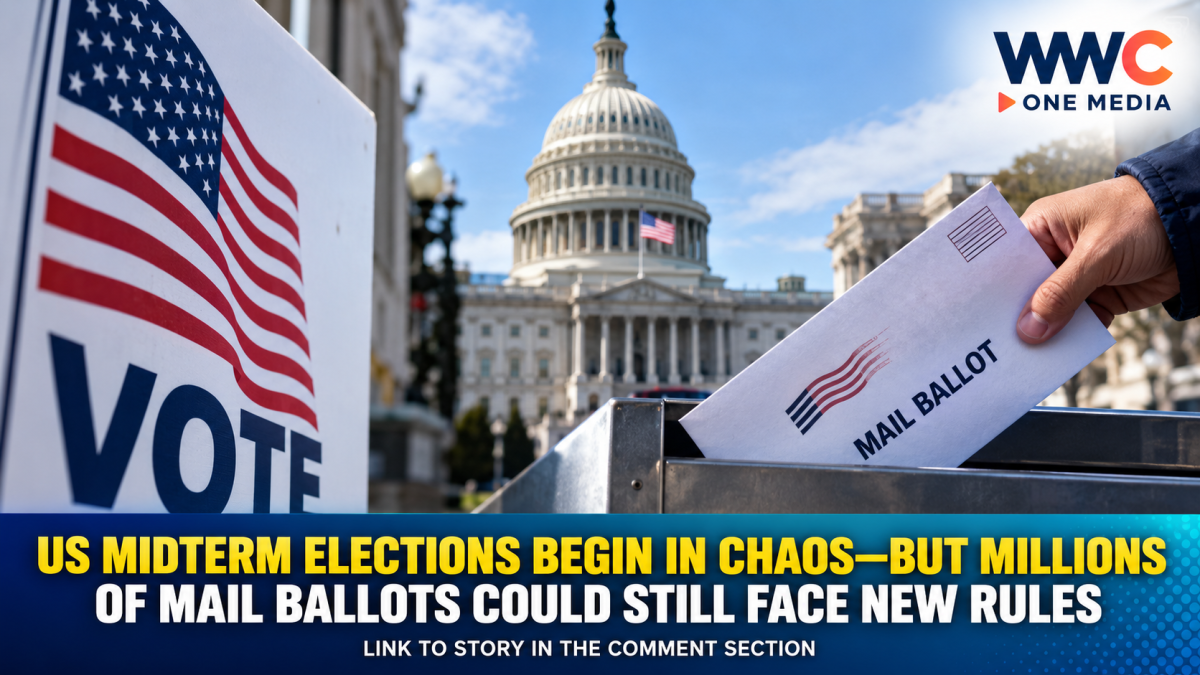
WASHINGTON, D.C. — The 2026 US midterm elections have officially begun, but millions of Americans may still be left wondering which rules will govern their mail ballots as a fierce legal battle over President Donald Trump’s proposed voting restrictions intensifies.
North Carolina began widely distributing mail ballots on Friday, formally opening an election season that will culminate on November 3 and determine which party controls the US Congress during the final two years of President Donald Trump’s term.
But as ballots started reaching voters, election officials across the country were still facing uncertainty over potential new federal requirements for mail-in voting.
The Trump administration has been pushing to impose stricter rules on how mail ballots are handled, while Democratic-led states, election officials and voting-rights advocates have warned that changing procedures so close to Election Day could create widespread confusion and potentially disrupt legitimate votes.
Trump Administration Takes Mail-Ballot Fight Back to Supreme Court
The latest confrontation centers on new US Postal Service procedures connected to Trump’s March executive order targeting mail-in voting.
Under the proposed system, states could be required to provide voter information through a new federal process, while ballot envelopes would face additional identification and barcode requirements. Critics say ballots or mailings that fail to meet the new standards could face delays or rejection.
A federal judge, however, extended a block on implementing the restrictions, warning that states had little time to overhaul election procedures without risking disruption as ballots were already being distributed.
The Trump administration has continued fighting the ruling and has sought intervention from the US Supreme Court, creating a rapidly changing legal landscape just weeks before the November 3 election.
The Supreme Court had previously opened a path for possible implementation of Trump’s broader executive order on procedural grounds, but it did not rule that every measure proposed by the administration was automatically lawful. Additional court challenges have continued, leaving election officials uncertain about what requirements could ultimately take effect.
Ballots Are Already Going Out as Rules Remain in Limbo
The timing has become one of the biggest concerns.
North Carolina became the first state to widely distribute mail ballots, while election officials in other states are also approaching their own deadlines. In some jurisdictions, ballots have already been sent under existing procedures.
Election administrators have warned that implementing major operational changes after voting has begun could be extraordinarily difficult.
CBS News reported that election officials have described the prospect of rapidly adopting new mail-voting requirements as potentially “virtually impossible” given the tight timeline before the midterms.
The uncertainty is especially significant because mail voting remains a major part of the US election system. According to federal data cited by the Associated Press, roughly 30 percent of ballots cast during the 2024 presidential election were submitted by mail.
Why Trump’s Mail-Voting Restrictions Are So Controversial
Trump has repeatedly criticized mail-in voting and has argued for tighter restrictions, saying stronger safeguards are needed to protect election integrity.
The administration maintains that the proposed changes are designed to ensure only eligible voters receive and cast mail ballots.
But critics argue that the federal government is attempting to make sweeping changes to election procedures too close to a major national vote.
Democratic-led states have also challenged the administration’s authority, arguing that the US Constitution gives states and Congress major responsibility for administering elections.
The legal fight has therefore become about more than mail ballots—it has evolved into a broader battle over federal power, state election authority and who gets to set the rules for one of the most consequential midterm elections in recent years.
Postal Service Concerns Add to Election Uncertainty
The controversy has been further complicated by concerns surrounding Postal Service operations and proposed ballot-verification systems.
An anonymous whistleblower allegation reported by AFP said a proposed ballot system had been developed through a rushed and flawed process, raising concerns that technical problems involving barcode verification could delay ballot processing.
USPS has disputed the suggestion that mandatory verification procedures were already being imposed and indicated that election officials would initially use the new portal voluntarily.
Separate reporting has also highlighted concerns among some state officials about rejected ballots and postal-processing issues, adding another layer of anxiety as election preparations accelerate.
Control of Congress Is at Stake
The legal battle comes at a critical political moment.
The November 3 midterm elections will determine control of Congress, with Republicans defending narrow majorities and Democrats hoping to regain ground.
That means even relatively small disruptions involving mail ballots could become politically explosive in closely contested races.
The dispute over voting rules is also unfolding alongside other election-related court battles, including conflicts over congressional maps and voter-registration procedures in several states.
What Happens Next?
For now, election officials are continuing to operate under the rules currently in force while courts consider the Trump administration’s latest requests.
But with ballots already being mailed and the election only weeks away, officials face a difficult question:
What happens if the rules change after millions of voters have already begun casting their ballots?
The answer could depend on a series of fast-moving court decisions—and potentially the US Supreme Court.
As America’s 2026 midterm elections officially get underway, the fight over mail voting is no longer a distant political debate.
The ballots are already moving. The courts are still deciding. And the rules may not yet be settled.
WWC ONE MEDIA




Leave a Reply