
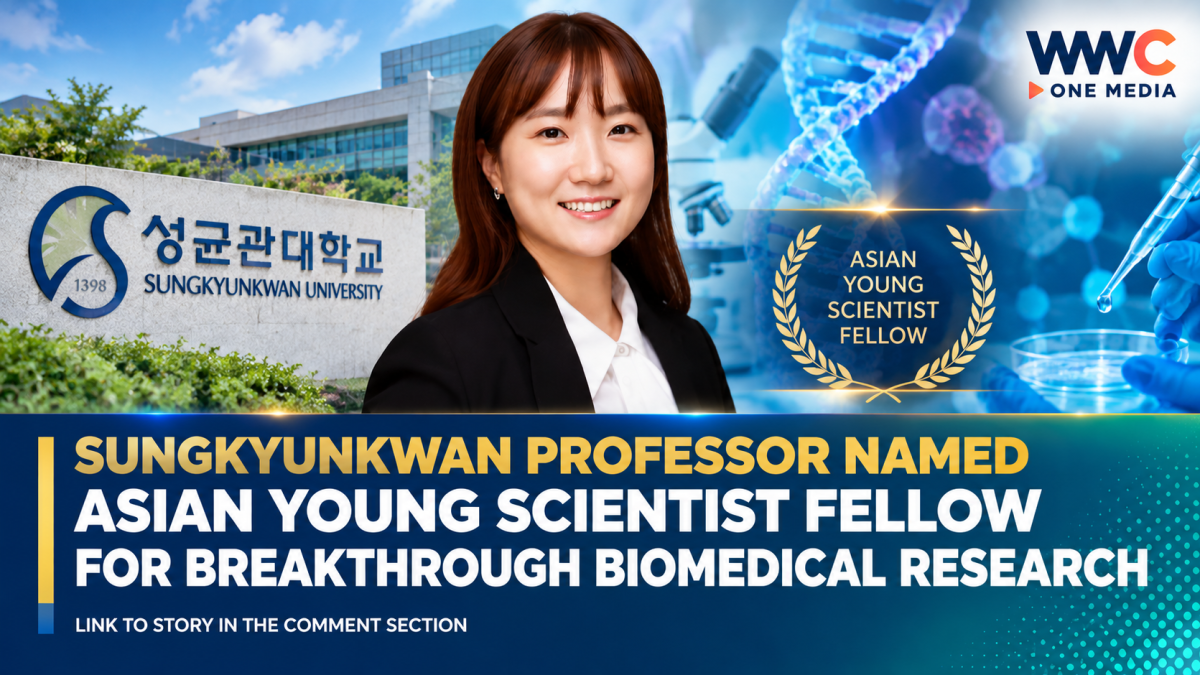
SEOUL, South Korea — A South Korean biomedical engineer whose research is pushing the boundaries of soft, electrically conductive materials has been selected as one of the 12 recipients of the 2026 Asian Young Scientist Fellowship, placing her among a new generation of researchers gaining recognition for potentially transformative work in science.
Mikyung Shin, an associate professor in the Department of Biomedical Engineering at Sungkyunkwan University, was named an Asian Young Scientist Fellow in the Physical Sciences category for her work on adhesive and electroconductive hydrogels designed to interact more naturally with biological tissue.
The fellowship, announced Sept. 4, provides Shin with $100,000 in research funding over two years, along with access to an international network of young scientists and the fellowship’s annual conference at the University of Hong Kong.
But the recognition is about more than an academic award.
Shin’s research is aimed at solving one of biomedical engineering’s most difficult problems: how to make electronic devices and biological tissue work together without the rigid interfaces that can interfere with the body’s constantly moving organs.
Why hydrogels could matter in future medicine
Traditional implantable electronic devices often rely on comparatively rigid materials, while organs and tissues are soft, flexible and continuously moving.
That mismatch can make it difficult for an electronic device to maintain stable contact with tissue.
Shin’s research explores hydrogels that can combine softness, electrical conductivity and strong adhesion—properties that could allow bioelectronic devices to conform more closely to biological structures.
Sungkyunkwan University says her work draws inspiration from natural adhesive mechanisms and aims to create materials that better mimic the mechanical characteristics of human tissue while maintaining reliable electrical signaling.
That could be particularly important for technologies designed to monitor or interact with the heart, muscles, nerves and potentially the brain.
The heart research already made headlines in science
Shin’s recognition comes after several high-profile research projects.
In a 2023 study published in Nature Electronics, researchers including Shin developed an adhesive bioelectronic patch designed for direct contact with the heart.
The study reported that the patch could achieve conformable adhesion to cardiac tissue in less than 0.5 seconds without external stimulation, while maintaining electrical performance during stretching.
The technology combines an ionic tissue adhesive, a viscoelastic film and a conducting composite to create an interface capable of adapting to moving tissue.
The researchers reported that the system could be used for cardiac monitoring, including recording electrocardiogram signals.
The significance is straightforward: instead of forcing a rigid electronic component to conform to a moving organ, the researchers are attempting to make the electronic interface behave more like the tissue itself.
From muscle repair to robot-assisted rehabilitation
Shin was also part of a 2023 study published in Nature that investigated an injectable tissue prosthesis based on a soft, electroactive hydrogel.
The research team reported that the injectable material could provide bidirectional electrical communication with the neuromuscular system and demonstrated robot-assisted rehabilitation in rats with severe muscle injury.
The work is significant because conventional bioelectronic interfaces are often patch-based and may be difficult to place on irregular, narrow or deep areas of tissue.
An injectable material could potentially overcome some of those limitations.
However, there is an important distinction.
The study was experimental and involved animal research. It does not mean that the hydrogel is currently an approved treatment for human muscle injuries.
That distinction is crucial when discussing emerging biomedical technologies.
Her next research target: the brain
With support from the Asian Young Scientist Fellowship, Shin plans to expand her work toward the central nervous system, according to Sungkyunkwan University.
Her proposed research involves developing a dual-function hydrogel filler that could potentially be injected into the cavity left after brain-tumor surgery.
The goal would be to investigate whether such a material could simultaneously help prevent tumor recurrence while supporting recovery of damaged neural tissue.
That is an ambitious research direction because neurons have limited regenerative capacity, while surgery for brain tumors can leave cavities and damaged surrounding tissue.
The proposed technology is therefore aimed at addressing two problems at once: the risk associated with tumor recurrence and the challenge of restoring damaged neural tissue.
But again, this remains research rather than an established clinical therapy.
The science behind the promise
The broader field of hydrogel-based bioelectronics has attracted increasing scientific attention because these materials can potentially combine properties that are difficult to achieve with conventional electronic implants.
They can be soft and deformable while also supporting electrical signaling.
Shin’s recent research portfolio shows that her work is expanding beyond a single application.
Sungkyunkwan University’s research database lists recent work involving brain-adhesive bioelectronics, tissue-adaptive hydrogel-liquid-metal composites and strategies for muscle-tissue regeneration.
This suggests a broader research program focused on developing materials that can communicate with living tissue while minimizing the mechanical mismatch between electronics and biology.
Why the Asian Young Scientist Fellowship matters
The Asian Young Scientist Fellowship is designed to support early-career scientists conducting creative and potentially transformative research across Asia.
Candidates must hold full-time academic positions in Asia and be within 10 years of receiving their doctoral degrees.
Shin is one of 12 fellows selected for the 2026 program.
Her selection also highlights the increasingly interdisciplinary nature of biomedical engineering, where materials science, electronics, biology and medicine increasingly overlap.
The fellowship’s financial support could give Shin’s team additional resources to investigate new applications for adhesive and conductive hydrogels.
A promising technology—but not a miracle cure
The excitement surrounding Shin’s work should nevertheless be balanced with scientific reality.
Laboratory and animal studies are important steps in developing medical technologies, but they do not guarantee that a technology will eventually become a safe and effective treatment for patients.
A material that works in an experimental model must undergo extensive additional research and, where applicable, clinical testing and regulatory review before it can be used routinely in medicine.
That means Shin’s proposed brain-related hydrogel should be viewed as an emerging research direction, not as a treatment that patients can currently receive.
Still, the underlying idea is compelling.
If scientists can develop materials that are simultaneously soft, adhesive, electrically conductive and biologically compatible, the boundary between electronic devices and living tissue could become increasingly flexible.
And that could eventually reshape how researchers approach everything from cardiac monitoring to rehabilitation and neural interfaces.
For now, the next chapter begins in the laboratory.
Shin’s fellowship provides the funding and international platform. Her research will determine how far these futuristic materials can actually go.




Leave a Reply