
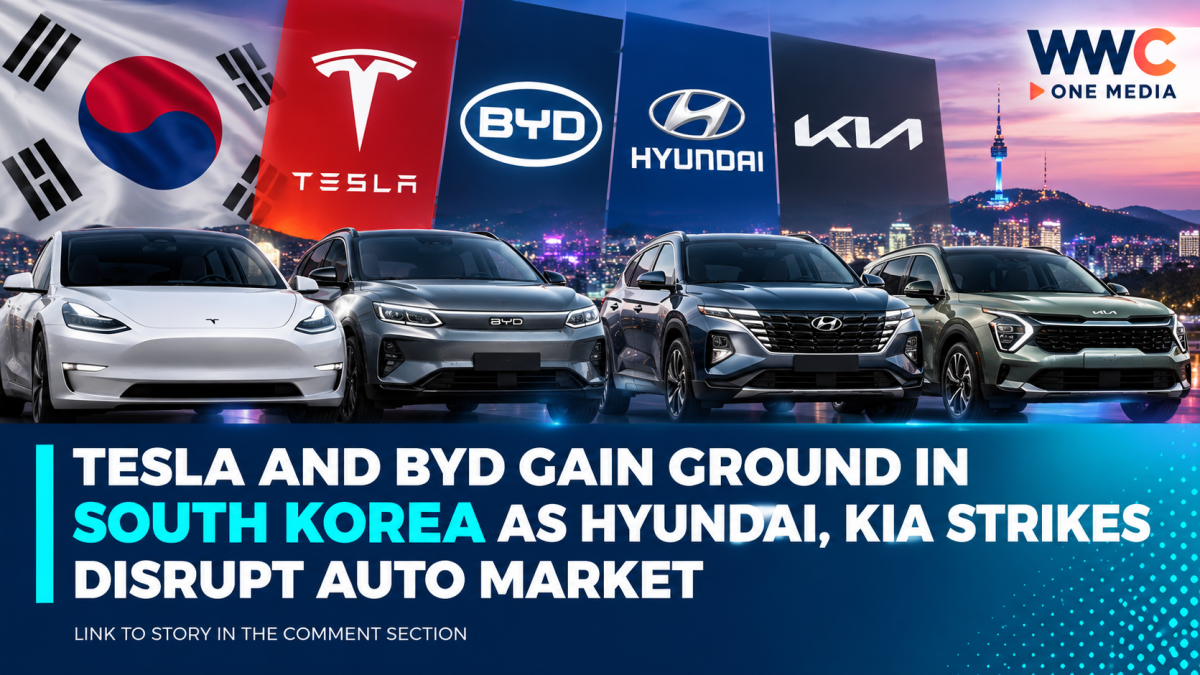
SEOUL, South Korea — A prolonged labor dispute at South Korea’s biggest automakers has created an unexpected opening for two of the world’s most aggressive electric-vehicle competitors: Tesla and China’s BYD.
Domestic vehicle sales plunged in August as strikes and production disruptions hit major Korean manufacturers, while imported-car sales moved in the opposite direction.
The result was a striking shift in South Korea’s auto market: Tesla and BYD captured a large portion of the growth in imported vehicles just as Hyundai Motor and other domestic manufacturers struggled with supply disruptions.
According to data cited by The Korea Times, combined domestic sales at Hyundai Motor, Kia, KG Mobility, Renault Korea and GM Korea fell 28.3% year on year to 79,601 vehicles in August.
Hyundai Motor suffered the sharpest decline among the major domestic brands, with sales falling 41.1% to 34,333 vehicles.
Kia’s domestic sales dropped 7.6% to 40,213 units.
Meanwhile, imported vehicle sales increased 9.2% to 29,817 units.
And two EV manufacturers stood out.
Tesla sold 10,400 vehicles, while BYD sold 3,002.
Together, the two companies accounted for approximately 45% of all imported vehicle sales in South Korea during August.
Hyundai’s production problems created an opening
The August numbers cannot be separated from the labor dispute that disrupted Hyundai’s production.
Hyundai workers staged partial walkouts from July into August, with cumulative stoppages reaching about 60 hours, according to the Korea Times report.
The disruptions were estimated to have reduced production by roughly 55,000 vehicles.
The impact went beyond factory output.
When vehicles cannot be produced, they cannot be delivered to dealerships and customers.
That creates a supply problem at precisely the moment consumers are shopping for new cars.
Hyundai’s union ultimately approved a wage agreement at the end of August, bringing the prolonged dispute toward a close.
Reuters reported that 61.55% of participating union members voted in favor of the agreement, which included a 4.1% base-pay increase and a performance bonus equivalent to 400% of base pay, alongside other payments.
That agreement could help Hyundai restore production and sales momentum in September.
But competitors have already taken advantage of the disruption.
Tesla’s Model Y dominates the EV conversation
Tesla’s performance is particularly significant because its sales growth in Korea has been driven heavily by the China-made Model Y.
The August result means Tesla alone accounted for roughly one-third of South Korea’s imported-car market for the month, according to the Korea Times.
The Model Y has emerged as a major force in the Korean market.
Earlier reporting from Seoul Economic Daily showed Tesla selling 66,376 vehicles during January-July 2026, representing a 149.8% increase from the same period a year earlier.
The Model Y alone accounted for 52,064 units during that period.
In July, it reportedly became the best-selling passenger vehicle in South Korea, surpassing popular domestic models including Hyundai’s Grandeur.
That is an important warning sign for Korea’s established automakers.
The competitive threat is no longer limited to luxury imported brands.
A mass-market EV can now challenge some of the country’s most recognizable domestic models.
BYD is moving even faster
BYD’s rise may be even more strategically significant.
The Chinese automaker only officially entered the Korean passenger-car market in January 2025, making its August performance particularly notable.
BYD sold 3,002 vehicles in August, with the Dolphin electric hatchback identified as its best-selling model during the month.
The company is competing primarily through pricing and increasingly broad EV offerings.
That matters in South Korea because consumers remain highly sensitive to vehicle prices.
Industry officials cited by the Korea Times say demand for more affordable EVs is increasing as consumers compare electric vehicles with conventional internal-combustion models.
The Korean market is therefore becoming a test case for a broader global trend:
Can lower-priced Chinese EVs break into markets historically dominated by established domestic and European manufacturers?
The bigger story isn’t just the strike
It would be misleading to attribute the entire August market shift to labor action.
Tesla and BYD were already gaining momentum in South Korea before Hyundai’s strike disrupted production.
Earlier reporting showed Chinese-made EVs increasingly reshaping Korea’s imported-car market, with price competitiveness and expanding consumer acceptance helping new brands challenge established players.
Tesla has also been expanding rapidly in Korea, while BYD has been building its presence since entering the market.
The strike therefore acted more like an accelerator than the original cause.
Domestic production problems gave imported brands an opportunity to reach consumers who might otherwise have purchased Korean-made vehicles.
Korea’s traditional advantage is under pressure
For decades, Hyundai and Kia benefited from strong brand recognition, extensive dealer networks, local manufacturing and consumer familiarity.
Imported brands traditionally competed from a smaller base and were often concentrated in the premium segment.
But EVs are changing the equation.
Electric vehicles require fewer mechanical components than conventional vehicles, while battery technology and software have become increasingly important to vehicle competitiveness.
That has created opportunities for companies that specialize in EVs from the beginning.
Tesla built its identity around electric vehicles.
BYD has built an enormous battery and EV ecosystem.
Meanwhile, Hyundai and Kia are attempting to balance their established internal-combustion businesses with an increasingly aggressive transition toward electric and software-defined vehicles.
Korean automakers are fighting back
The August numbers do not necessarily signal a permanent collapse in Hyundai and Kia’s domestic position.
Hyundai and Kia reached wage agreements in late August, reducing the immediate threat of further production disruptions.
Hyundai’s final agreement followed weeks of labor tensions and production stoppages.
That means September could look very different from August.
With factories operating more normally, domestic manufacturers should have greater ability to restore inventories and fulfill delayed orders.
But restoring production is only one part of the challenge.
The bigger question is whether Hyundai and Kia can keep customers from switching permanently to imported EVs.
The EV battle is getting tougher
South Korea is becoming an increasingly important battleground for global EV manufacturers.
Tesla is expanding its customer base.
BYD is building brand recognition.
Other Chinese EV manufacturers are also looking toward overseas markets as competition intensifies at home.
Reuters reported this month that Chinese regulators issued new guidelines governing automakers’ overseas expansion, reflecting the rapid international push by companies such as BYD and other Chinese manufacturers.
That means Korean automakers are not simply competing against Tesla.
They are increasingly competing against an expanding group of Chinese manufacturers with aggressive pricing strategies, large battery operations and growing export ambitions.
September could tell a different story
The immediate crisis for Hyundai and Kia may be easing.
But the competitive problem exposed by August is harder to solve.
If domestic manufacturers can quickly restore production and capitalize on their strong local brands, the August sales decline could prove temporary.
If Tesla, BYD and other imported EV makers retain the customers they attracted during the disruption, however, the market could be entering a more permanent shift.
The numbers offer an unmistakable warning:
A production stoppage can temporarily take Korean cars off the road—but once consumers discover competitive alternatives, getting them back may be much harder.
And with South Korea’s EV market becoming one of Asia’s most fiercely contested battlegrounds, the real test for Hyundai and Kia may only be beginning.




Leave a Reply