
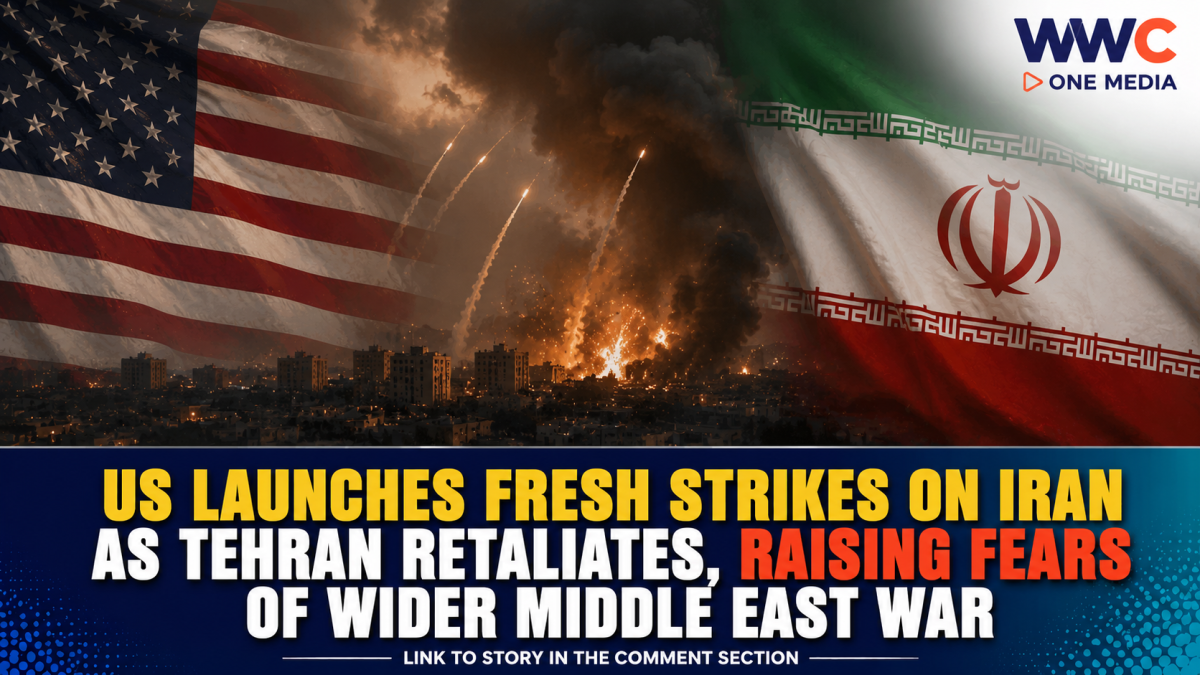
WASHINGTON/DUBAI — The United States launched a new wave of strikes against Iran on Tuesday, September 1, triggering a rapid Iranian military response and pushing the already volatile Middle East conflict into another dangerous phase.
The renewed fighting marks the most serious escalation in weeks after roughly a month of relative calm between Washington and Tehran.
According to Reuters, US forces targeted Iranian military capabilities including air-defence systems, radar installations, maritime assets, mine-laying facilities and communications sites. Washington said the operation followed Iranian attempts to threaten commercial shipping in the Strait of Hormuz and US forces stationed in the region.
But Tehran did not wait long to respond.
Iranian forces launched ballistic missiles and drones toward US-linked military positions in Jordan, Bahrain and Iraq, according to Iranian statements and regional authorities cited by Reuters and AP. Jordan said its air defences dealt with 13 ballistic missiles entering its airspace, intercepting 10 of them. Bahrain also said Iranian drones were intercepted.
Trump warns Iran of an even larger attack
US President Donald Trump described the American strikes as justified and warned Tehran against retaliating.
Trump said the US would respond with an even stronger attack if Iran continued its military response, raising fears that the latest exchange could become the beginning of another sustained escalation rather than a short-lived confrontation.
Trump said the latest strikes were carried out in response to what he described as an Iranian attempt to lay sea mines in the Strait of Hormuz, as well as the firing of missiles toward a US military base in Jordan.
The US military has similarly said its operations were aimed at Iranian capabilities threatening commercial shipping and American personnel in the region.
Iran threatens the world’s oil supply route
The biggest concern may extend far beyond the battlefield.
Iran has threatened to prevent oil from being exported through the Gulf if its own oil exports are blocked. That puts the Strait of Hormuz—one of the world’s most important energy corridors—at the heart of the confrontation.
Reuters reported that the waterway carried roughly one-fifth of the world’s oil before the war and that Iran has effectively closed the route to normal shipping.
The financial markets reacted almost immediately.
The Wall Street Journal reported that WTI crude settled 5.2% higher at US$90.22 a barrel, while Brent crude gained 4.6% to US$94.65 as traders worried that prolonged fighting could further disrupt oil shipments through the Persian Gulf.
That means the consequences of the latest strikes could reach well beyond Iran, the United States and their regional allies.
Higher oil prices can eventually translate into increased transportation, energy and consumer costs around the world if disruptions persist.
Civilian casualties reported after US strikes
The renewed attacks have also raised fresh concerns over civilian casualties.
Reuters reported that the Iranian Red Crescent said five people were killed and 50 wounded at a wedding near Sirik, on Iran’s southern coast. Iranian media gave different casualty figures, with IRNA citing a provincial official who said 68 people were wounded.
AP separately reported an Iranian provincial official saying a US strike hit a home hosting a wedding ceremony in Kuhestak, killing two people and injuring at least 20 others.
The differing casualty figures had not been independently reconciled at the time of reporting.
That distinction is important as information continues to emerge from an active conflict zone.
Iran claims US casualties—but Washington disputes it
The Iranian Revolutionary Guard Corps said it had inflicted heavy casualties on US forces in its retaliatory strikes.
However, Reuters reported that two US officials said there were no US casualties from the Iranian attack on facilities in Jordan at that point, while stressing that the situation remained fluid.
Iran also claimed attacks on US-linked facilities in Bahrain and Iraq, but some of those claims had not been independently confirmed by Washington or local authorities.
A fragile ceasefire is now looking even more distant
The latest confrontation follows a month-long period in which Washington and Tehran largely held their fire while tensions remained high.
A US-Iran agreement reached in June subsequently broke down, with disagreements over the Strait of Hormuz emerging as one of the major sticking points.
Iranian President Masoud Pezeshkian said earlier Tuesday that Tehran was prepared to return to the ceasefire arrangement if Washington also honoured its terms.
Trump, however, appeared far less optimistic, telling Fox News that he did not believe another agreement with Iran was worthwhile.
The result is a dangerous cycle:
US strikes → Iranian retaliation → US threats of a larger response → further Iranian warnings.
And with the Strait of Hormuz caught in the middle, the stakes are no longer limited to the two countries.
What happens next could determine how far the conflict spreads
The immediate question is whether the latest exchange ends with another round of retaliation—or whether Washington and Tehran move toward a much broader confrontation.
For now, both sides are sending increasingly aggressive signals.
Trump has threatened further US strikes. Iran has warned that it could restrict oil exports from the Gulf. Meanwhile, regional governments are activating air defences and warning their populations as missiles and drones cross national airspace.
The next Iranian or American move could therefore determine whether this latest escalation burns out—or becomes the start of an even wider regional war.
WWC ONE MEDIA J.M.D




Leave a Reply